Showing posts with label invasive species. Show all posts

Tuesday, October 9, 2012

Bees develop proteins that fight colony collapse

Bees have evolved proteins that help them fight an insect known to contribute to colony collapse disorder, concludes research published in Genome Biology. The Varroa mite sucks the blood of bees, weakening their immune systems and contributing to deaths of entire hives. (Science Daily photo by Queenie Chan)

The proteins prompt removal of diseased bee larvae and reproductive mites, Science Daily reports. After researchers scanned 1,200 proteins, they found several associated with this behavior. A protein involved in blood clotting was unused in damaged larvae, and this appeared to spur the adult bees' removal of them.

"Bee keepers have previously focused on selecting bees with traits such as enhanced honey production, gentleness and winter survival," University of British Columbia lead researcher Leonard Foster said. "We have found a set of proteins which could be used to select colonies on their ability to resist Varroa mite infestation and can be used to find individuals with increased hygienic behavior. Given the increasing resistance of Varroa to available drugs this would provide a natural way of ensuring honey farming and potentially survival of the species." (Read more)

Thursday, September 20, 2012

The grass that took the West may have a tiny but potent enemy: a fungus with a scary name

Ecologist Susan Meyer stands in cheatgrass in
Utah's Skull Valley. (NYT photo by Michael Friberg)
Called "the black fingers of death," the tiniest fringe, the barest wisps of darkness on white wheat-colored grass may, in fact, save an iconic American landscape from perhaps the most disruptive invasive plant in the country.

"Black fingers, the fungus with the horror-movie handle, is the new artillery that wildland biologists are firing at cheatgrass, a weed that has remade the landscape of the Intermountain West," writes Felicity Barringer of The New York Times. The fingers, "no longer than a baby’s eyelashes," are like "little marching armies of toothpicks." Fungus armies, that is.

Mike Styler, head of the Utah Department of Natural Resources, said of cheatgrass: “It’s changed the entire ecology of the West.” Creatures that depend on the sagebrush habitat, from butterflies to the greater sage grouse, which is being considered for protections under the Endangered Species Act, are severely stressed by its proliferation. And because cheatgrass and development are moving closer together, a few years ago a cheatgrass-fueled fire near Boise unfortunately burned down homes.

Dr. Susan Meyer is a U.S. Forest Service ecologist based in Provo, Utah, and her work these days is centered on figuring out how this fungus, which looks like a miniature mohawk haircut, does its lethal work, and how, exactly, to get the tiny spears do more of it. Barringer writes, "The black fingers of death, Pyrenophora semeniperda, may help restoration ecologists like Meyer reclaim some beachheads in the vast swath of land already conquered by cheatgrass," Barringer writes. "For decades, scientists have been trying to stop its advance, to little effect."

Lately, the effort has gotten attention from all sorts of places, and the pressure to control cheatgrass is increasing. Financial support for the fungus research has come from the Joint Fire Science Program of the National Interagency Fire Center.  (Read more)

Thursday, September 13, 2012

Emerald ash borer sighted in Mass. for first time

The emerald ash borer is eating its way up the East Coast, leaving swaths of dead or dying ash trees in its wake. It has been spotted in Massachusetts for the first time, officials said yesterday, in Berkshire County in the hilly western part of the state. Ash trees are the main component of the state's northern hardwood forest.

State officials said they are working with the U.S. Department of Agriculture to limit the beetle's impact on forests and the wood-products industry, Ros Krasny of Reuters reports. Massachusetts Department of Conservation and Recreation commissioner Ed Lambert said officials "are not taking its presence lightly" and are defining a quarantine area to limit movement of certain wood products, and working with landowners to properly treat and dispose of infested timber.

The invasive Asian beetle has destroyed tens of millions of trees in the U.S. since being accidentally introduced here in the 1990s. It was first discovered in Michigan in 2002, and has been found in 17 other states since then. Its larvae feed on the inner bark of trees, cutting off their ability to take in water and nutrients. Infested ash trees die within a few years. (Read more)

Friday, August 17, 2012

Might our Asian carp problem might be solved by catching them and making them into, uh, hot dogs?

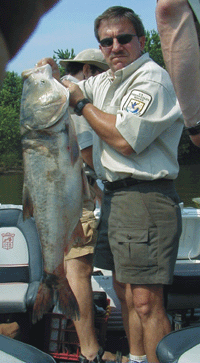
Asian carp, large and voracious fish that are making their way up the Mississippi River system toward the Great Lakes, where they could ruin the fishery, have long vexed those who want to find ways to keep the population in check. Ash-har Quraishi reports for PBS NewsHour that scientists think it's time to call in those who have been hankering for years to help: the area's commercial fishermen. (Photo by Nerissa Michaels, Great Lakes Fishery Commission)

Vic Santucci, the Asian carp specialist for the Illinois Department of Natural Resources, said that while "the ultimate goal is to fish down the populations to prevent ecological damage, there have to be enough Asian carp left to make the business lucrative for commercial fishermen." The important thing, notes Quarishi, is reducing the population to reduce pressure on young carp to get through the electric barrier in the Chicago Sanitary and Ship Canal, the Army Corps of Engineers' last line of defense.

Carp leap after getting electric shock
Philip Willink, a senior research biologist at the John G. Shedd Aquarium in Chicago, said the consensus among scientists is that the barrier works really well but is probably not perfect. That's why you need the fishermen. So far, 10 commercial fishermen have been allowed to fish these backwaters accompanied by state biologists. But big fish don't always translate into big money. Willink explained, "One of the problems with getting people interested in eating Asian carp is they happen to have a lot of bones in some strange places, so they're really hard to filet." Also, carp are not popular in the U.S. but are a staple in most other nations.

Shafer Fisheries in Thompson, Ill., a company that has been looking for ways to process and market the carp to U.S. and foreign markets stepped up offered its already percolating ideas such as carp salami, bologna, jerky and, yes, hot dogs. So sure is Schafer of its enterprise that they launched a proposal two years ago for a processing plant expansion at Wickliffe, Ky., where the Ohio River enters the Mississippi. The plant would use its waste products to make organic farm fertilizer. Tax credits to build the plant received preliminary approval from the Kentucky Economic Development Finance Authority in June. Read the transcript of the NewsHour report here. Listen to the report here.

Wednesday, July 25, 2012

As wild hogs invade Northwest, officials start a 'Squeal on Pigs' campaign to track them down

The proliferation of wild hogs has spread to the Northwest, to the point that Washington, Oregon and Idaho have started a "Squeal on Pigs" campaign to get rural residents to report the porcine invaders.

“Early detection and rapid response are key,” Amy Ferriter, Idaho’s invasive species coordinator, told Rocky Barker of the Idaho Statesman in Boise. “The invasive species councils of the Pacific Northwest consider this a priority.” Wild hogs are estimated to cause $1.4 billion a year in damage to crops, wildlife, pastures and livestock. (Read more)

Read more here: http://www.mcclatchydc.com/2012/07/23/157299/northwest-states-declare-war-on.html#storylink=cpy

Little weevils eat pestiferous vine in Eastern states

Tiny beetles have become the most recent state employees in Maryland, devouring invasive Asian weeds that are usually destroyed with chemicals or heavy machinery," Candus Thomsom of The Baltimore Sun reports. The plant is known as the mile-a-minute weed, and its newfound nemesis, the weevil, only feasts on it. The weed grows six inches a day and covers all other vegetation, strangling it. Though the plant first started in Pennsylvania, it's now found in 12 East Coast states, and state officials hope the tiny weevils can help control its spread.

Maryland's State Highway Administration released weevils this summer at seven wetlands, and four more sites are scheduled to receive them. Officials had already released Japanese beetles to eat the weed. They cause immediate damage by eating the leaves, but the weevils "lay waste to the whole plant over time," Thomson reports. Weevil larvae burrow into stems, killing the plant and preventing it from releasing seeds. The federal government approved use of weevils to control mile-a-minute growth in 2004, and they've been released in 10 states since then. (Read more)