Showing posts with label international trade. Show all posts

Tuesday, October 9, 2012

Drought lowers Great Lakes levels, stifles shipping

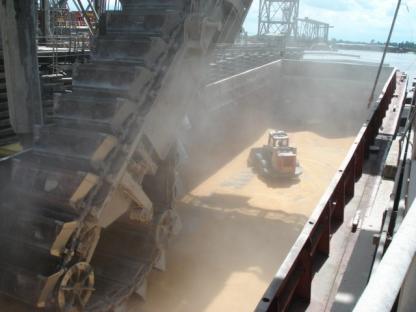
The severe drought in the Midwest has lowered levels in the Mississippi River and in Lakes Michigan and Huron, stifling the shipping industry that depends on them. According to the Army Corps of Engineers, the lakes are down almost a foot from last year, and in the next few months could break a record low set in 1964. (Associated Press photo: Freighter passes port re-opened after dredging)

Water levels near ports on the lakes determine how much coal, iron, grain and other cargo can be shipped, Joe Barrett and Caroline Porter of The Wall Street Journal report. "This is very much an industry where inches count," Lake Carriers' Association Vice President Glen Nekvasil said. He told Barrett and Porter that lower lake levels means ships are carrying about 1,200 to 1,500 fewer tons per load, a loss that is very hard to recover.

Low water also highlights the need for more dredging of ports to keep them clear of sediment, the reporters write. The Corps of Engineers has identified at least $200 million worth of dredging needs in the lakes' channels and harbors. (Read more)

Friday, September 28, 2012

China's slowdown hits hard in some Appalachian communities that mine metallurgical coal

"Slowing growth in China is taking a brutal toll on Appalachian coal mines and coal towns," Kris Maher reports for The Wall Street Journal from Wharton, W.Va., where he photographed laid-off miner Phillip Powell, 38, and his family. "A lot of guys that I worked with are scared of losing everything they own," he said.

"The Chinese economy is slowing and so is its steel industry. That has sent the price of coal used for steelmaking down nearly 50 percent to $170 a metric ton. Those coal producers who counted on Chinese sales are reeling," Maher writes. "While many have blamed the downturn in the U.S. coal industry on cheap natural gas supplanting coal and tougher environmental regulations, the slide in metallurgical coal demand has been equally devastating. Coal companies were caught flat-footed after ramping up production last year with the expectation that steep prices would cover their rising costs, despite coal's past cyclicality. Instead, demand in China began to falter just as Australian metallurgical coal production—interrupted by floods last year—surged back into the market." (Read more)

Thursday, September 13, 2012

In debate, presidential candidates' surrogates give glimpses of their positions on farm and rural policy

Chris Clayton, agriculture-policy editor for DTN/The Progressive Farmer, sums up yesterday's debate on such issues between surrogates for the presidential candidates:

"Democratic President Barack Obama has supported rural America as farmers achieved record income over the past four years or is 'anti-agriculture' and helped induce an unprecedented regulatory burden on rural America.


"Republican Mitt Romney will either wreck the rural economy and cut meaningful rural programs or unleash greater prosperity by stopping new regulations on farmers and businesses while more aggressively championing free trade deals.

"Those were the stark contrasts for farmers as surrogates for both campaigns debated positions on agricultural and rural issues on Wednesday before a group largely made up of members of the National Association of State Directors of Agriculture." (Read more)

Wednesday, August 29, 2012

'Farm Bill Now' group pushes on, but what if a hasn't passed when some laws expire Sept. 30?

The days are getting shorter for a 2012 Farm Bill, with the U.S. House having only eight more days in session before the election, and perhaps more important, before Sept. 30, when most of the current bill expires. Proponents of passing a full bill, not just a stopgap extension, say their task is made all the harder because farm income numbers are looking up in spite of the drought. Agri-Pulse reports that hasn't stopped major farm organizations, and a group called the Farm Bill Now Coalition from hitting the road in an effort to push to see things their way.

"Agriculture is one of the few bright spots in the American economy," explained National Corn Growers Association Vice President Pam Johnson during a press conference at the Farm Progress Show in Boone, Iowa, where the coalition went looking for support. "Our farmers continue to be more productive and innovative. But to continue that trend, we need to have some certainty about how we plan our business. And this is exactly what the Farm Bill does." The coalition plans another event on the grounds of the U.S. Capitol on Sept. 12.

Agri-Pulse notes that many programs will not expire on Sept. 30 if the bill is not reauthorized. Crop insurance, for example, is permanent. But dairy farmers would be particularly hard-hit, as would some conservation programs. Also set to disappear would be many nutrition programs, international trade and food aid programs, some targeted specifically at children.

Agri-Pulse is subscription-only, but free trials are offered at www.agri-pulse.com.

Friday, August 17, 2012

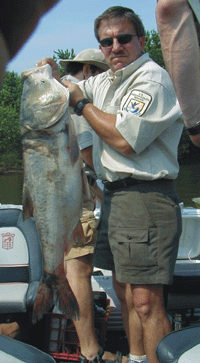
Might our Asian carp problem might be solved by catching them and making them into, uh, hot dogs?

Asian carp, large and voracious fish that are making their way up the Mississippi River system toward the Great Lakes, where they could ruin the fishery, have long vexed those who want to find ways to keep the population in check. Ash-har Quraishi reports for PBS NewsHour that scientists think it's time to call in those who have been hankering for years to help: the area's commercial fishermen. (Photo by Nerissa Michaels, Great Lakes Fishery Commission)

Vic Santucci, the Asian carp specialist for the Illinois Department of Natural Resources, said that while "the ultimate goal is to fish down the populations to prevent ecological damage, there have to be enough Asian carp left to make the business lucrative for commercial fishermen." The important thing, notes Quarishi, is reducing the population to reduce pressure on young carp to get through the electric barrier in the Chicago Sanitary and Ship Canal, the Army Corps of Engineers' last line of defense.

Carp leap after getting electric shock
Philip Willink, a senior research biologist at the John G. Shedd Aquarium in Chicago, said the consensus among scientists is that the barrier works really well but is probably not perfect. That's why you need the fishermen. So far, 10 commercial fishermen have been allowed to fish these backwaters accompanied by state biologists. But big fish don't always translate into big money. Willink explained, "One of the problems with getting people interested in eating Asian carp is they happen to have a lot of bones in some strange places, so they're really hard to filet." Also, carp are not popular in the U.S. but are a staple in most other nations.

Shafer Fisheries in Thompson, Ill., a company that has been looking for ways to process and market the carp to U.S. and foreign markets stepped up offered its already percolating ideas such as carp salami, bologna, jerky and, yes, hot dogs. So sure is Schafer of its enterprise that they launched a proposal two years ago for a processing plant expansion at Wickliffe, Ky., where the Ohio River enters the Mississippi. The plant would use its waste products to make organic farm fertilizer. Tax credits to build the plant received preliminary approval from the Kentucky Economic Development Finance Authority in June. Read the transcript of the NewsHour report here. Listen to the report here.

Coal exports head for new high; India latest buyer

As U.S. coal exports head for a new record, a New Jersey energy company has signed a deal to sell Kentucky and West Virginia coal to India. Under the deal, Kentucky coal companies will export about 9 million tons of coal annually for 25 years to India.

The deal between India's Abhijeet Group and FSJ Energy LLC comes on the heels of a massive two-day power failure across India in late July when 600 million people lost electricity. The blackout was attributed to the collapse of three regional grids. UPI reports that about 70 percent of India's electricity comes from coal-fired power plants and while India does produce coal, domestic production cannot keep up with demand. (Read more) See the story as reported from FirstPost, an Indian newspaper, here.

U.S. coal exports "are rising because U.S. demand for coal is falling as electric utilities burn more natural gas, which has plummeted in price, instead of coal," CBS Money Watch reports. "At the same time, demand for coal is rising in developing countries such as China and India as those countries work to bring electricity to millions who don't have it." (Read more)

Friday, August 3, 2012

Activists fight plans to build coal-haul railroads, ports in West and power plants on Asian coasts

Locals in rural communities across the West are concerned that some of the world's biggest coal and railroad companies will build rail lines through their backyards to haul Powder River Basin coal to the coast and on to Asia. They fear pollution, noise and congestion. Similarly, Asian activists don't want coal-fired power plants built next to traditional fishing communities.

As a result, world-wide environmental groups, grassroots groups in India and China, 300 doctors in Oregon and Washington, local governments in rural towns -- including Mosier, Ore., Edmonds, Wash., and Sandpoint, Idaho -- numerous Northwest Native American tribes and the city council in the port city of Bellingham, Wash., have all come together as allies in the worldwide fight against the international coal trade, reports Ray Ring of High Country News.

Ring reports that big coal companies, including Arch Coal Inc. and Peabody Energy, have shipped coal from the Powder River Basin to the Eastern U.S. for decades. But stricter regulations on burning fossil fuels and the natural gas boom have decreased the need for coal in Eastern power plants. Companies are selling to China and India, he writes, because those countries "are on a coal-fired power-plant building binge." Ring reports the opposition wants "thorough evaluations that weigh all the impacts" and public hearings around the Northwest. (Read more)

Monday, July 23, 2012

Faced with high grain prices from drought, meat producers are importing cheaper, foreign corn

Oppressive drought is inflicting much hardship on farmers across the U.S., forcing ranchers to shrink cattle herds and corn and fresh meat prices to soar. With all new estimates predicting no quick end to the dry weather, some livestock producers are beginning to import cheaper corn from overseas. (Photo: Corn & Soybean Digest)

Meat companies, including top pork producer Smithfield Foods, are importing Brazilian corn, something that "is an unusual thing," U.S. Grains Council Global Strategies Director Erick Erickson told Gregory Meyer and Samantha Pearson of the Financial Times. Bulk corn hasn't been imported to the U.S. since 2008, according to ports database Piers, and then it was in seed form, not for animal feed. Experts say meat companies can buy Brazilian corn at a $12 per ton less than U.S. corn, Meyer and Pearson report. 

This doesn't mean the U.S. is being forced to stop corn exports; the Department of Agriculture estimates 40 percent of globally traded corn will come from the U.S. But international merchants still selling last year's U.S. corn crop are "growing nervous" about slowing exports, Meyer and Pearson report. (Read more)

Friday, June 22, 2012

Midwest bankers survey: International economic situation dampening growth in region

A monthly survey of bankers has indicated a slowing of economic growth in rural areas of 10 Midwestern and Western states, according to a Bloomberg News report. The reason: The problems in Europe and elsewhere, according to a report released Thursday. "International economic problems are affecting us here," said Dale Bradley, CEO of Citizens State Bank in Miltonvale, Kan. The survey covers rural areas of Colorado, Illinois, Iowa, Kansas, Minnesota, Missouri, Nebraska, North Dakota, South Dakota and Wyoming, most of the Great Plains and the Corn Belt.

Creighton University economist Ernie Goss oversees the survey. He said the results suggest that areas dependent on agriculture and energy will generally continue growing, but more slowly. The overall index on the monthly survey of bankers declined to 56.7 in June, from May's 58.5. That's the lowest level for the index in 2012, but any score above 50 still suggests growth in the months ahead. 

Wednesday, June 13, 2012

Ohio river town's revitalization could be example to U.S.-based companies: buy American

Corporate labor out-sourcing has hurt the economies of many rural towns across America, but the revitalization of one Ohio River town could become an example to other U.S.-based companies about the value of the rural American workforce.

East Liverpool, Ohio, was once the pottery capital of the U.S. when four dozen pottery factories were all at full operation, but when global competition became cheaper, the industry almost died, reports Stephanie Strom of The New York Times. The American Mug and Stein Company was near closing last year when Ulrich Honighausen, owner of tableware company Hausenware asked the Ohio company to make mugs for Starbucks. American Mug owner Clyde McClellan, right, agreed.

The pottery maker's mugs went on sale in Starbucks across the country this week as part of the corporation's new line of American-made merchandise branded Indivisible. The partnership has kept American Mug running, prevented four people from losing their jobs and created eight more positions. Money from the sale of the mugs, and other Indivisible products, will be put into Starbuck's "Create Jobs for USA Fund," which helps small businesses stay afloat. (Read more)