Showing posts with label Appalachia. Show all posts

Friday, October 19, 2012

Laid-off Appalachian miner blames politicians, but not those you might think, for region's woes

Thousands of Central Appalachian coal miners have been laid off since January as coal companies decrease operations in the region and move to more lucrative mining areas, including the Powder River Basin in Wyoming. There are several reasons for this, the biggest of which is cheap natural gas. Mimi Pickering and Sylvia Ryerson of radio station WMMT in Whitesburg, Ky. recently interviewed Letcher County miner Gary Bentley, to collect his thoughts.


Bentley, 29, lost his job with Arch Coal Inc. in June, and after months of searching, was hired at a mine in Owewnsboro, Ky., five and a half hours from Whitesburg in the western part of the state. He worked for Arch for 10 years, and is a Letcher County native. The layoffs are unlike anything he's seen, he told Ryerson and Pickering, and he doesn't think it's fair.

"People come in here and they make billions of dollars, and they've been doing it for hundreds of years here, and now when they're leaving, they're just leaving us with nothing," Bentley said. He was lucky to find work in Kentucky, he said, because many other miners he worked with had to get jobs in Alabama, Pennsylvania, West Virginia and even Australia. It's also been slightly easier for him because he has a high school diploma. Some older miners he knows have no more than a sixth-grade education, and were hired before mining companies began requiring at least a high school education.

Bentley said local politicians want to blame Central Appalachian coal's decline on the federal government because of increased Environmental Protection Agency regulations, but what he saw at EPA hearings in Pikeville, Ky., showed him a different story. "I was real disappointed with our local, state and regional politicians because I felt like they all wanted to get up there and point fingers and say 'It's this person's fault, it's this person's fault. They're trying to destroy our industry; they're destroying Eastern Kentucky,'" Bentley said. "But at the same time, they're in the position. Why weren't they doing more to stand up for the region? Why weren't they doing more to try and bring in other industry?"

Bentley continued: "Anybody with any sort of intelligence that keeps up on the coal industry saw the declines coming. ... So, I feel that the political leaders really failed us by not having a back up plan for this area and for these communities. ... We need real answers and real solutions, not just a bunch of hot wind." To listen to Bentley's full interview, click here.

Wednesday, October 17, 2012

Consultant: Central Appalachian coal outlook poor

Alan Stagg, one of the most respected consultants in the coal industry, told a major industry gathering last month that Central Appalachian coal mining would last at least 10 to 20 more years, but will continue to decline because the job-hungry region's coal is getting more difficult to mine, mainly because of geological limitations but also because of regulations.

"It's going to run out some day — there's a finite amount of coal — but I don't see that happening in 10 or 20 years," Stagg told Pam Kasey of The State Journal, a business-oriented weekly in West Virginia. Stagg, the president and CEO of Stagg Resource Consultants Inc., has been pessimstic about the industry's long-term prospects for several years, as we reported here, but this is his gloomiest forecast yet.

"This is the elephant in the room. No one wants to acknowledge that reserve depletion is profound," Stagg, of Cross Lanes, W.Va., said at Platt's Coal Marketing Days in Pittsburgh on Sept. 21, according to SNL Financial. "Mining conditions are difficult, and the cost to produce is high. That is a physical fact. It's not pleasant. Nobody wants to acknowledge it. That is a fact, and companies that ignore that fact will not do so well. . . . And by nature, regulations will always increase."

"Stagg cast such a pall on the Central Appalachia coal industry that West Virginia Coal Association President Bill Raney, speaking later in the day, said he felt like a 'funeral director'," Darren Epps wrote for SNL. "Stagg expressed optimism, however, for the Powder River Basin" in Wyoming, which overtook West Virginia as the leading coal-producing state many years ago.


An earlier version of this story was based on a report from SNL Financial that Stagg says misquoted him as saying that he expects coal mining in Central Appalachia to end in the next 10 to 20 years. He did not dispute the rest of the report.

Tuesday, October 9, 2012

Good pay, independent culture, dislike of Obama make Appalachian coal miners 'proud to be scabs'

"As recently as the 1980s, plenty of coalfield residents thought Big Coal was the problem. But these days, in . . . Central Appalachia — southern West Virginia, southwestern Virginia, eastern Kentucky and eastern Tennessee — coal mining is overwhelmingly popular, despite well-documented risks to workers’ health and community safety," reports Gabriel Schwartzman of In These Times, a liberal, labor-oriented managzine. (Photo by Schwartzman: Supervisory miner gets coffee before work)

Schwartzman spent this summer in the region trying to determine why the previous Democratic and union stronghold has turned so sharply to the right, and doesn't mince words in presenting his conclusion: "At $108,000 a year, nothing in Appalachia compares to miners' wages," he writes. Those wage increases are linked to increased mechanization and smaller workforces, and have changed the political and financial nature of that workforce, he reports. One miner in Pike County, Kentucky, told him he would lose everything if "coal was shut down" because no job in the region could pay him as much.

The union battles for higher wages, better safety and benefits of 30 years ago were largely lost, ultimately ending with the United Mine Workers of America abandoning strikes, Schwartzman writes. Companies raised wages without unions, but cut many jobs with increased mechanization. A major unionized company in the region, Patriot Coal, is now bankrupt and unable to pay miners' pensions.

Miners with jobs told Schwartzman the non-union life is good. "We are scabs. We're proud to be scabs," one surface miner at Camp Branch mine in West Virginia told him. They are loyal to their companies, and that loyalty extends to families, friends and businesses supported by coal miners, Schwartzman reports. But an Energy Information Administration forecast of a 58 percent decline in Central Appalachian coal production by 2035 is reason for many to worry. Though the current decline is being caused mainly by competition from cheap natural gas and the decreased viability of Appalachian coal, miners tend to believe increased environmental regulation is the cause.

Schwartzman reports intimidation and threats received by those who advocate for safer mining practices or oppose mountaintop-removal mining. "Social media is used as a mobilizing tool against 'tree huggers,'" Schwartzman reports. "Aside from calling rallies and protests, post like this August 6 one appear regularly on Citizens for Coal's Facebook page: 'Just saw a post saying tree hugger in Gilbert eating at Wallys restaurant.'"

Many miners expressed to Schwartzman the need to vote out President Obama, even though his administration increased mine safety inspections, probably reducing miner injuries; increased health care for black-lung victims, and increased investments in clean-coal technology. Schwartzman writes that coal companies stir up anti-Obama rhetoric, but the Christian right and the National Rifle Association also play a role. "Those forces play upon values of autonomy and independence that run deep here," Schwartzman writes. "For 150 years, these values have helped Appalachians survive outsiders exploiting their mountain resources. Now those values have become aligned with out-of-state coal companies against environmentalists and liberals." (Read more)

Neither party has supported policies that will help the coal miner, Betty Dotson-Lewis writes for the Daily Yonder.

Monday, October 8, 2012

Feds pencil another non-Appalachian county into their efforts to fight drug traffic in the region

When the Appalachian Regional Commission was created in 1965, it included for political and other reasons many counties that were not part of the poor, mountainous region but resembled it economically. Since then, Congress has added several such counties to the officially recognized region to make them eligible for ARC help. Some truly Appalachian counties grumbled that the pool of money was being diluted, and they are doing likewise now that the Obama administration has placed Kentucky's central crossroads town in the Appalachia High Intensity Drug Trafficking Area, "a jurisdiction set up to fight the drug trade in the mountains," reports Roger Alford of The Associated Press, who once reported for the wire service from Eastern Kentucky.

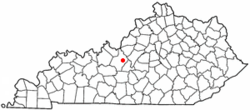
"This is a place of rolling countryside, cattle farms and cropland," Alford writes."That's why some eyebrows arched when the Obama administration penciled Hardin County into Appalachia." (Wikipedia map locates Elizabethtown in Hardin County; map below shows the ARC territory, which is not affected by the anti-drug jurisdiction's boundaries.)
The Office of National Drug Control Policy said it added Hardin County at the request of U.S. Sen. Mitch McConnell of Kentucky, the Senate Republican leader. McConnell told the AP, "The argument I made is that, even though this is not technically an Appalachian county, it's not too far away from Appalachia and it's right here with two interstates going north and south and east and west, and clearly is a transit point" for drugs. Louisville and Bowling Green, metropolitanm areas north and south of Elizabethtown on Interstate 65, had already been added to the area. At the same time it added Hardin County, the drug office also added Brooke, Hancock, Marshall and Ohio counties in northern West Virginia.

Some Central Appalachian political leaders say adding western counties to the list will make it harder for federal money to reach eastern counties that need it more. "Bringing on more counties only makes our situation less hopeful," Harlan County Judge-Executive Joe Grieshop told Alford. (Read more)

Physicians for Social Responsibility say 'each step of the coal life cycle impacts human health'

A new report released this week analyzes the human health impacts of coal, with a specific focus on the cumulative impacts of air pollution from burning coal on the respiratory, cardiovascular and nervous systems. The Physicians for Social Responsibility study, "Coal's Assault on Human Health," concluded that "each step of the coal life cycle -- mining, transportation, washing, combustion and disposing of post-combustion waste -- impacts human health."

Researchers found that mining of coal contributes to heart disease, cancer, stroke and chronic respiratory diseases, four of the five leading causes of death in the U.S. In particular, burning coal contributes to diseases affecting large portions of the U.S., including asthma, lung cancer, heart disease and stroke. It also impairs lung development, increases heart-attack risk and hinders intellectual development. The report adds to previous correlation studies suggesting possible links between mountaintop mining and increased rates of disease in Appalachia by University of West Virginia public-health professor Michael Hendryx.

Physicians for Social Responsibility makes several recommendations, including reducing carbon dioxide emissions "as deeply and as swiftly as possible," ending construction of new coal-fired power plants, reduction of fossil fuel use and the development of renewable energy sources. (Read more)

Friday, September 28, 2012

China's slowdown hits hard in some Appalachian communities that mine metallurgical coal

"Slowing growth in China is taking a brutal toll on Appalachian coal mines and coal towns," Kris Maher reports for The Wall Street Journal from Wharton, W.Va., where he photographed laid-off miner Phillip Powell, 38, and his family. "A lot of guys that I worked with are scared of losing everything they own," he said.

"The Chinese economy is slowing and so is its steel industry. That has sent the price of coal used for steelmaking down nearly 50 percent to $170 a metric ton. Those coal producers who counted on Chinese sales are reeling," Maher writes. "While many have blamed the downturn in the U.S. coal industry on cheap natural gas supplanting coal and tougher environmental regulations, the slide in metallurgical coal demand has been equally devastating. Coal companies were caught flat-footed after ramping up production last year with the expectation that steep prices would cover their rising costs, despite coal's past cyclicality. Instead, demand in China began to falter just as Australian metallurgical coal production—interrupted by floods last year—surged back into the market." (Read more)

Wednesday, September 19, 2012

Coal plays role in election, largely because of Ohio

Romney and Ohio miners (Getty Images)
Coal has become a hot-button topic on the campaign trail as "Mitt Romney and President Barack Obama have wholeheartedly embraced" it, "despite past statements from Romney and Vice President Joe Biden that pollution from coal-fired power plants kills people," reports Sean Cockerham of McClatchy Newspapers. The issue is mostly become a big one because "the coal-producing state of Ohio is among a handful that are expected to decide the election."

Ohio is ranked 10th in coal production and gets 86 percent of its electricity from coal, and "is among the most crucial prizes in the presidential campaign," Cockerham writes. Virginia and Colorado are also significant coal producers and "key battleground" states. There's also a lot of talk about what a Romney presidency could mean for the industry in the top coal-producing states: Wyoming, West Virginia, Kentucky, Pennsylvania and Texas.

Romney is telling voters that the Obama administration is waging a "war on coal," the battle cry of many state and federal lawmakers from coal-producing states. He's promised to reverse Environmental Protection Agency regulations if elected, and recently attended a political rally at an Ohio underground coal mine. Obama has played up coal differently, suggesting the country should invest in "clean coal" technologies. His campaign has circulated radio ads in Ohio "hammering on that theme and portraying Romney as the one who's really anti-coal," Cockerham reports. (Read more)

Friday, September 14, 2012

Teachers from elsewhere give hope in Eastern Ky.

TFA's Liz Selden teaches math
(Photo by Amy Wallot, Ky. Dept. of Ed.)
Teach for America, which for 20 years has been placing top students from top colleges in low-income school districts, placed its first teachers in Appalachia only a year ago. The program is expanding, and now has 36 teachers in 20 schools in 11 Eastern Kentucky counties.

This relatively small group of young teachers in Eastern Kentucky is stirring hope that their sharp minds, youthful energy, diverse backgrounds and fresh perspectives will inspire their students, their colleagues, school officials and their communities to dream bigger dreams and achieve more of them, raising the region's education levels, attracting brighter students to teaching and boosting the chronically poor region's economy.

And because most of the traditional teachers in the 11 counties are natives who went to the nearest college, the coming of TFA has put traditional teacher-preparation programs under pressure to improve, and focused fresh attention on teacher quality and effectiveness.

All these topics and more are explored in four stories written for the Institute for Rural Journalism and Community Issues by its first iHigh writer in residence: John James Snidow, an Eastern Kentucky native who earned a Harvard University degree in economics with honors and is now at Yale Law School. To read the stories, click here.

Monday, September 10, 2012

Larry Gibson, who helped start the fight against mountaintop-removal mining of coal, dies at 66

Larry Gibson, who spent most of the last 25 years fighting large-scale strip mining in Central Appalachia, died yesterday after suffering a heart attack while working on his land atop Kayford Mountain in Raleigh County, West Virginia. He was 66.

In 1986, Gibson moved back to his birthplace and childhood home on Kayford Mountain and found that coal companies had started mountaintop-removal mining on his family's land, threatening his family cemetery, which was "the final resting place for his ancestors stretching back to the 18th century," reports Mackenzie Mays of The Charleston Gazette. Gibson told the Gazette's Ken Ward Jr. in 1997 that the graveyard and a nearby community park that he built was "the last 54 acres the coal companies don't own. They own all the rest. I don't think the coal companies have the right to take everything."

Gibson was among the first Appalachian people to protest publicly against mountaintop mining and faced backlash from his community as a result, according to his daughter, Victoria, 24. He was shot at, run off the road by coal trucks and burned in effigy by those who disagreed with him, she told Ashley Craig of the Charleston Daily Mail. But he never stopped fighting to save his home and the homes of other from mountaintop removal.

"When my dad passed away you could still smell the mountain air on him," she said. "You could still see the dirt underneath his nails and the stains on his hands. He was working. He lived his life devoted to the mountain."

Gibson once said, "My mother gave me birth, but this land gave me life. Growing up here was an adventure every day. I played with my pet bobcat, my fox, my hawk. All of these things, the good Lord provided on this land, But just a stone's throw away, on that mountaintop-removal mining site, you couldn't find anything alive if you wanted to. It's bare rock, uninhabitable."

He refused to sell his land for mining, and instead put 50 acres on top of Kayford Mountain into a land trust, which means it is protected and can never be sold. He built cabins there, and the area has been the site of the annual Mountain Keeper Music Festival for the last 26 years. Gibson was founder and president of the Keeper of the Mountains Foundation, and was director of the Ohio Valley Environmental Coalition. He traveled the world speaking with families, communities, churches and university groups against mountaintop removal.

The Keeper of the Mountains Foundation released a statement about Gibson's passing, and Ward eulogizes him on his Coal Tattoo blog, here.

Friday, August 31, 2012

Data show each county's number of uninsured, how many would benefit from Medicaid expansion

The U.S. Census Bureau released data this week showing 2010 estimates of health insurance coverage for all 50 states and each of the nation’s counties. The data are exactly what journalists need to do their own stories about the problem of the uninsured and the potential impact of Medicaid expansion under federal health reform.
The Census Bureau press release has a link to the map above and to a list of every U.S. county with estimates of the number of people who would be covered if Medicaid were expanded to 138 percent of the poverty level.

Laura Ungar of The Courier-Journal in Louisville used the data to show what parts of Kentucky and Indiana have the most uninsured and which would benefit most from Medicaid expansion. The greatest area of need in Kentucky was in the state's south-central region which is part of Appalachia but has no coal. Ronald Wright, judge-executive in Casey County told Ungar that his hilly county depends largely on industries such as timbering and farming, and many residents don’t have employer-sponsored health coverage. “I don’t know how we correct it,” Wright said. “Most people just can’t afford (insurance). It’s getting so expensive.” He said the uninsured often seek care in emergency rooms that can’t turn them away or at the local health department, which “is always busy.” (Read more)

Rural editor wins national opinion award, again, and gets in line to be publisher of The Anniston Star

UPDATE: Davis, 47, has been named associate publisher in preparation to become publisher. He will remain editor. He is an Anniston native who has been at the Star since 2003. Read more here.

For the second year in a row, Bob Davis of The Anniston (Ala.) Star was named Opinion Journalist of the Year for newspapers with circulations less than 100,000 by the Association of Opinion Journalists (formerly the National Conference of Editorial Writers).

Davis is editor of the 20,000-circulation Anniston Star in rural northeastern Alabama, a paper that serves several small towns and rural counties along Interstate 20 between Birmingham and Atlanta, at the southern end of Appalachia near the Talladega National Forest.

Davis was praised for both the quality of his writing and for the breadth of issues he tackled in his columns and editorials (links to some examples are below). The judges wrote: "Bob Davis' columns have the best anchor any local newspaper could have -- a sense of place. Whether he's doing a devastating takedown of one state Sen. Scott Beason or advocating literacy programs (as opposed to absurd immigrant laws), the voice is always that of a thoughtful Alabama Southern gentleman who's considered all arguments."

When Davis won the award last year, the judges particularly praised his editorial campaign calling for reform of the Alabama constitution, which dates to 1901 and has a number of obsolete items in it, such as language making interracial marriage illegal and calling for the segregation of schools, both rendered moot by federal laws.

"His focus on issues that matter to all Alabamians (even if they don't know it yet) is clear, determined and precise," the 2011 judges wrote. "He even breathes a diverting life into the issue of Alabama's execrable 1901 constitution, the gift that keeps on giving to Alabama editorial writers and the problem that refuses to go away."

The Star is a storied community newspaper, made famous for its anti-segregation stances during the Civil Rights movement and its persistent watch-dogging of local and regional government agencies under publisher H. Brandt "Brandy" Ayers.

The AOJ's Opinion Journalist of the Year award for publications above 100,000 circulation went to Thomas Frank of Harper's magazine, who has written much about low-income rural people who vote against their economic interests by supporting candidates who stress religious and social issues (What's the Matter with Kansas?)

Here are some links to Davis' winning entries, which he provided to The Rural Blog:
"Reading into a real problem," Sept. 30, 2011; "Beason's gamble: State lawmaker walks thin 'wire'," June 16, 2011; "A 'band of brothers' for Bentley," Jan. 23, 2011; "Memories to warm us during the rebuilding," May 1, 2011.

Thursday, August 30, 2012

Wanted: Sitter for rural bookstore, whose owners will be on tour promoting the book about it

If you've ever fancied yourself the owner of an independent bookstore, now's your chance to take on the job completely risk-free -- just be prepared to feed the dogs and bookstore cats after a day's work. Owners of Tales of the Lonesome Pine Used Book store in Big Stone Gap, Va., are taking a two-month hiatus for a book tour to promote their memoir about the store and what it means to their community of just over 5,000 residents. Rather than shutter the store, they want someone to fill in for them, and they're making a nationwide call.

"It's ironic that it's a book about independent bookstores that's got me in this position, but I cannot close our community bookstore to gallivant off and have fun with other bookstores," co-owner Wendy Welch told online book newsletter Shelf Awareness. She and co-owner Jack Beck (in photo) can't offer wages for the sitter; the shop doesn't make enough to allow that. But, they are offering room and board -- "from laundry soap to the occasional pizza delivery."

Tales of the Lonesome Pine Used Book is surely not the only small, independent book shop in all of rural America, and Welch's bookThe Little Bookstore of Big Stone Gap, has a lot to teach others about the thrills of owning and operating a small community institution. It takes a community to keep the shop open, but Welch insists their bookstore is the same as any other: "I think the beauty and smallness of Big Stone are the only truly unique elements of our shop; other than that, we’re the same as others, and that’s what I think those interested in this experience will be after: an archetypal rather than unique experience." (Read more)

Interested parties should contact Wendy and Jack at jbeck69087@aol.com. For more information about the store, read Wendy's blog Wendy's blog or check out this video:

Sentencing of former Upper Big Branch Mine boss delayed again as he aids probe of blast that killed 29

A judge has again postponed sentencing of a former superintendent at the Upper Big Branch Mine in West Virginia because prosecutors said the delay would help their ongoing criminal investigation of the April 5, 2010, explosion that killed 29 coal miners.

L.A. Times photo
Former superintendent Gay May, left, is "cooperating in an ongoing investigation and the parties need additional time to fully develop the extent of his cooperation," Assistant U.S. Attorney Steve Ruby said this week, reports Ken Ward Jr. of The Charleston Gazette. Ruby said the additional time would allow "significant further development of the investigation." District Judge Irene Berger rescheduled the sentencing hearing for January.

In a plea deal, May admitted that he plotted with others to conceal hazards at Upper Big Branch on numerous occasions that compromised workers' safety. He also admitted that he participated in a "scheme to provide advance warning of government inspectors and then hide or correct violations before federal agents could make it into working sections of the mine," Ward reports.

Monday, August 27, 2012

The Box Project celebrates its 50th year of personal outreach to those in rural poverty all across the U.S.

Marilyn Kriegl of San Francisco, right,
and Willie Mae Bush of Mississippi,
paired through Box Project (BP photo)
The Box Project, a grass-roots program of the Community Foundation of Northwest Mississippi, still holds promise for relieving rural poverty as it marks its 50th year. The project, writes Henry Bailey of The Commercial Appeal in Memphis, was "designed to link needy families in the Delta and other areas with sponsors across the country." Originally focused on the Mississippi Delta, and based in Hernando, Miss., the Box Project has expanded its outreach efforts to include rural areas in Maine, Appalachia including West Virginia, Kentucky and the Native American reservations of South Dakota.

An example of its work: Tim Holston grew up among the dirt roads around Itta Bena, Miss., and faced bleak prospects. But as a youth, he received the first two books he ever owned from his Box Project sponsor, Marcia Cook of Concord, Mass. -- and now he's completing a doctorate in computer science. His sister has already graduated.

The Box Project began with an airline conversation, and in the living room of a woman from New Hampshire. On a 1962 flight, Virginia Naeve met Coretta Scott King, the wife of the Rev. Dr. Martin Luther King Jr.  Bailey writes, "The conversation turned to conditions in rural Mississippi and what might be done to help families in the Mississippi Delta, one of the worst areas of rural poverty in America. 'Mrs. King gave Virginia the name of a specific family she knew needed help,' Tom Pittman, president of the Community Foundation, said. 'Virginia returned home and began writing letters and sending boxes of clothing, food and supplies that the family desperately needed.' Soon, neighbors heard of her actions and were giving her boxes to send to Mississippi too. Other families in poverty were added to the mailing list, and things kept growing until Naeve got the simple idea of matching up sponsor families directly, and the Box Project was launched. Since that modest start, it's grown to a network that has directly helped more than 15,000 recipient families." (Read more)

Who wins in W.Va. when big surface coal mine comes (too?) close to adventure tourism sites?

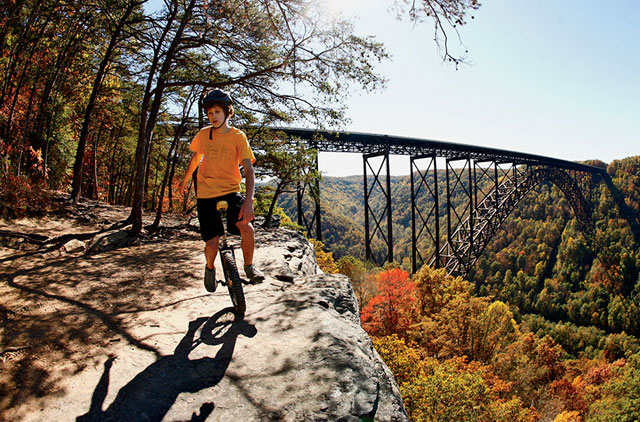
One-wheel cycling, one of the many
adventures in the New River Gorge.
(Photo by Harrison Shull)
Perched on the rim of the New River Gorge and a short drive from the Gauley River, a major whitewater stream, Fayetteville, W.Va., is one of the country's top outdoor destinations. But before its reincarnation as an adventure mecca, Fayetteville suffered the boom and bust of both timber and coal. Jesse Wood of Sierra Magazine writes that rafters, canoeists, kayakers and cliff climbers have "transformed the local economy and revitalized the area."

Now Frasure Creek Mining is proposing a major expansion of its mountaintop-removal coal operation in the center of Fayette County. Those who make their living in sustainable tourism fear the worst, Wood reports. After all, it seems like a hard-luck deja vu to many of them. When major underground mines shut down, said Clif Bobinski, "tourism seemed like the new way to try to make it and stay. Now a lot of restaurants are dependent on that business." The influx of outdoor enthusiasts has influenced Fayetteville's culture in other ways as well. Before the tourism boom, many downtown storefronts stood vacant; now they house a yoga studio, a bead shop, art galleries, multi-ethnic cafes, and numerous biking, climbing, and whitewater shops. The national Boy Scout Jamboree is expected there in 2019.

(Map from Plateau Action Network shows Fayetteville and New River Gorge bridge on US 19 at lower right, and new mine area at far lower left; click on map for larger image)
Some worry now whether the crowds will continue to flock to an area scarred by an enormous strip mine. The project would cover 3,662 acres and create 20 "valley fills" for the mountaintops leveled to reach the coal. Blasting can already be heard within the gorge, sometimes several times a day; the strip mine is visible from high spots; and Fayetteville's outdoor community isn't trusting the coal industry to "do it right," Wood reports. Kenny Parker, co-owner of an outdoor-gear shop co-owner, "emphasizes that he's not against coal miners," saying: "Everybody's father and everybody's grandfather was a coal miner. You respect that because that is their heritage. I understand that. But like it or not, coal is not going to rule the day in Fayette County." (Read more) For Catherine Moore's story in The Register-Herald of Beckley about approval of the permit, click here.

Tuesday, August 21, 2012

Male life expectancy falls in some rural areas; Central Appalachian coalfield stands out

The life expectancy of the average American man increased by 2.1 years from 1999 to 2009, but only 15 percent of all rural and exurban counties matched that increase, and in 158 of them, male longevity declined, according to data compiled by the Institute for Health Metrics and Evaluation at the University of Washington.

Counties where men's lifespan is growing shorter in rural America are clustered in Appalachia, the deep South and Southern Oklahoma, report Bill Bishop of the Daily Yonder and Roberto Gallardo of Center for Rural Affairs. The data suggest that rural men are "simply not keeping up with the health advances in the rest of the country," they write. Of the 50 rural or exurban counties with the largest declines in male longevity, 29 were in coal-producing counties in Kentucky, Tennessee, Virginia or West Virginia. Six were in Oklahoma and four were in Georgia. (Yonder map; click on image for larger version)
Bishop and Gallardo write that men were already living shorter lives in these counties than the national average before 1999; but over the last decade, men's short lives grew shorter. States with the ten counties where men's longevity shortened the most are Tennessee, Kentucky, West Virginia and Mississippi. Five of those counties are in Kentucky and three are in West Virginia. The states with the 10 counties where men's lives grew longer are Washington, Arizona, Texas, Utah, Pennsylvania, Alabama and Minnesota. (Read more)

Monday, August 20, 2012

Independent auditing arm of Congress says tougher coal-dust limits sound, would reduce black lung

The Obama administration used appropriate scientific studies and analysis when it proposed tightening limits on coal dust to fight a resurgence of deadly black-lung disease, says a federal government audit made public Friday. The review, mandated by Congress and done by its Government Accountability Office, supported the federal Mine Safety and Health Administration proposal and dismissed industry complaints that challenged MSHA's evidence and methodology. (MSHA photo)

In its 24-page report, the GAO said key scientific studies support MSHA's conclusion that tightening the dust limit would reduce miners' risk of getting black lung: "Our evaluation of the reports MSHA used to support its proposal and the key scientific studies on which the reports were based shows that they support the conclusion that lowering the PEL [permissible exposure limit] from 2.0 mg/m3 to 1.0 mg/m3 would reduce miners’ risk of disease. The reports and key studies concluded that miners’ cumulative exposure to coal mine dust at the current PEL over their working lives places them at an increased risk of developing progressive massive fibrosis, and decreased lung function, among other adverse health outcomes. . . . To mitigate the limitations and biases in the data, the researchers took reasonable steps, such as using multiple x-ray specialists to reduce the risk of misclassifying disease and making adjustments to coal mine dust samples where bias was suspected.

The report also says "Researchers used appropriate analytical methods to conclude that lowering the existing PEL would decrease miners’ risk of developing black lung disease. For example, in addition to taking steps to precisely estimate a miner’s cumulative exposure, the researchers accounted for several factors in their analyses—such as the age of the miners, the carbon content of the coal (coal rank), and other factors known to be associated with the disease—to better estimate the effect of cumulative exposure to coal-mine dust."

Completion of the GAO report frees MSHA to finalize the rule, but agency officials last week offered no timeline for when they would do so, reports Ken Ward Jr. of The Charleston Gazette. Read the report here.

Friday, August 17, 2012

Coal exports head for new high; India latest buyer

As U.S. coal exports head for a new record, a New Jersey energy company has signed a deal to sell Kentucky and West Virginia coal to India. Under the deal, Kentucky coal companies will export about 9 million tons of coal annually for 25 years to India.

The deal between India's Abhijeet Group and FSJ Energy LLC comes on the heels of a massive two-day power failure across India in late July when 600 million people lost electricity. The blackout was attributed to the collapse of three regional grids. UPI reports that about 70 percent of India's electricity comes from coal-fired power plants and while India does produce coal, domestic production cannot keep up with demand. (Read more) See the story as reported from FirstPost, an Indian newspaper, here.

U.S. coal exports "are rising because U.S. demand for coal is falling as electric utilities burn more natural gas, which has plummeted in price, instead of coal," CBS Money Watch reports. "At the same time, demand for coal is rising in developing countries such as China and India as those countries work to bring electricity to millions who don't have it." (Read more)

Wednesday, August 15, 2012

Who can speak for Appalchia? A recent transplant is figuring out that it might be OK if it's him

Local citizens gathered 'round the
microphone at WMMT in Whitesburg,
Ky., where Parker Hobson works.
The Appalachian hills are the world's oldest, according to real geologists, but another old question is the one that Parker Hobson found himself mulling this week in The HillVille, the weekly online magazine of urban Appalachia, a literary meeting place where Appalachian city folks meet with Appalachian rural folks and come to an understanding. Hobson, a native of Louisville who has been living in the mountains for all of eight months, writes that he went back to the city for a festival and when people asked him where he was from, he got to thinking closely about his answer. Then he came home and wrote this:

"I kept thinking back to an article I read this past April. It was, on the whole, a well-written history of the Louisville-Kentucky rivalry and basketball in the state, but a passage near the end grabbed me and wouldn’t let go. After describing driving along Letcher County’s [Kentucky] Route 7 and meeting a 'rawboned' man on a front porch, the author went on to write of Appalachian Kentucky: . . . Communities [here] long have been victimized and exploited . . . More often than anyone wanted, Kentucky’s basketball success became the natives’ only source of pride. As exciting as it was to see Route 7 garner a national shout-out, I couldn’t get past that last sentence.

"A theory began to take hold among sociologists in the 1960s that Appalachia had been treated in many ways like an 'internal colony' of the United States. Whether or not you, reader, buy this specific notion, the fact stands that southeastern Kentucky’s resources have generated incredible wealth over the past century, and very little of that wealth has remained in the region. Kentucky’s coalfield district, in fact, was recently rated by Gallup as having the absolute worst overall quality of life of any of the 436 [congressional] districts in the entire United States. In this context, the use of 'natives,' particularly in support of such a questionable conclusion -- there has existed nothing for the 'rawboned' 'natives' of southeast Kentucky to be proud of save the results of basketball games played hundreds of miles away? -- seemed fairly demeaning and wholly unnecessary. Was . . . this easy characterization of Appalachian folks as simple, different, and somehow apart not in some way responsible for the very sort of exploitation the author mentioned? So that should have been it, right?

"It’s pretty easy to take offense to things—you come upon something, you get the old hackles raised, and presto! You’ve taken offense! People do it every day! I began doubting myself, though. Was it even my place to take offense? What did I even really know about this place? Who was I to speak for anyone here? I suppose I’m still not sure. The more that I’m learning and the longer I live here, I’m slowly becoming more comfortable advocating for Appalachia as an objectively incredible, important and downright inspiring place, but I still feel uneasy speaking for it. . . . This place is worth fighting for, and not just because of the vast, deeply-woven, uniquely American traditional culture that has managed to survive here, or just because these mountains contain a beauty of which I had no idea Kentucky was even capable. There are people here who have been overlooked and under served throughout Kentucky’s history, and remain so today.  . . .  This is a long-simmering crisis of human rights and elected sloth, and the people of this region certainly deserve better. No matter where I’m from, how long I’ve been here, or what you want to call me, I’ve got no problem saying that." (Read more)

Thursday, August 9, 2012

UMWA plans no endorsement in presidential race

The United Mine Workers of America does not plan to endorse either presidential candidate in the upcoming election, something that has not happened in memory, Amy Harder of the National Journal reports.

The vice president of the UMWA's International Executive Board, Mike Caputo, right, told Harder that he wanted the organization to stay out of the fray. "I don't think quite frankly that coalfield folks are crazy about either candidate," he said. Obama and presumptive Republican candidate, Mitt Romney, are circulating ads and making stops in swing states with coal mines, such as Ohio and Virginia, to convince residents that they support the industry, Harder writes. Caputo said it's "unusual" for the UMWA to pass on presidential candidate endorsement. The organization hasn't officially completed its endorsement selection decisions, but expects to by mid-September; it had endorsed Obama by May in 2008.

"Politically, the Environmental Protection Agency is the culprit for the coal industry's woes," Harder writes, and this has influenced UMWA member's decisions on endorsement. Caputo said new mercury emission regulations were first introduced under George H.W. Bush, but "whoever is in charge is going to get blamed." Labor unions traditionally side with Democratic candidates, but the UMWA "has been ranting more about Obama for much of 2012," Harder writes, perhaps peaking with UMWA President Cecil Roberts' description of EPA Administrator Lisa Jackson's actions on regulation as terroristic. (Read more)