Showing posts with label defining rural. Show all posts

Wednesday, October 17, 2012

New feature at Tenn. weekly answers question newcomers get: Why did you come here?

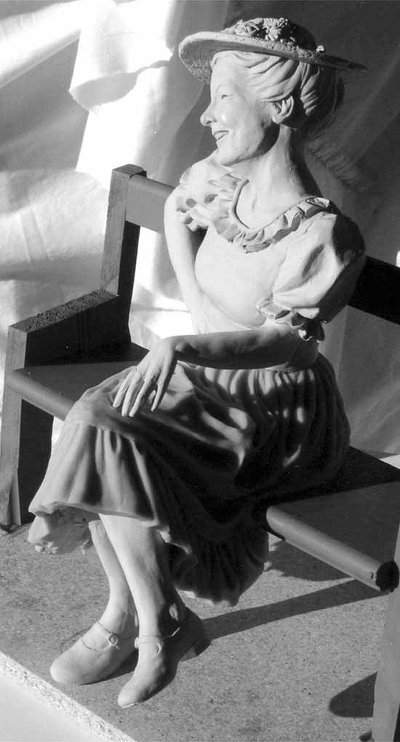
"I'm just so proud to be here" was
the opening line of Hickman County
native Minnie Pearl, whose statue will
soon be placed at the 
courthouse
They packed everything they had into a U-Haul, threw the dogs and cats into the truck and came to Hickman County, Tennessee, without jobs, friends, family or, frankly, anything but a deed to a piece of pretty property. Mark and Nicole Lewis came to the county seat of Centerville because they'd seen Nashville, 50 miles east, and were tired of New Hampshire winters. Six years later, the Lewises are so delighted by their decision they decided to tell the local weekly newspaper about it. Thus began the feature, "Why Did You Come Here?," a once-a-month installment that is now part of the Hickman County Times. 

Nicole Lewis' piece supports a recent trend "because that's the focus: newcomers who are creative types," Editor Brad Martin wrote. " Lewis fits that bill, having come to town and finding herself the founder of the county's Arts and Ag Tour straight-away. But why wouldn't she? In her 10-point list of things she loves about her county, she includes, along with a long growing season, Goo-Goo clusters, okra, strangers who wave and beautiful vistas, "I have met some of the most interesting, friendly, genuine, funny, smart, talented and caring people here in Tennessee." The Times is not online, but you can read Lewis's essay here.

A second "Why Did You Come Here" piece, offered up by the long-time member service adviser for the local electric cooperative, Jim Griffin, isn't as poetic, but it rings with heartfelt love of a town he came to in 1958 and has never seen reason to leave. We look forward to more.

Tuesday, September 18, 2012

In redefinining 'rural,' Senate version of Farm Bill could cut funds for neediest rural areas

The Senate version of the Farm Bill would streamline definitions of “rural” but one result "could be less funding for the very areas that most meet what many Americans would consider the targeted recipients for these programs," Farm Bill policy expert Aleta Botts writes for The Rural Blog and the Daily Yonder.

USDA Rural Development programs use varying definitions of “rural area,” Botts explains. “Rural water programs are allowed to go only to cities, towns, or unincorporated areas of fewer than 10,000 people. The limit for community facility programs (which pay for libraries, health centers, and many other community brick-and-mortar investments) is 20,000, while the limit for business programs is 50,000.” The Senate bill would use a 50,000 limit for all programs.

That could hurt rural areas with small populations, Botts writes. She notes testimony by the National Rural Water Association that more than 400 communities will have to wait until at least next year for water-project money. “This is an oversubscribed program and has been for years,” she writes.  “If it is oversubscribed now with its limit at 10,000 people, what will result when the population limit is raised to 50,000?”

The bill sets aside half of one rural water program’s funds to communities with fewer than 3,000 people and gives a “priority” to areas with fewer than 5,500. “But more than 80 percent of the funding already goes to areas of 5,000 or fewer, according to the National Rural Water Association testimony, so this language may actually mean little in practice,” Botts writes. For her full article, click here.

Wednesday, August 15, 2012

Who can speak for Appalchia? A recent transplant is figuring out that it might be OK if it's him

Local citizens gathered 'round the
microphone at WMMT in Whitesburg,
Ky., where Parker Hobson works.
The Appalachian hills are the world's oldest, according to real geologists, but another old question is the one that Parker Hobson found himself mulling this week in The HillVille, the weekly online magazine of urban Appalachia, a literary meeting place where Appalachian city folks meet with Appalachian rural folks and come to an understanding. Hobson, a native of Louisville who has been living in the mountains for all of eight months, writes that he went back to the city for a festival and when people asked him where he was from, he got to thinking closely about his answer. Then he came home and wrote this:

"I kept thinking back to an article I read this past April. It was, on the whole, a well-written history of the Louisville-Kentucky rivalry and basketball in the state, but a passage near the end grabbed me and wouldn’t let go. After describing driving along Letcher County’s [Kentucky] Route 7 and meeting a 'rawboned' man on a front porch, the author went on to write of Appalachian Kentucky: . . . Communities [here] long have been victimized and exploited . . . More often than anyone wanted, Kentucky’s basketball success became the natives’ only source of pride. As exciting as it was to see Route 7 garner a national shout-out, I couldn’t get past that last sentence.

"A theory began to take hold among sociologists in the 1960s that Appalachia had been treated in many ways like an 'internal colony' of the United States. Whether or not you, reader, buy this specific notion, the fact stands that southeastern Kentucky’s resources have generated incredible wealth over the past century, and very little of that wealth has remained in the region. Kentucky’s coalfield district, in fact, was recently rated by Gallup as having the absolute worst overall quality of life of any of the 436 [congressional] districts in the entire United States. In this context, the use of 'natives,' particularly in support of such a questionable conclusion -- there has existed nothing for the 'rawboned' 'natives' of southeast Kentucky to be proud of save the results of basketball games played hundreds of miles away? -- seemed fairly demeaning and wholly unnecessary. Was . . . this easy characterization of Appalachian folks as simple, different, and somehow apart not in some way responsible for the very sort of exploitation the author mentioned? So that should have been it, right?

"It’s pretty easy to take offense to things—you come upon something, you get the old hackles raised, and presto! You’ve taken offense! People do it every day! I began doubting myself, though. Was it even my place to take offense? What did I even really know about this place? Who was I to speak for anyone here? I suppose I’m still not sure. The more that I’m learning and the longer I live here, I’m slowly becoming more comfortable advocating for Appalachia as an objectively incredible, important and downright inspiring place, but I still feel uneasy speaking for it. . . . This place is worth fighting for, and not just because of the vast, deeply-woven, uniquely American traditional culture that has managed to survive here, or just because these mountains contain a beauty of which I had no idea Kentucky was even capable. There are people here who have been overlooked and under served throughout Kentucky’s history, and remain so today.  . . .  This is a long-simmering crisis of human rights and elected sloth, and the people of this region certainly deserve better. No matter where I’m from, how long I’ve been here, or what you want to call me, I’ve got no problem saying that." (Read more)

Friday, August 3, 2012

Reporter finds Chick-fil-A debate very complex in South, where food is cultural

Chick-fil-A has recently found itself in the middle of a national debate about gay rights after the chain's CEO Dan Cathey Jr. made public statements opposing same-sex marriage. Perhaps, not since the Civil Rights movement of the 1950s and 60s has a restaurant been so embroiled in controversy. Kim Severson of The New York Times explores the complexities surrounding this issue in the South, where Chick-fil-A began in Atlanta in 1946.

Choosing to eat at Chick-fil-A "is not as simple as choosing sides in a national cultural war" for Southerners, Severson reports. Southerner Justin Breen told Severson the chain is "tradition," something she writes is "laced throughout daily life in the South." Locals tend to "be emotional about their food, which is a great defining aspect of the region."

"One of the most controversial stories I wrote was about tomato sandwiches," The Charlotte Observer's food editor Kathleen Purvis told Severson. Southerners are very "proud and fiercely protective of homegrown brands," she writes. University of North Carolina's Marcie Cohen Ferris said Southerners have strong associations with Southern-founded fast food chains because "they speak of industrialization and becoming a part of modern America, but still holding on to identity." (Read more)

Wednesday, July 18, 2012

Wendell Berry getting another big award, this time for his conservative values

Agrarian poet-philosopher Wendell Berry has astounded us again, this time with the continuing length, depth and political sway of his admirers.

Witness first the unabashed love letter to him from National Review reporter and essayist John Miller, in the form of a profile as Berry prepares to receive the Russell Kirk Paideia Prize this Friday. It seems the 77-year-old liberal-talking, Democratic-voting sheep farmer who was honored to give the 2012 Jefferson Lecture at The Kennedy Center in April is getting a prize named for the author of The Conservative Mind. The prize is awarded by the CiRCE Institute, which promotes Christian classical education, for “cultivating virtue and wisdom.” If that weren't enough, notes Miller, last year ISI Books, part of the conservative Intercollegiate Studies Institute, published The Humane Vision of Wendell Berry, a collection of essays that seek to illuminate, according to the dust jacket, the “profoundly conservative” ideas of its subject.

Miller's trip to Berry's Henry County, Kentucky farm informs his essay, "A Jeremiah for Everyone: Why Left and Right like Wendell Berry." It's here where Miller remembers old-time conservative Kirk's words to make his case. Kirk, a longtime National Review contributor who, like Berry, opted for a rural life, discovered the Kentuckian around 1978. Kirk, writes Miller, "was probably the first prominent conservative to detect an undercurrent of conservatism in Berry’s work: suspicion of progress, support for local autonomy, and a preference for the old ways of doing things. Berry certainly doesn’t view himself as a conservative, and he seems both puzzled and amused that his work would find favor with conservatives." But he has conservative streaks, telling Miller, "Abortion for birth control is wrong. That’s as far as I’m going to go. In some circumstances, I would justify it, as I would justify divorce in some circumstances, as the best of two unhappy choices."

Miller concludes, "As Berry enters the final stage of his career . . . he appears content with the way he has lived out his convictions, no matter how they’re labeled. 'It’s been an extraordinarily rich life,' he says. At the same time, the contentment always fades to worry. The world is going to pot, and, if you leaf through Berry’s body of work, you’ll see that it’s been going there for a long time." (Read more)
  

Small towns in Kentucky, Texas, New Mexico and Florida win Best of the Road contest

What happens when 30 small towns vie for a big prize, taking on tough critics who require winners to have the nation's friendliest people, best scenery, hottest patriotic fervor, most excellent food and endless fun, fun, fun? USA Today's Laura Bly reports many miles were driven, lots of food was eaten, countless smiles were exchanged, and the winners of the "Best of the Road" contest sponsored by the newspaper and map maker Rand McNally will get their own Travel Channel special hosted by Bert Kreischer on July 25 at 8 p.m. ET. And the winners, named Wednesday, are:

Bardstown, Ky., better known for its bourbon, won "Most Beautiful." Judges loved the Outer Bluegrass region, with the Knobs in the distance. "We realized that maybe we're not just here to see mountains and rivers, maybe there's something else," they wrote. "Our hearts are still in this place." (USA Today photo: Old Nelson County courthouse, with historic Talbott Tavern in background.) Gainesville, Tex., took "Most Patriotic" honors. "It's not just the number of flags or monuments, memorials or programs; it's not even just for the people who serve. It's how you care for the people who were fought for," the team of judges wrote.

Murray, Ky., in the southwestern end of the state, wowed judges who dubbed it "Most Friendly." Coloradans Jennifer, Jordan and Robert Schatz remarked, "It feels like home in Murray more than anywhere else." Residents "had a way of bringing you in, and we made friends. This is the only town where we went into people's homes." Santa Fe, N.M., won "Best Food." As one local chef told Best of the Road, the state capital's cuisine is unique because of "the vibrancy of the city" and the tapestry of cultures — Native American, Hispanic and European. Delray Beach, Fla., took the trophy for "Most Fun" for its "Miami meets Manhattan in the '60s"vibe. Think Panama hats and individually owned shops, not flip-flops and chain restaurants. You can be a yogi beach bunny one minute, on a boat crusing the marina the next, then get your taste of great locally-sourced grub decked out in a dress you got at one of the many awesome vintage stores before you hit one of the town's night spots," the team says.  (Read more)

Monday, July 9, 2012

Writer tells the rural side of power outage story

Rebecca Smith washes dishes during
the power outage in a stream near 

her W.Va. home (Huenink photo)


A week after a storm knocked out electricity across a lot of the country, Rebecca Hartman Huenink has plenty of sympathy for urban dwellers who lost air conditioning. But life in non-electrified rural America, she reports for the Daily Yonder, is a bit more complicated than that. "That’s because in our part of the country, these days nearly everyone depends on a well for water. Modern wells depend on electric pumps. So, no power? No water. No water? No dish washing, no showers -- and no toilet. Think on that one for a minute."

Huenink goes on: "No power? No gas pumps. No gas pumps? No going anywhere. When you live 15, 20, or even 30 miles from the nearest town, you can't just walk down the street and buy a quart of milk. Oh, and that quart of milk? Gone sour -- in the dumpster. The grocery store, 20 or 30 miles away, doesn't have power either. So no power? No food. None to buy, anyway. Speaking of food, people in the country rely on their freezers. Animals (deer, cattle, hogs) generally go in the freezer in the fall and feed the family for the rest of the year. No power? No freezer. No freezer? No meat. As my teenage neighbor pointed out, "If the meat in the freezer goes bad, we'll be very, very vegetarian until the next calf is grown."

Huenink reminds that this is not a part of the world "where people tend to have paid time off for things like natural disasters. Most people work hourly jobs that don't pay you if you don't show up, or they run small-to-tiny farms and businesses that stand to lose big or even fold in the face of a week or more without water or transportation." Now, writes Huenink, people are talking about self-sufficiency, "neighbors wondering about wind (or solar) powered well pumps, Facebook friends swearing to ask their grandmothers to teach them to can." Meanwhile, West Virginians are used to finding a way to get by, she writes, all the while, remembering that their coal miners are the ones who keep the lights on for a lot of Americans and the awful irony that, because of terrain and remoteness, she will wait an inordinately long time for the power company to turn her electricity back on.

Tuesday, July 3, 2012

Andy Griffith dies at 86; will always be remembered as sheriff in Mayberry, modeled after his hometown

Andy Griffith, who exemplified rural America for a generation of television viewers, died today at his home in Roanoke Island, N.C. He was 86.

From 1960 to 1968, Griffith was Sheriff Andy Taylor on "The Andy Griffith Show," set in Mayberry, N.C., which he as show co-owner modeled after his home town of Mount Airy, just south of the Virginia border in the shadow of the Blue Ridge and Pilot Mountain (also the name of a tiny town that became the larger town of Mount Pilot on TV). After the show went into reruns, which still continue, it was succeeded by a spinoff, "Mayberry R.F.D," and the town's name became a metaphor for small-town America, sometimes favorable, sometimes not.

The first show "gave rise to other small town, Main Street USA shows," Joanne Ostrow writes for The Denver Post. Until then, TV "was centered in New York duplexes . . . urban police stations and hospitals, and suburban ranches and Colonials." Doug Martin of The New York Times notes that "The Real McCoys" debuted in 1957 (and offers several other tidbits, such as Griffith's endorsement of President Obama's health-care reforms). The Times' Neil Genzlinger says the McCoy show was "unflattering," but the Griffith show countered a rural and especially Southern "stereotype defined by ignorance and bigotry" and confirmed "the notion that the moral center of the country lives somewhere in a small town." Griffith "made rural values universal," The Boston Globe said in an editorial.

Mount Airy, population 10,000, gradually adopted a Mayberry image, particularly after the decline of the region's main industries: textiles, tobacco and furniture. "Tourism has really saved us," Tanya Jones, executive director of the Surry County Arts Council, told CNN. Griffith originally resisted helping the town promote itself as Mayberry, perhaps remembering prejudice he felt growing up on the wrong side of the town's railroad tracks, but in recent years participated in those efforts, including establishment of the Andy Griffith Museum. He won the Presidential Medal of Freedom in 2005.

As Lonesome Rhodes, with Patricia Neal
Griffith's first big star turn was as "a country singer and egomaniacal psychopath named Lonesome Rhodes in the gut-wrenching drama 'A Face in the Crowd.' It is the story of a wildly popular entertainer who becomes too big too fast and is corrupted beyond salvation. His fall from grace is even faster than his sudden rise from anonymity," Dennis Rodgers writes for the Raleigh News & Observer. "Griffith nailed it. He was dead-on brilliant. His demonic anger and barely controlled energy were difficult to watch, however, and the public stayed away in droves. Today, film buffs consider it a classic. But when it was released, only critics seemed to approve."

As lawyer "Matlock"
Griffith's last big role was as fictional Wilmington, N.C., lawyer Ben Matlock, in an eponymous series that ran "off and on from 1986 to 1995," Rodgers writes. "Griffith’s Matlock was wise, cranky, stubborn, funny and 100 percent Andy. Those who knew the actor said he was much closer to Matlock’s persona than he ever was to TV’s beloved sheriff. It was also a favorite of fans of the old show who tuned in to catch the sly Mayberry-related asides Griffith would slip into the dialogue."

Rodgers concludes, "Andy Griffith never won an Oscar, an Emmy or a Tony for his acting. But then, around here we never thought of him as an actor. He was just our friend and neighbor and we were so proud of him we couldn’t hardly stand it. And if the rest of the world happened to tune in to his popular shows and just happened to assume folks in North Carolina were anywhere near as good-hearted as Andy Taylor, Ben Matlock or the good people of Mayberry, well, that was OK with us, too." (Read more)

Read more here: http://www.kansascity.com/2012/07/03/3688509/andy-griffith-he-was-just-our.html#storylink=cpy

For coverage from the Mount Airy News, click here. For an obituary from Inside TV, go here. TV Week has reaction, including President Obama's, and some video clips, including a "Face in the Crowd" trailer and a segment from another movie, "No Time for Sergeants," which followed TV and Broadway versions that starred Griffith.

Friday, June 22, 2012

NEA honors rural craftsman with annual Heritage Awards; 2012's best -- snowshoes, baskets, gospel

National Endowment for the ArtsSnowshoes made from ash wood and rawhide by Paul and Darlene Bergren of Minot, North Dakota -- the Begrens' craftsmanship and teaching have been honored by the National Endowment for the Arts.
The Daily Yonder reminds that The National Endowment for the Arts has announced its National Heritage Awards for 2012. And that Paul and Darlene Bergren -- dog-sled and snowshoe makers from Minot, North Dakota -- are among them. "The awards honor artists who are preserving traditional crafts, music, and visual arts through teaching and the excellence of their own work. Over the past 30 years, hundreds of rural makers and musicians have been recognized, from woodcarver George Lopez (Cordova, New Mexico) to zydeco accordionist Clifton Chenier (Opelousas, LA) to weaver Teri Rofkar (Sitka, Alaska). Many folk expressions originated as the practical arts of rural life (saddlery, quilting,..making snowshoes)." A list of the 2012 winners and past winners is available here.

Thursday, June 14, 2012

Rural communities in Ga., Ky., Maine, N.C., Wis. get public-private grants to create spaces for artists

Several rural communities are getting grants for "creative placemaking" from ArtPlace. a collaboration of eleven large foundations, six large banks and the National Endowment for the Arts.

Artplace has singled out Chattooga County, Georgia, for a grant in an effort to help restore artist and preacher Howard Finster's Paradise Gardensright. The $445,000 grant will be used to maintain Finster's home and art environment in Pennville, a press release said. Finster, who said he was divinely inspired, made works that combined naive, folk and visionary art. He died in 2001.

Other rural communities gettimg grants include Sitka, Alaska, $350,000; Cumberland, Ky., $273,000; Eastport, Maine, $250,000 and Sauk County, Wisconsin, $75,000. Siler City, Sanford and Greenville, N.C., will share $485,000 to house artists at under-capacity manufacturing plants.


“Across the country, our communities are using the arts to help shape their social, physical, and economic characters,” said NEA Chairman Rocco Landesman. “In rural settings, where people live far apart from one another, the arts can offer an opportunity to come together and share a common experience." The full list of 47 grants is here.