Showing posts with label agriculture. Show all posts

Friday, October 19, 2012

Farm Bill includes conservation provisions important to hunters and the economy

Many Americans probably don't realize that the Farm Bill contains provisions for wildlife conservation programs, and that this has caused more than just farmers to press Congress for a vote on the bill. Hunters, anglers and conservationists have also been petitioning for passage of the stalled legislation. In a Politico opinion piece this week, Dale Hall, former director of the U.S. Fish and Wildlife Service and current CEO of Ducks Unlimited, writes about why conservation programs are so important.

"The Farm Bill's Conservation Reserve Program and Wetlands Reserve Program not only have a positive impact on wildlife populations but also help conserve soil and keep our streams, rivers and lakes clean," Hall writes. The incentive-based programs allow conservation groups to work with farmers  to create benefits for all stakeholders: wildlife, farmers, ranchers, the environment and hunters and fishers, "which generates significant financial support for out nation's economy," Hall says. Hunters, fishers and wildlife watchers spent $145 billion on wildlife-related recreation last year, according to the Fish and Wildlife Service.

Three aspects of the Farm Bill are of particular concern to conservation groups, Hall writes: maintaining and strengthening effective wetland protections, a national "sodsaver" provision to protect native prairies, and preserving conservation programs. (Read more)

Wednesday, October 17, 2012

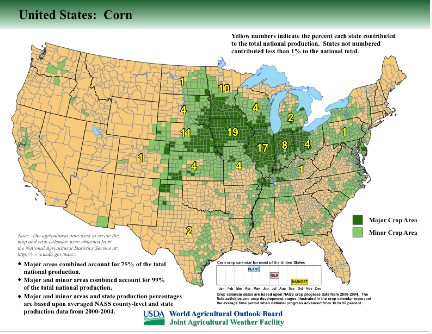
Climate change is moving U.S. corn production north

The Corn Belt is moving north, proving to food producers across the country that this summer's drought was not a fluke. The most corn since 1937 was planted this year, but growers in Kansas planted the fewest in three years, turning instead to crops that are less water-intensive, including wheat and sorghum. But in Manitoba, corn acreage has almost doubled over the past decade.
(Click on map for larger version)
This shift is "a glimpse of a future altered by climate change that will affect worldwide production," the Sydney Morning Herald of Australia reports. Changes are happening faster than plants can adapt, said Axel Schmidt, a former International Center for Tropical Agriculture scientist.

Agriculture businesses are adapting. Agribusiness Cargill Inc. is investing more in northern facilities in anticipation of increased production there. DuPont Co. is developing genetically modified corn seed that could withstand drought, and boosting research in sorghum and other crops.

U.S. corn was worth $76.5 billion last year, more than twice the value of soybeans and five times that of wheat. Most ethanol comes from corn, most livestock eats it, and high-fructose corn syrup is used in a mass array of products. While climate change will likely move its production north, the Midwest will probably remain the corn belt just because of its good soil and generally favorable weather, Illinois' Heritage Grain Cooperative manager Jerry Rowe told the Herald. (Read more)

Swing-state rural voters prefer Republican Farm Bill

Since the failure of the Republican-led House to pass a Farm Bill before the September 30 deadline, Democrats running for office in rural districts have been using it as ammunition. Whether that makes rural voters pick Democrats on election day is yet to be seen, but in the latest National Rural Assembly and Center for Rural Strategies poll of rural voters in nine swing states, voters preferred the Republican approach over the Democratic one, 61 to 27 percent.

The poll described the Democratic position this way: "Democrats have said allowing the Farm Bill to expire is devastating for rural America. The Farm Bill supports rural development programs, invests in renewable energy industry, and provides an important safety net for farmers and producers. It would especially help those suffering for record drought. The Supplemental Nutrition Assistance Program, also called food stamps, not only helps feed people, but 14 cents per dollar of the money from this program goes into the pockets of farmers."

It described the Republican position like this: "Republicans have said they want to pass a Farm Bill that is helpful to farmers and rural communities. Eighty percent of the current Farm Bill goes to fund the food stamp program, which is in dire need of reform. The number of people on food stamps has increased by 59 percent under President Obama, and the program is filled with waste and fraud. Many other provisions of the Farm Bill are badly outdated. We need a modern Farm Bill focused on helping farmers."

Voters polled said the Republican approach was closer to their view by a 34-point margin. "We should point out that not many rural voters actually have anything to do with farming," reports Bill Bishop of the Daily Yonder, which is published by the center. Only 7 percent of those polled said they or someone in their family made more than half their income from farming, and 12 percent said they received less than half of it from farming. Eight of 10 said no one in their families made any income from agriculture. (Read more)

Tuesday, October 16, 2012

Farmers hiring legal migrant workers often deal with visa application delays, report says

Farmers who expect to face a shortage of agricultural workers during a season can apply for federal H-2A visas, which allow migrant workers from other countries to live and work legally in the U.S. Recently released Government Accountability Office data shows there are major flaws with the application process. While 90 percent of applications were approved in 2011, 37 percent were processed after the deadline, including 7 percent that were approved less than 15 days before workers were needed. (Good Fruit Grower photo: H-2A worker picks apples)

Delays in processing gives employers little time to complete the second phase of application and for workers to get visas. They can apply for visas online, but most of the H-2A process requires paper handling, which contributes to delays, the GAO said. Employers who need workers at different times during the season must repeat the entire application process for each set of workers. Farm employers say new rules implemented last year are causing the delay, even though the agencies in charge of it say they can't pinpoint why delays happen.

The GAO was asked to examine the program by the Departments of Labor, Homeland Security and State for aspects that create problems for employers, and how federal agencies have addressed those challenges. GAO found that federal agencies are trying to improve the application process through electronic systems, but those improvements have been delayed. It recommends the Departments of Labor and Homeland Security implement their electronic application systems and use them to collect data about the delays. It says the agencies should use that information to streamline the process. (Read more)

Restaurants hit with higher food prices caused by drought; small, local eateries struggle most

This summer's oppressive drought scorched Midwestern crops, raising the cost of feed, dairy and meat. Those high prices are impacting the size of restaurant menus across the U.S., with small, local eateries feeling the pinch the most. The cost of food now rivals labor as the top expense for most restaurants, Tiffany Hsu of the Los Angeles Times reports. Owners are reducing menu offerings, shrinking portion sizes and considering staff cuts. (L.A. Times photo by Francine Orr: patrons eat at Smokin' Jonny's BBQ in Gardena, Calif.)

Restaurant prices have been rising for more than a year, with wholesale food costs increasing by 8.1 percent in 2011, Hsu reports. The increases will continue, but at a quicker pace, because the price of corn, which is a key component in livestock feed, powdered sugar, salad dressing, and more, jumped by 60 percent this summer. Chicken and turkey prices rose by 5.3 and 6.9 percent, respectively, and eggs now cost 18 percent more. Analysts expect overall food prices to rise from between 5 to 20 percent by year's end.

Big chains are able to weather drought price hikes well, but small restaurants will suffer, Hsu reports. "The smaller mom-and-pop restaurants are going to get hit with the drought very shortly," Motley Fool analyst Don Krueger told Hsu. It's forcing small restaurant owners to make tough decisions. Restaurant consultant Kian Abedini told Hsu more restaurants are using small plates and tapas dishes to save money. He's also noticed cheaper cuts of meat on menus, along with more curry and rice dishes. Pickled items are showing up as well because they're less expensive than fresh foods, Abedini said.(Read more)

Monday, October 15, 2012

Farmers more likely to be depressed amid harvest

There is an increased risk of depression among farmers during harvest season, and one doctor who treats a lot of them says it's important for them to take breaks to reduce stress, Julie Harker of Brownfield Agriculture News reports. Weather and other harvest-time pressures can increase farmers' stress, which can lead to increased risk of accidents and more, Harker heard from Dr. David Schwarts of Waukon, Iowa.

Schwartz said there is an increased risk of depression during this time of year, but many farmers don't seek help because they tend to think they are "tougher than that," he told Harker. Schwartz said he's seen an increase in cases of depression at his clinic this year because of the drought. He said family physicians can treat depression, but often farmers can reduce stress by "taking time out for enjoyable activities," Harker reports. (Read more) To listen to Harker's interview with Schwartz, click here.

Friday, October 12, 2012

Central Kentucky's few remaining small tobacco farmers having difficulty finding harvest labor

The good news for some Kentucky tobacco-growing counties is that this year's crop is one of the better they've seen in a while. The bad news is that the migrant labor that was once abundant in those parts isn't as available as before. Leslie Moore of the Central Kentucky News-Journal reports that in Taylor County, "finding workers to cut and house this season’s predicted 2,500 pounds of tobacco has been a labor in itself."  (Moore photo)

Pat Hardesty, the county extension agent for agriculture, told Moore the number of migrant workers who help with the harvest has dwindled because there are simply not enough small farms now in the area to keep them employed for long. “Some of our smaller producers have been waiting on crews or they’ve been trying to get local help, which is very difficult,” Hardesty said. “That’s why the migrants are here, because we can’t get enough local labor to get the crop in.” He said migrant workers aren't taking jobs away from Americans: “I promise you, if a tobacco producer here in Taylor County could get local, dependable help, there wouldn’t be migrants here.” Local farmer Aaron Newcome agreed that finding steady local help this year has been difficult. On any given day, he told Moore he has no idea how many workers will show up or how long they will stay.

As a killing frost loomed, Hardesty explained to Moore that speed is of the essence. If frost hits tobacco, the crop's quality is reduced and acres of it can be wasted.

News-Journal stories are behind a paywall. To get a 30-day free trial subscription, go here.

Thursday, October 11, 2012

California poultry company files for bankruptcy; will be eighth poultry firm to fold in the last year

Zacky Farms LLC, a California poultry company that dates to the 1920s, filed for bankruptcy this week. High feed costs following this summer's oppressive drought led to the decision, P.J. Huffstutter of Reuters reports. The company employs about 1,500 people in southern California, and listed between $50 and $100 million in assets, with debts in the same range.

The bankruptcy filing showed that the company's largest unsecured creditors are feed company Western Milling, to whom Zacky Farms owes about $6.6 million, and poultry company Foster Farms LLC, which is owed about $1.2 million. "Zacky Farms will be the eighth poultry firm to be sold, entered into Chapter 11 bankruptcy or shut down altogether since 2011, according to data from trade group National Chicken Council," Huffstutter reports. (Read more)

Huffstutter advises in an email that Zacky's is ranks about among poultry companies in revenue, and about 10th among turkey packers.

Lots of money spent on agriculture research, but not very much on rural community development

The amount spent on agricultural biotechnology research has exploded over the past 30 years, but very little is spent on understanding how rural people and communities can survive, according to new research from the Department of Agriculture's Economic Research Service.

"We spend billions of dollars trying to understand how crops and animals live, but only a smidgen on how humans and their communities can grow and develop," Bill Bishop of the Daily Yonder writes. It's understandable, he writes, that private businesses invest money in research and development that will earn high private returns, according to the economists who wrote the report, at least. However, a 2001 survey found that three-quarters of private crop breeding investments went to just three commodities: corn, soybeans and cotton, Bishop reports.

From 1980 to 2010, research spending by seed and biotech companies increased to more than $2 billion from $100 million. There was no increase in spending on social and community development research. "And that may be one reason why we know a heck of a lot about how to grow corn in a drought but not so much about how to develop rural communities that thrive," Bishop writes. "No wonder we have bountiful harvests and troubled towns." (Read more)

Tuesday, October 9, 2012

Romney releases rural platform, criticizes Congress and Obama for lack of new Farm Bill

Mitt Romney released his rural platform today. "Like President Obama, the Republican's rural policy is all about agriculture," says the Daily Yonder. "Of course, most people in rural America have little to do with farming, but in a campaign short on substance, we'll take what we can get." (Des Moines Register photo)

The Yonder notes that the platform criticizes Congress for failing to pass a Farm Bill before recessing for the election season. That has created some heat for Republican members of the House from rural areas. In an appearance in Iowa yesterday, Romney also blamed Obama, saying "The president has to exert the kind of presidential leadership it takes to get the House and Senate together and actually pass a farm bill.”

The four main points of the platform, which is available here, are:

  • Implement effective tax policies to support family farms and strong agribusiness;
  • Pursue trade policies that expand upon the success of the agriculture sector, not limit it;
  • Create a regulatory environment that is commonsense and cost-effective; and
  • Achieve energy independence on this continent by 2020.
  • Monday, October 8, 2012

    Presidential candidates don't focus on rural issues

    "As they campaign, presidential candidates Barack Obama and Mitt Romney pretty much ignore rural-specific issues," even though they have plenty of opportunity to focus on those issues, Don Davis of the Grand Forks Herald reports, noting that some major swing states that are frequent stops on campaign trails are "heavy on agriculture."

    The House Agriculture Committee ranking Democrat, Rep. Collin Peterson of Minnesota, told Davis that the gist of each candidate's stance on agriculture is this: Mitt Romney favors fewer regulations, as do many rural residents; Obama is better at supporting the Farm Bill, which includes disaster relief for farmers and funding for rural development projects. University of North Dakota economics professor David Flynn told Davis rural people are "'forced' to back the candidate of their favorite parties ... because neither delivers enough information for them to make good decisions."

    "Neither candidate is laying out any specifics regarding rural-specific policies, even the consequences of other policy ideas such as energy on rural economies," Flynn said. "There is no attention being paid to it. At some level, it is a disservice." Ed Schafer, former agriculture secretary and a member of Romney's Agriculture Advisory Team, said the candidates miss an opportunity to talk about the strength of U.S. farming when they don't focus on rural issues. Obama focuses on renewable energy when talking farm issues, but other parts of the farm-sector "can't get an ear anywhere," Schafer said.

    "Rural America is not on the front burner for one main reason: votes," Davis writes. Center for Rural Strategies President Dee Davis said the issues facing rural America are complex and not easy to solve, and candidates know they get most of their votes from urban areas. (Read more)

    Thursday, October 4, 2012

    USDA beginning farmer grants awarded in 24 states

    The U.S. Department of Agriculture announced earlier this month it would give more than $18 million to beginning farmer programs in 24 states through its Beginning Farmer and Rancher Development Program. The money will go to groups that provide education, training, technical assistance and outreach programs to farmers or ranchers who've been working for less than 10 years.

    The University of Kentucky College of Agriculture has been awarded a $561,000 grant for its KyFarmStart training program for those who are considering a farming career. Program director Lee Meyer told UKnow's Carol Spence that Kentucky's farm population is aging, with 30 percent of farmers over 65, higher than the national average of 57. "To keep farming viable in the state, we have to be able to replace these people," he said.

    Rural Community Development Resources in Yakima, Wash. is another grant recipient, getting $562,500 to help Latino farmers in the Yakima Valley become interested farming. The grant will help the nonprofit host educational workshops about farm and financial management and expand its Center for Latino Farmers into the Wenatchee area to meet increasing demand, RCDR business counselor and loan specialist Maria Garcia told David Lester of the Yakima Herald-Republic.

    A beginning farmer program in North Carolina received $180,000 and will give up to $8,000 each to farmers who create innovative opportunities in production, processing and marketing through the Tobacco Communities Reinvestment Fund. The program is administered by the Rural Advancement Foundation International-USA. The program is designed to keep farmers farming and maintain an economic base for North Carolina's traditional tobacco farming communities. (Read more)

    Wednesday, October 3, 2012

    Dairy farmers struggled through drought, now battle armyworms; will suffer without Farm Bill

    Dairy farmers will lose up to 10 percent of their monthly income from milk beginning in October because the Milk Income Loss Contract expired when the Farm Bill wasn't renewed on Sept. 30. MILC is a program that provides dairy farmers with payments when the price of producing milk is more than the price for which it's sold. (Oklahoma Farm Report photo)

    MILC payouts were cut to 34 percent, from 45 percent, when the Farm Bill expired, Melissa Miller of the Southeast Missourian in Cape Girardeau reports. High feed and gas prices have forced farmers to sell their least productive cows to slaughter, and some small farmers are considering leaving the business. Miller writes that the armyworm is adding to farmers' misery. The pest strips pasture grass, which often replaces expensive feed. Dairy Farmer John Schoen told Miller most farmers are likely losing $10,000 to $15,000 a month.

    "Dairy is one of the few commodities that will get hit immediately by this [Farm Bill expiration] because we're on a monthly schedule," Jefferson County Farm Bureau president Michael Kiechle told Ted Booker of the Watertown Daily Times in far upstate New York. "We probably won't get anything now until the crops go in the ground next spring."

    Commercial dairy farmers in Maine "depend on subsidies in the [Farm Bill] to help them get through tough times," reports Jay Field of Maine Public Broadcasting. They are selling milk for less than it costs to produce it because of high gas and feed prices. One farmer told Field he will spend $6,000 more on fuel this year, and is barely covering operating costs right now.

    Child farm-labor rules, unchanged after lobbying, probably affect more children than statistics indicate

    The recent debate about child farm-labor laws revolved around what many farm families said was an integral part of growing up on a farm: helping out around the fields. What many may have overlooked, though, is that the children of migrant workers don't grow up on farms; they just work on them. And advocates say "lax enforcement of underage labor laws and inadequate safety rules for teens are threatening the long-term health of thousands" of those migrant children, Anthony Schick of The Oregonian reports. (Oregonian photo by Faith Cathcart: Diana Cristal Mendoza Sanchez, 12, picks blackberries)

    Farm lobbyists have blocked tighter restrictions on the work children may legally do, and efforts for closer monitoring have failed, Schick writes. The industry won a huge victory when the Obama administration stopped the Labor Department's plan to revise child labor rules written in 1974 and adopt in regulation a policy adopted by the second Bush administration more than 10 years ago. Most child labor in heavy agricultural states is largely hidden "because official data do not include underage workers," Schick reports. "Visits to fields and interviews with farmworkers indicate it is far more widespread than statistics show."

    Schick continues: "Nearly everyone involved has an incentive to allow underage labor. Farmers need crops picked, farmworkers need money children bring home and advocates for workers risk alienating whole families if they broach the subject. The tenuous residency status of many Mexican-born workers also plays a role." Even though parents and farm owners say the jobs children do are relatively safe, but Schick reports that all children working on farms face "significant risks:" Child farmworkers suffer fatal injuries four times as often as in other industries, extreme heat, repetitive strain and exposure to toxic substances can create chronic health problems. (Read more)

    Tuesday, October 2, 2012

    College graduates with no farm experience are turning to careers in agriculture

    The number of farms in the U.S. increased by 4 percent from 2002 to 2007, according to the last Census of Agriculture, and recent college graduates seem to be fueling this trend by returning to the land, sometimes learning farming as they go, Natalie Kitroeff of The New York Times reports. Many don't have agriculture-related degrees, but became interested in farming through other means, including working in food service or supermarkets. Several work as farmhands, learning the trade through a workers' perspective.

    Hearty Roots Community Farm, which raises vegetables in upstate New York, hired 10 farmhands this past season, none of whom had agriculture backgrounds, and all of whom are young, college graduates. Some such farmhands go on to establish their own farms. The newcomers to farming are helping increase the number of farms, which had been steadily declining since 1920. (NYT photo by Nathaniel Brooks: Hearty Roots farm crew manager Jordan Schmidt harvests beets)

    Hiring college graduates with no experience can have drawbacks, Kitroeff reports. "Most of the people here who work for me are here for one season and then move on to other farms, and so that's actually the biggest challenge, Hearty Roots owner Ben Shute said. "Every year it's like training new people." But he added that having such an ambitious staff who want to own their own farms someday is a benefit because they are very willing to learn. (Read more)

    Common use of genetically modified crops leading to rise in pesticide, herbicide use

    Use of genetically modified crops has become commonplace in agriculture, but has led to an increase in use of pesticides and herbicides, according to a new study. Weeds and pests have have adapted to the modified crops and become resistant to the chemicals used to protect them, so farmers have been forced to spray crops with increasing amounts of the chemicals. The use of pesticides increased by 404 million pounds from 1996 to 2011. Herbicide use increased by 527 million pounds, and insecticide use by 123 million pounds.

    Charles Benbrook, lead author of the Washington State University study, said it "undermines the value of both herbicide-tolerant crops and insect-protected crops," Carey Gillam of Reuters reports. Monsanto's Roundup Ready seeds were a hit with farmers, who enjoyed the benefits of being able to spray their entire crop, killing weeds and bugs without hurting their crops. However, more than two dozen weed species have become resistant to Roundup.

    The amount of herbicide needed to fight "superweeds" is increasing by about 25 percent every year, Benbrook said. The annual increase has risen to 90 million pounds in 2011, up from 1.5 million in 1990. Insecticide use dropped 28 percent from 1996 to 2011, but is now rising, Benbrook said. (Read more)

    Monday, October 1, 2012

    Pork producers struggle through drought, sending more young female hogs than ever to slaughter

    More female hogs than ever are being sent to slaughter because producers can't afford high feed prices caused by this summer's oppressive drought. Sows are building blocks of herds, so slaughtering them not only shrinks herds but expands the pork supply, sending prices plummeting, P.J. Huffstutter and Theopolis Waters of Reuters report. Producers are left to either use savings to survive, or sell herds and leave the business. (Photo by John Gress)

    Just under 10 million head of hogs were sent to slaughter in August, the most ever for that month, according to data analyzed by Reuters. But, the U.S. Department of Agriculture in its quarterly inventory of hogs and pigs on Friday said the number increased slightly through Sept. 1. There were 67.5 million head, up 3 percent from June 1.

    Still, large producers are "scouring the Midwest to snap up whatever feed they can find, or are sinking tens of millions of dollars into importing [feed] from Brazil," Huffstutter and Theopolis report.

    Climate change keeping pests alive through winter

    Climate change is not only causing crop-killing drought, but its increasing the longevity of at least one species of pest that can devastate potato, tomato, pepper and about 40 other crops. The potato-tomato psyllid, right, sucks plants dry and can spread "zebra chip" disease in potatoes that causes potato chips to have a burnt flavor, Gabriela Quiros of Quest. That disease has cost producers in three states about $8 million so far. (University of California photo by Jack Clark)

    Farmers have dealt with psyllids for more than 100 years, but rises in temperature are allowing them to survive through winter. "Our temperatures have increased by 2 to 3 degrees Fahrenheit, and that seems to be enough to keep them from being frozen out during the winter,” said University of California, Riverside entomologist John Trumble. If pests can live through winter, they can attack crops early in the growing season, which could leave to even more widespread loss of crops because of the bugs, Trumble said. (Read more)

    Alabama's Hispanic farmworkers being replaced by African and Haitian refugees

    Alabama farmers are turning to a different set of immigrants to help harvest after the state's controversial immigration law requiring police to check status drove many Hispanics to other states and caused a labor shortage. African and Haitian refugees, which were brought to the U.S. legally by labor brokers, are filling the gap, Margaret Newkirk of Bloomberg News reports.

    Most of the refugees were recruited by poultry companies, according to the Pew Hispanic Center. They sought refugees because not enough local residents were interested or qualified to work in the plants, Wayne Farms spokesman Frank Singleton told Newkirk. The poultry company spent $5 million to replace and retrain workers after most of its Hispanic workers left. Alabama doesn't track the number of refugees who came to fill jobs, but it had about 95,000 illegal Hispanic immigrants in the workforce in 2010. (Read more)

    Healthy Foods, Local Farms Conference Oct. 13

    The 13th annual Healthy Foods, Local Farms Conference in Louisville will feature such speakers as author-farmer-poet-philosopher Wendell Berry, Goldman Prize winner Lynn Henning, Environmental Protection Agency water administrator Nancy Stoner, and Dennis Dimick, National Geographic's executive editor for environment.

    The conference will be held from 9 a.m. to 5:30 p.m. Saturday, Oct. 13 at Kentucky Country Day School in eastern Louisville. The registration fee is $40 and includes meals with locally and sustainably grown food. Scholarships are available. For information email or call Aloma Dew at 270-685-2034. A pre-conference Harvest Party on Friday evening, Oct. 12, at the Bashford Manor B & B, is $45. For information email or call  Joan Lindop at 502-836-3853.