Showing posts with label economic development. Show all posts

Thursday, October 11, 2012

Lots of money spent on agriculture research, but not very much on rural community development

The amount spent on agricultural biotechnology research has exploded over the past 30 years, but very little is spent on understanding how rural people and communities can survive, according to new research from the Department of Agriculture's Economic Research Service.

"We spend billions of dollars trying to understand how crops and animals live, but only a smidgen on how humans and their communities can grow and develop," Bill Bishop of the Daily Yonder writes. It's understandable, he writes, that private businesses invest money in research and development that will earn high private returns, according to the economists who wrote the report, at least. However, a 2001 survey found that three-quarters of private crop breeding investments went to just three commodities: corn, soybeans and cotton, Bishop reports.

From 1980 to 2010, research spending by seed and biotech companies increased to more than $2 billion from $100 million. There was no increase in spending on social and community development research. "And that may be one reason why we know a heck of a lot about how to grow corn in a drought but not so much about how to develop rural communities that thrive," Bishop writes. "No wonder we have bountiful harvests and troubled towns." (Read more)

Wednesday, October 10, 2012

Farmers, energy firms hike bids to delist endangered species and protect them with voluntary agreements

The U.S. Fish and Wildlife Service is seeing increased interest in agreements to remove certain species from endangered lists, which would absolves the federal government from protecting them, in the wake of its decision to remove the dunes sagebrush lizard from the list this summer.

If a species is removed, its protection falls to voluntary state-led conservation agreements, and landowners don't have to follow federal protection policies. Voluntary agreements "have been a long time in the making," Allison Winter of Energy and Environment News reports. The Endangered Species Act has been shrouded in controversy since its 1973 enactment, she writes, even though environmentalists say its one of the most effective laws for protecting species. Critics of the act say it's become too cumbersome and restrictive on development. Voluntary agreements began during the Clinton administration, and more than 70 landowners have enrolled 1.1 million acres in conservation agreements, providing habitat for 41 species.

Ranchers, farmers, wind-energy companies and oil and gas companies are increasing requests for such agreements so they can increase development on previously protected land, and the FWS is trying to determine how to streamline the review process, Winter reports. The agency plans to issue final listing decisions for 251 species, and initial findings on hundreds of other species, as part of a legal settlement with environmental groups. Two high-profile candidates are the greater sage grouse and the lesser prairie chicken, the status of which could affect development across the West, Winter reports.

Monday, October 8, 2012

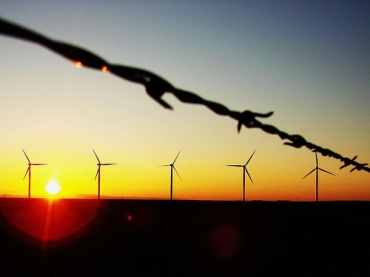
Wind farm in Eastern Washington could revitalize rural community, be example to others

The small farming town of Oakesdale, Wash., just south of Spokane, population 420, looks much like other small towns and rural communities across the country: boarded-up storefronts, empty restaurants, few opportunities. Now city officials hope a $200 million wind farm just west of town will provide a boost to the local economy, Kaitlin Gillespie of The Spokesman-Review reports. (S-R photo by Derek Harrison)

First Wind, a Boston-based energy company, owns the Palouse Wind Project, a 58-turbine facility that will supply power to about 30,000 people. The four-year project is expected to be completed by Thanksgiving, though 37 turbines will be producing power by the end of next week. The project is "blowing in more than renewable energy," Gillespie writes. It's bringing business and tax revenue to Whitman County. The wind farm will generate $790,000 a year in property taxes, for a total of $13.8 million over its 30-year lifespan. The project created more than 100 jobs during construction and will provide 10 permanent positions. (Read more)

Tuesday, October 2, 2012

High court OKs rule limiting roads in national forests

The Supreme Court upheld on Monday the "roadless rule," which limits road building and timber harvesting on 45 million acres of undeveloped national forest land. The state of Wyoming and the Colorado Mining Association challenged the 2001 Roadless Area Conservation Rule, saying it "unfairly jeopardized multiple industries and hampered economic development," notes Amy O'Donoghue of the Deseret News in Salt Lake City.

The rule was upheld by the 9th and 10th circuit courts of appeals, and the Supreme Court refused to hear the case. Supporters of the rule said the court's move resolved "what has been a decade of uncertainly over management of inventoried roadless areas," O'Donoghue writes.

"Sound roadless conservation policies safeguard big-game habitat security, productive trout and salmon fisheries and our sporting traditions," said Theodore Roosevelt Conservation Partnership Center for Western Lands director Joel Webster told the reporter. "The 2001 roadless rule remains a strong mechanism for conserving America’s outdoor heritage." (Read more)

Monday, September 10, 2012

Walmart: Express stores 'filling gap' in rural areas

Walmart started a new line of stores last year to infiltrate the urban market, but they are having an impact in rural areas, too. They're called Walmart Express, and they've been popping up in at least three states: North Carolina, Arkansas and Illinois. The company says they are designed to compete with dollar stores, which dominate the convenience and low-price market in rural areas.

Walmart Express stores average about one-tenth the size of a Walmart Supercenter, and manager of Walmart Express in Snow Hill, N.C., told Leoneda Inge of WUNC in June that the small size allows associates to have relationships with all their customers. The IGA grocery store across the street has been closed for years, and the nearest Supercenter is at least 15 miles away in Kinston. Inge reported that the Express stores are "basically grocery stores, with a pharmacy and a few extras."

Walmart Regional Vice President Ronny Hayes told Inge there's a void to fill in rural communities that are 20 or more miles away from a Supercenter. "We see this as an opportunity to come into this community and offer them, not only affordable but healthy food options and let's face it today, with the gas prices and everything else, our customers are going to appreciate that." (Read more)

Saturday, September 8, 2012

Study says wind energy development increases personal income and creates jobs in rural counties

After all the cheerleading and naysaying on the matter, at last, a systematic analysis of how wind energy development affects rural counties has been done. That study, in the current issue of Energy Economics, shows that wind energy development increases both personal income and employment in the county where the development is located. The paper was authored by Jason P. Brown and John Pender of the U.S. Department of Agriculture's Economic Research Service, Ryan Wiser and Ben Hoen of the Lawrence Berkeley National Laboratory and Eric Lantz of the National Renewable Energy Laboratory.

The Daily Yonder breaks down the complexities to explain that "the economists looked at wind capacity installed in 12 states from 2000 to 2008. The states included Iowa, Kansas, Minnesota, Nebraska, North Dakota, South Dakota, New Mexico, Oklahoma, Texas, Colorado, Montana, and Wyoming. In all, the study area included 1,009 counties. Their findings concluded that for every megawatt of wind power capacity installed, total county personal income increased by $11,150 over the 2000 to 2008 period. And, for every megawatt of wind energy installed in a county, one half of a job was created." (Read more)

Wednesday, September 5, 2012

Two Kentucky towns 'go undercover' to give each other different perspectives on themselves

Ever wonder what someone from another town might think about yours, and how those first impressions could help you better your community? The Christian County Chamber of Commerce in Hopkinsville, Ky., did, and invited near-neighbors from Henderson to do an "undercover" investigation of their county seat to give them a different perspective of their community. (Wikipedia map: Hopkinsville in red, Henderson, approximately, in blue)

About a dozen Henderson residents traveled to Hopkinsville this summer, anonymously touring the town, taking notes for their report, "1st Impressions." The crew, at least some of whom had never been to the town 72 miles to the south, said during a Chamber meeting last week that they previously thought of Hopkinsville as "crime-ridden and rundown in its older areas," reports Nick Tabor of Hopkinsville'sKentucky New Era. After their visit, they said they were impressed with development and downtown businesses. They also had some suggestions: more locally-owned business should be downtown, and the downtown needs more beautification.

Kentucky New Era graphic by Tom Kane
Tabor reports the Henderson group's recommendations were nothing new to Chamber officials, who have already included the suggestions in the county's strategic plan. Chamber President Carter Hendricks said, "It's good to have validated that the strategies we've been implementing need to continue to be implemented." The chamber has agreed to send volunteers to "go undercover" in Henderson in the future. To see the Henderson group's report, click here (subscription required).

Hopkinsville has a population of almost 32,000, making it the sixth largest city in Kentucky. It's about an hour and 15 minutes north of Nashville and about an hour and a half south of Evansville, Ind., and Henderson. The latter town has a population of 29,000, and was once home to noted ornithologist and painter John James Audubon.

Tuesday, August 28, 2012

Farm Bill's Rural Development Title dates to 1972

This year marks the 40th anniversary of the Rural Development Title, a section of the Farm Bill that outlines development spending in rural areas. It has continuously been threatened with budget cuts, and remains threatened in this year's deliberations over the farm law. For the Daily Yonder, Timothy Collins, director of research, policy, outreach and sustainability at the Illinois Institute for Rural Affairs, provides some history about the title and its importance to rural America.

The roots of the title can be traced to Franklin Roosevelt's post-Depression efforts to rebuild the country, but a bipartisan title wasn't included in the Farm Bill until 1972. "This was a watershed event," Collins writes. "It was an effort to bring together diverse programs that helped rural areas and moved rural development under the umbrella of the U.S. Department of Agriculture." The title was also a shift from the War on Poverty, which focused mainly on urban areas, to "a more clearly defined" rural development policy, Collins writes.

After Richard Nixon, right, took office in 1969, he appointed the Task Force on Rural Development to develop a report about rural policy. The report "connected rural and urban well-being, mainly focusing on helping rural communities slow the migration to cities and develop community leaders. It also stated that rural development couldn't happen unless local communities actively worked for it. Nixon wanted to "reshape federal-state relationships" and give rural communities more flexibility in how they used federal funds, David Roth writes in "The Nixon Administration Through Passage of the Rural Development Act of 1972."

The 1972 Farm Bill included loans for commercial and industrual development in rural areas; insured and guaranteed loans, instead of direct federal loans, to press the private sector into playing a role in rural development; cost-sharing provisions; and, improvements in the administrative machinery of the Farmers Home Administration. Rural Development became a named section of USDA. (Read more)

Collins reports the USDA is taking "particular pains to tell its story and point out where its Rural Development programs are working" because the title is struggling under budget cuts and has been threatened with more. To learn more about the "success stories," click here.

Monday, August 27, 2012

Survey: Rural businesses still worried about training, planning, sufficient capital

The Center for Rural Affairs asked rural business owners to list their concerns, and they continued to put training and planning on top of the list. The center’s third biennial survey results also reveal that sufficient capital and taking on more debt also remain primary concerns, the Omaha World-Herald reports. “The need for working capital is a natural response for start-up or less-experienced businesses, but for capital issues to remain after a business is established is both a reflection of the current economy and the nature of operating a small business in a rural place,” said Jon Bailey, rural research and analysis director for the Nebraska-based center and co-author of the report on the survey.

“How businesses respond to these financial challenges, with the assistance of business development programs and public policy, is critical for the rural economy,” Bailey said. “If established businesses are facing these challenges, we have to find solutions to keep them in business in their communities, and find incentives for start-up businesses in similar communities that may face identical challenges.” (Read more)

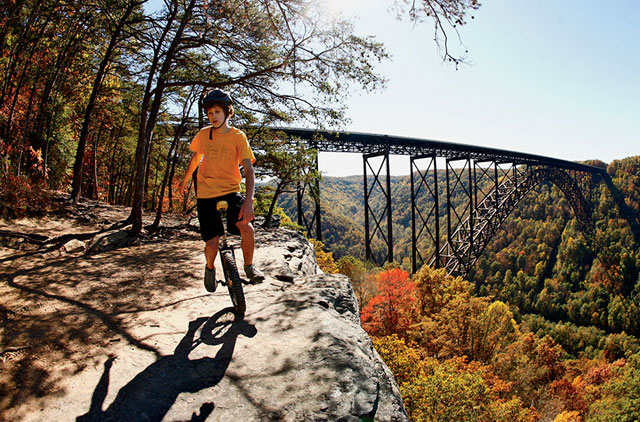
Who wins in W.Va. when big surface coal mine comes (too?) close to adventure tourism sites?

One-wheel cycling, one of the many
adventures in the New River Gorge.
(Photo by Harrison Shull)
Perched on the rim of the New River Gorge and a short drive from the Gauley River, a major whitewater stream, Fayetteville, W.Va., is one of the country's top outdoor destinations. But before its reincarnation as an adventure mecca, Fayetteville suffered the boom and bust of both timber and coal. Jesse Wood of Sierra Magazine writes that rafters, canoeists, kayakers and cliff climbers have "transformed the local economy and revitalized the area."

Now Frasure Creek Mining is proposing a major expansion of its mountaintop-removal coal operation in the center of Fayette County. Those who make their living in sustainable tourism fear the worst, Wood reports. After all, it seems like a hard-luck deja vu to many of them. When major underground mines shut down, said Clif Bobinski, "tourism seemed like the new way to try to make it and stay. Now a lot of restaurants are dependent on that business." The influx of outdoor enthusiasts has influenced Fayetteville's culture in other ways as well. Before the tourism boom, many downtown storefronts stood vacant; now they house a yoga studio, a bead shop, art galleries, multi-ethnic cafes, and numerous biking, climbing, and whitewater shops. The national Boy Scout Jamboree is expected there in 2019.

(Map from Plateau Action Network shows Fayetteville and New River Gorge bridge on US 19 at lower right, and new mine area at far lower left; click on map for larger image)
Some worry now whether the crowds will continue to flock to an area scarred by an enormous strip mine. The project would cover 3,662 acres and create 20 "valley fills" for the mountaintops leveled to reach the coal. Blasting can already be heard within the gorge, sometimes several times a day; the strip mine is visible from high spots; and Fayetteville's outdoor community isn't trusting the coal industry to "do it right," Wood reports. Kenny Parker, co-owner of an outdoor-gear shop co-owner, "emphasizes that he's not against coal miners," saying: "Everybody's father and everybody's grandfather was a coal miner. You respect that because that is their heritage. I understand that. But like it or not, coal is not going to rule the day in Fayette County." (Read more) For Catherine Moore's story in The Register-Herald of Beckley about approval of the permit, click here.

Friday, August 24, 2012

Ky. agriculture commissioner, Sen. Rand Paul start push to legalize hemp as an industrial crop

Kentucky's agriculture commissioner and one of its U.S. senators launched a push yesterday for the legalization of hemp as a fiber and oil product, a move that would require changes in state and federal laws — changes opposed by police who fight marijuana.

Commissioner James Comer and Sen. Rand Paul, both Republicans, held a press conference with Democratic state Sen. Joey Pendleton of Hopkinsville before the annual state-fair breakfast of the Kentucky Farm Bureau, which Comer said is now neutral on the idea after opposing it. Paul (speaking in Courier-Journal photo by Aaron Borton) said every other industrialized country allows the production of industrial hemp, and he wore a hemp shirt that he said he ordered online from Canada. Comer said that if Kentucky could be a pilot state for legalization, it would be a long-term advantage. The state was once a big hemp producer.

"The efforts by Comer and Paul face an uphill battle in both legislatures," writes Greg Hall, farm reporter for The Courier-Journal. "U.S. Rep. John Yarmuth, D-[Louisville], said it’s unlikely that an industrial hemp bill would pass in a Congress that hasn’t been eager to deal with other weighty issues. . . . Both of the agriculture committee chairmen in the Kentucky legislature said Thursday that they are willing to discuss the issue — but stopped short of saying they’d allow a vote." (Read more)

Thursday, August 23, 2012

Millions of rural Americans still without broadband

About 19 million Americans, 14.5 million of whom live in rural areas, do not have access to high-speed Internet, according to a new Federal Communications Commission report. That number is down from the 26 million who were without access before the FCC started the Connect America Fund to extend access across the U.S. Only about 4.5 million non-rural residents were without broadband as of July 2011.

The "ranking of states again underscored the correlation between broadband access and economic productivity," Roger Yu of USA Today reports. "Economically struggling states fared worse than more thriving areas of the country." West Virginia has the highest percentage of people without broadband at 45.9 percent. It is followed by California, Montana, South Dakota and Alaska. (Read more)

Friday, August 17, 2012

Might our Asian carp problem might be solved by catching them and making them into, uh, hot dogs?

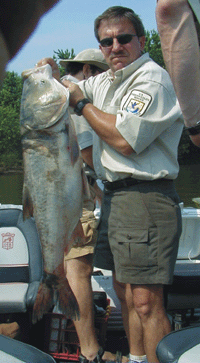
Asian carp, large and voracious fish that are making their way up the Mississippi River system toward the Great Lakes, where they could ruin the fishery, have long vexed those who want to find ways to keep the population in check. Ash-har Quraishi reports for PBS NewsHour that scientists think it's time to call in those who have been hankering for years to help: the area's commercial fishermen. (Photo by Nerissa Michaels, Great Lakes Fishery Commission)

Vic Santucci, the Asian carp specialist for the Illinois Department of Natural Resources, said that while "the ultimate goal is to fish down the populations to prevent ecological damage, there have to be enough Asian carp left to make the business lucrative for commercial fishermen." The important thing, notes Quarishi, is reducing the population to reduce pressure on young carp to get through the electric barrier in the Chicago Sanitary and Ship Canal, the Army Corps of Engineers' last line of defense.

Carp leap after getting electric shock
Philip Willink, a senior research biologist at the John G. Shedd Aquarium in Chicago, said the consensus among scientists is that the barrier works really well but is probably not perfect. That's why you need the fishermen. So far, 10 commercial fishermen have been allowed to fish these backwaters accompanied by state biologists. But big fish don't always translate into big money. Willink explained, "One of the problems with getting people interested in eating Asian carp is they happen to have a lot of bones in some strange places, so they're really hard to filet." Also, carp are not popular in the U.S. but are a staple in most other nations.

Shafer Fisheries in Thompson, Ill., a company that has been looking for ways to process and market the carp to U.S. and foreign markets stepped up offered its already percolating ideas such as carp salami, bologna, jerky and, yes, hot dogs. So sure is Schafer of its enterprise that they launched a proposal two years ago for a processing plant expansion at Wickliffe, Ky., where the Ohio River enters the Mississippi. The plant would use its waste products to make organic farm fertilizer. Tax credits to build the plant received preliminary approval from the Kentucky Economic Development Finance Authority in June. Read the transcript of the NewsHour report here. Listen to the report here.

Tribe divided over tapping their lands' resources

There is great beauty on the Blackfeet Indian Reservation in Montana, writes Jack Healy of The New York Times. "But there is also oil, locked away in the tight shale thousands of feet underground," and tribal leaders of the Blackfeet Nation "have decided to tap their land’s buried wealth. The move has divided the tribe while igniting a debate over the promise and perils of hydraulic fracturing, or fracking, in a place where grizzlies roam into backyards and many residents see the land as something living and sacred. All through the billiard-green mesas leading up to the Rocky Mountains are signs of the boom."(NYT photo by Rich Addicks)

"Oil exploration here began in the 1920s, largely on the plains along the eastern edge of the reservation, but it died off in the early 1980s. Over the last four years, though, new fracking technologies and rising oil prices have lured the drillers back, and farther and farther west, to the mountains that border Glacier National Park," Healy reports. "It is an increasingly common sight for tribes across the West and Plains: Tourist spending has gone slack since the recession hit. American Indian casino revenues are stagnating just as tribal gambling faces new competition from online gambling and waves of new casinos. Oil and fracking are new lifelines. One drilling rig on the Blackfeet reservation generated 49 jobs for tribal members — a substantial feat in a place where unemployment is as high as 70 percent. But as others watched the rigs rise, they wondered whether the tribe was making an irrevocable mistake."

 “These are our mountains,” Cheryl Little Dog, a new member of the Blackfeet Tribal Business Council, the reservation’s governing body, told Healy. Pauline Matt told him, “Ity threatens everything we are as Blackfeet.” But tribal leaders think "Oil wealth could be more lucrative and reliable than any casino," Healy reports. But to find the opposing view, Healy drove just five miles toward the mountains. The divisions are more than disputes over the economy and environment — they represent two visions of the land where Blackfeet members have lived for centuries. It is a division without compromise. (Read more)

Wednesday, August 15, 2012

Delaware, Maryland entice and train young farmers with grants and no-interest loans

Cara and Philip Sylvester, on their farm
in Delaware (State photo)
Two states have recently introduced programs that make it easier for young people to start farming.

In Maryland's Montgomery County, this month County Executive Isiah Leggett announced an initiative that will train young farmers and place them on privately owned land to grow sustainable crops and livestock for five years or more. The Washington Post reports that county officials hope to approve five to 10 participants this winter and prepare them to farm in the spring. Funded by a federal Small Business Administration grant, the New Farmer Pilot Project aims to help build small farms at a time when the county is struggling to preserve farming. (Read more)

In Delware, 10 young farm families and individuals are on their way to owning their dreams with help from an economic development program designed to boost agribusiness in The First State. The farmers from Kent and Sussex counties all received help purchasing land – nearly 900 acres total – from the Delaware Young Farmers Program, marking its first year. The no-interest loan program was launched in July 2011 by Gov. Jack Markell as a way to reduce the capital investment for young people looking to set up agribusiness operations. It was funded through $3 million in the fiscal 2012 budget. (Read more)

Public-private battle in rural Minn. over broadband service is case study in a nationwide struggle

Cable companies weren't interested when the federal government dangled millions of dollars to expand broadband Internet service and boost economic opportunities in Lake County, Minnesota, on Lake Superior (Wikipedia map). But "They didn't want anyone else to build a system, either," report Jim Spencer and Larry Oakes of the Minneapolis Star-Tribune. "That would mean competition in small parts of the county they already serve, even if it would leave thousands of northeastern Minnesota residents and businesses without broadband. So in 2010, when Lake County applied for federal stimulus funds to build a countywide network, it ran straight into a challenge from industry giant Mediacom and the Minnesota Cable Communications Association. The conflict that ensued is part of a national struggle," one that is repeated over and over in communities across the country, perhaps one you know or cover.

"Public officials and some of their constituents argue that rural broadband is like rural electrification: It's a lifeline for small-town America that the free market will not extend. Economics are at the center of the debate, since both sides acknowledge that running broadband exclusively into remote areas won't pay for itself," the reporters write. "Cable and Internet providers argue that government-backed programs should run broadband only into unserved areas, not locations where private providers already operate. They have lobbied extensively to cut broadband initiatives from the federal budget."

In Lake County, the battle grinds on. Mediacom has charged that "county officials illegally inflated statistics, U.S. senators improperly meddled to keep the project alive," and the Rural Utilities Service of the U.S. Department of Agriculture was negligent. "County officials, the senators and the USDA deny those claims, and an inspector general's investigation found them to have no merit. Yet the fight has moved from the rural shores of Lake Superior to a hearing room on Capitol Hill. It shows no signs of ending, even as Lake County begins to run fiber-optic cable." (Read more

Tuesday, August 14, 2012

West's timber industry booming, mainly via exports

The timber industry is making a comeback in Western states, and boosting the economies of rural towns in the process. Demand for timber used in construction plummeted when the housing market crashed in 2009, and it's been slow to recover. But, as Justin Scheck of The Wall Street Journal reports, the "boom-trend" is "part of a West Coast logging rebound" driven mostly by exports.

Overseas wood shipments more than doubled from 2008 to 2011, according to RISI International Wood Markets Group, a timber research group, and U.S. Forest Service data shows log exports increasing by 5.3 percent in the first quarter of 2012, Scheck reports. The increase has reopened some sawmills, raising employment in rural areas and causing "an uptick in local spending and new stores," Scheck reports. (Read more)

Friday, August 10, 2012

Editor: Exciting times in agriculture will need 'new blood and passion' to build rural communities

With populations moving out of rural areas, with some farmers finding it hard to press on against drought, with a lot of other obstacles we name daily, here comes Susan Crowell, editor of the Eastern Corn Belt's Farm and Dairy, to do a bit of cheerleading under the hot August sun. It's just so refreshing, we include a bit of it here, to wrap up the week.

"There’s farm material in carpets, plywood, concrete sealer, the foam in automobiles, industrial coatings, adhesives, lubricants, and, of course, fuel," Crowell writes. "Last year, PepsiCo unveiled a new bottle that was made entirely of plant material (switchgrass, pine bark and corn husks, among other things). In Missouri, they’re even breaking down hog manure into a tarry product that can either be burned to generate electricity, or used as an asphalt binder. That’s right, the road to agriculture’s future is paved with hog manure. . . Not only do we need these new products and new opportunities, but we need that new blood and passion to continue to build our rural communities."

Crowell then quotes Agriculture Secretary Tom Vilsack saying recently, "The greatness of this country, the soul of this country, lives in rural America." Crowell was clearly moved by that. "This year may be a difficult year for many farmers, but these are exciting times in agriculture. I wish I was 21 again." (Read more)

Tuesday, August 7, 2012

Amish one of U.S.'s fastest-growing religious groups

A new Amish community is established about every three and a half weeks in the U.S. and more than 60 percent of all existing Amish communities have been founded since 1990, according to a new census of the Amish population by Ohio State University researchers. They say this suggests that the Amish are growing more rapidly than most other religions in the U.S. The growth can be linked to large families and high baptism rates, while growth in other religions would more likely be linked to conversion. The study restricted its count to "Old Order" Amish and others who limit their use of most modern technologies. (Fotosearch image)

There are now 456 Amish settlements, compared to just 179 in 1990, according to the census, Science Daily reports. If the growth continues at its current rate, there could be more than 1 million Amish people living in more than 1,000 settlements across the U.S. by 2050, which would "bring economic, cultural, social and religious change to the rural areas that attract Amish settlement." Researchers predict Amish will buy land vacated by farmers, but "the availability of farmland might not keep pace with population growth," forcing many Amish men to seek non-farm work, including woodworking and construction, which could increase land prices and enhance local economies.

The Amish should not be confused with Mennonites, who are similar and share common backgrounds, but are more "assimilated into mainstream culture and are more likely to live in urban and suburban settings," according to the Young Center for Anabaptist and Pietist Studies at Elizabethtown College in Pennsylvania, whose senior fellow is Amish scholar and expert Donald Kraybill. The Ohio State census found that Amish live in 29 states, mostly in the Midwest and Great Lakes region, but as far south as Florida and Texas, as far northeast as Maine and as far west as Montana. Ohio contains the most Amish, Pennsylvania is second and Indiana is third. New York has seen the most recent growth in settlements, with 15 founded since 2010. (Read more)

Kansas program forgives student loans for those who move to struggling rural communities

UPDATE, Sept. 4: Julianne Couch wrote a nice feature story for the Daily Yonder about the program.

Click on map to view larger version
Rural areas across the country could learn from Kansas about how to repopulate and revive economically struggling communities. The state started its Rural Opportunity Zones program last year in 50 rural counties: mostly poor, agricultural communities that had lost about 10 percent of their population since 2000. If college graduates move to some of those areas (with stars on map) for at least five years, $15,000 of their student loans are forgiven.

Hillsboro Development Corp. Executive Director Clint Seibel told Benjamin Reeves of International Business Times that rural Kansas needs more young people. "We've done a great job educating our young people in rural America and then we buy them a suitcase and send them to a major university and never see them again," Seibel said. The program draws about one new applicant per day. Almost 75 percent of applicants, aged 25 to 35, meet program requirements, and most are from Kansas, with a large portion coming from Nebraska, Oklahoma and Colorado. But others have come from California, New York and Florida.

Some in the region are opposed to the program, including the Jefferson City, Mo., News Tribune's editorial board, who said the program offers no direct financial incentives and worries it will use tax dollars to supplement loan repayments. It called the program "inequitable and elitist." Reeves reports many local residents in Kansas' Rural Opportunity Zones "resent the encroachment of those they perceive as overeducated outsiders." The opposition has led the state's lawmakers to cut the program's budget by $250,000. (Read more)