Showing posts with label oil. Show all posts

Thursday, October 18, 2012

North Dakota oil boom overloading rural hospital emergency rooms and leaving them with unpaid bills

The Bakken oil boom in western North Dakota -- with its massive equipment and its young, transient oil workers -- is puting tremendous strain on the region’s small hospitals that are finding it hard to shoulder the increasing emergency trauma load and the unpaid bills left behind it. John McChesney reports in the Daily Yonder that if that weren't enough, "Nurse and staff recruitments have become much more difficult due to high housing prices and high competitive wages in the oil patch. And attracting physicians, always a problem for rural areas, has gotten tougher, even as needs soar."

Randall Pederson of Tioga Medical holds
piles of unpaid bills returned from
addresses for people long gone.
(Photo by John McChesney)
Randall Pederson, president and CEO of the 25-bed Tioga Medical Center and a regular ambulance volunteer, says his town has seen a dramatic leap in ambulance runs and emergency room patients this year. “In 2007 we would see 600 patients in ER per year,” Pederson told McChesney. “In 2012, we anticipate seeing over 2,000.” That means in a five-year period, Tioga’s emergency room visits have more than tripled. “We are seeing a lot more industrial accidents, major trauma, many of those involving car accidents, because there’s a lot more vehicles on the roads these days,” Pederson explains. Many accidents involve 40-ton tank trucks colliding with 5,000-pound passenger cars, writes McChesney, "incidents that can bring several patients with horrible injuries into the small ER at the same time. The one doctor on call has to scramble for help."

According to Darrold Bertsch, president of North Dakota’s Rural Health Association, private insurers pay less in North Dakota than in most other states. And many of these ER patients -- many who come from out-of-state for piecemeal work -- don’t pay their bills. Tioga's Pederson in Tioga says his hospital had to write off $270,000 in bad debt. Other area hospitals report similar collection problems. McChesney reports that North Dakota's McKenzie County Hospital will lose more than half a million dollars this year because of patients' unpaid bills. Likewise, Montrail County Medical Center in Stanley, has 25 to 30 percent of revenue written off to bad debt. In Williston, Mercy Hospital’s bad debt has sky rocketed from a pre-oil-boom $2 million a year to $7 million this year, hardly something rural hospitals can endure for long. Mercy's CEO Matt Grimshaw says most of those charges have been billed to people who have jobs and could afford to pay, but he just can’t find them. Could Obamacare help here, with its mandate that everyone have insurance? In this red state, no one wanted to answer that question, McChesney reports. (Read more)

Friday, October 12, 2012

Starting Monday, oil and gas frackers will have to tell EPA where they are doing it

Oil and gas companies will have to notify the Environmental Protection Agency by email before using hydraulic fracturing on wells, a development that has caught many in the industry by surprise.  "The notification requirement is a little-known aspect of air rules for hydraulic fracturing finalized earlier this year by the agency," Mike Soraghan of Environment & Energy News reports. "The hard-fought and better-known aspects of the rule don't kick in until January 2015. But the email notice requirement starts Monday."

The agency and the industry it oversees are already suspicious of one another and this new development has only fed the ill will. "I've heard people say it's the federal government trying to get their hooks into hydraulic fracturing any way they can," said Gifford Briggs, vice president of the Louisiana Oil & Gas Association. Briggs said that his group "went through rulemaking, and it was something everybody missed." Briggs said. Soraghan reports that when he inquired at EPA about the requirement, an agency spokeswoman "sent a fact sheet about the air rules that includes details about the notification requirement. But the fact sheet does not include the date the notification requirement goes into effect. It does, though, include the 2015 implementation date for other provisions of the rules. It states that drillers should include geographic coordinates of the well being fracked."

The industry wants to be allowed to go through only state agencies, the procedure to which it is accustomed. (Read more)

Monday, October 1, 2012

Colorado officials, pressured by local officials, plan to strengthen oil and gas regulation

Driven by local pressure and public opposition, Colorado officials are poised to revise state oil and gas laws, much to the chagrin of industry groups, Bruce Finley of The Denver Post reports. The state has proposed buffer-zone restrictions on new wells and mandatory groundwater testing prior to drilling, but local officials worry those won't do enough to ease communities' concerns.

Colorado Oil and Gas Conservation Commission director Matt Lepore, left, said he will ask commissioners to launch a new rule-making session to revise the rules last set in 2008. "We want to get it right, as best as we can, for as many people as we can," Lepore said. Colorado Oil and Gas Association attorney Andrew Casper said the group has identified "numerous concerns" with the proposed revisions and a new rule-making session. Homebuilders have also voiced concerns about bigger buffer zones, which could complicate urban planning.

Local and state lawmakers said their communities are complaining regularly about fracking. Democratic Rep. Su Ryden of Aurora said most of her constituents "want drilling as far away as possible." Colorado Conservation Voters director Pete Maysmith said during an invite-only community discussion with Gov. John Hickenlooper that "neighborhoods and fracking don't mix." Maysmith's group gave the governor a petition with 14,500 signatures from residents in Adams and Pueblo counties asking for their communities to be shielded from drilling. (Read more)

Friday, September 21, 2012

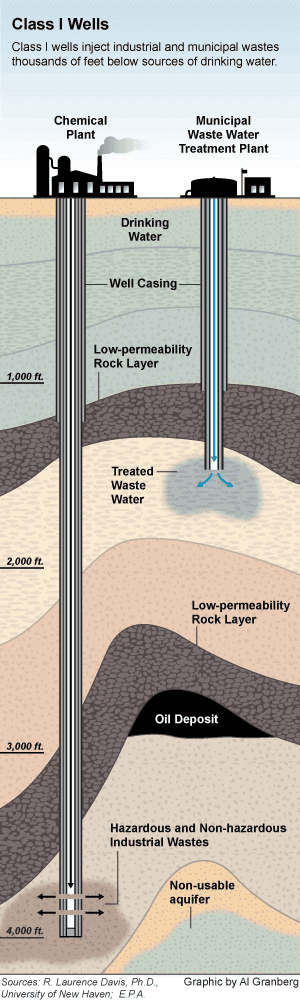
Lax rules for disposal of drilling waste lead to injection of other toxic materials into the earth

One of the trucks, after it was enveloped by
flames fed by fumes from injection-well waste.
(Chemical Safety Board photo)
In January 2003, two tanker trucks exploded, killing three workers after fumes from what was supposed to be waste saltwater from injection wells ignited and burned in Rosharon, Tex. What the workers were really unloading, to be buried deep inside the earth, were thousands of gallons of volatile materials, including benzene and other flammable hydrocarbons. "What happened that day at Rosharon," explains ProPublica reporter Abrahm Lustgarten, "was the result of a significant breakdown in the nation’s efforts to regulate the handling of toxic waste."

"The site at Rosharon is what is known as a 'Class 2' well," Lustgarten writes. "Such wells are subject to looser rules and less scrutiny than others designed for hazardous materials. Had the chemicals the workers were disposing of that day come from a factory or a refinery, it would have been illegal to pour them into that well. But regulatory concessions won by the energy industry over the last three decades made it legal to dump similar substances into the Rosharon site -- as long as they came from drilling. Injection wells have proliferated over the last 60 years, in large part because they are the cheapest, most expedient way to manage hundreds of billions of gallons of industrial waste generated in the U.S. each year.''

ProPublica has analyzed records summarizing more than 220,000 well inspections conducted between late 2007 and late 2010, including more than 194,000 for Class 2 wells. This most recent installment of by the independent, nonprofit news agency on U.S. injection wells had reporters examining federal audits of state oversight programs, interviewing dozens of experts and exploring court documents, case files, and the evolution of underground disposal law over the past 30 years. The report is exhaustive and includes several links showing that fundamental safeguards are sometimes being ignored or circumvented by use of the Class 2 rules. (Read more) For a state-by-state count of unauthorized, overpressurized and leaking injection wells, go here.

Thursday, September 13, 2012

Few state oil and gas agencies seek help from experts who review programs, suggest changes

There exists a team of oil and gas regulators, industry officials and environmental advocates who offer comprehensive reviews of state oil and gas oversight programs and make recommendations for improvement. It's called State Review of Oil and Natural Gas Environmental Regulations, but states aren't volunteering their oversight programs for evaluation. It's a predicament for STRONGER, Ellen Gilmer of Energy and Environment News reports.

State oil and gas regulatory officials are feeling pressure from the public and environmentalists to increase regulations on the booming industry, but Gilmer reports agency leaders are leery of STRONGER and the services it provides. They either don't have resources for it, or they fear increased public backlash. STRONGER's latest review was in 2007 in Tennessee. It did evaluate North Carolina's Department of Environmental and Natural Resources this year, but the state doesn't yet have any actual oil or gas wells.

The group has been evaluating hydraulic fracturing in Colorado, Arkansas, Oklahoma, Louisiana, Ohio and Pennsylvania since 2010, but "It's unclear which states will come next or whether checked-off states' evolving regulations merit further review," Gilmer writes. Mississippi officials have never asked for a review. Kansas officials seemed interested, but haven't asked. Gilmer reports that Texas could be a candidate, but officials there are writing new rules that will likely have to be finished before a review is requested. (Read more) Many state oil and gas agencies are dominates by people from the industries they regulate.

Wednesday, September 12, 2012

Water pollution from oil and gas drilling can be expected in karst regions, federal expert says

More and more drilling applications have been filed during the natural-gas boom for karst regions, with "a type of geology made of rocks that dissolve in mildly acidic water over time," and and oil and gas wells do fail over time in karst regions, which provide easy geologic pathways for pollution, says James Goodbar, head of the Bureau of Land Management's caves and karst resources program, reports Gayathri Valdyanathan of Energy and Environment News.

Scientists worry that contamination will increase if drilling increases in these regions. If drilling is properly done, with the correct amount of steel and cement casings, not much casing is needed in most geologic structures. But when well bores intersect with caves, drilling can pose greater risks. The cement and metal can corrode and leak over time because it's not surrounded by rock. "Threats to the springs and the wildlife that depend on them may be significant," Valdyanathan reports.

The BLM updated requirements for karst drilling in 2006, requiring at least three layers of high-grade steel and cementing, and plugging from the lowest karst zone when abandoning a well. But those standards aren't applicable on non-federal karst lands, or on older wells. (Read more)

Tuesday, September 4, 2012

Drought's short-term impact on food prices pales in comparison to global, long-term factors

The massive drought that hindered much of the Midwest's food production caused food prices to rise this summer, and they will probably rise more, but Science Daily reports much broader factors will have a longer and heavier impact on rising food costs than any U.S. drought.

Food marketing professor John Stanton told Science Daily that price increases from drought are short-term, while increasing demand from the rest of the world for crops including corn will affect prices for years. "The biggest cost in a box of corn flakes isn't the corn," Stanton says. "It's everything from the price of oil to transport the product to the marketing and the packaging. So something like the cost of oil will have a much more lasting effect on the price of your cereal than the supply of crops." (Read more)

Seminar on covering oil and gas drilling, with a field trip, set Sept. 27 in Youngstown, Ohio

Many rural areas are seeing a boom in drilling for oil and natural gas, which are more complex and perhaps more risky enterprises than ever before. To make sure journalists know enough to cover the subject, a half-day seminar will be held Sept. 27 at Youngstown State University in Ohio to "explain everything there is to know about the subject," say the sponsors: the Ohio Newspaper Association and the local newspaper, The Vindicator.

The program will include how horizontal hydraulic fracturing works, the economic impact of drilling, the environmental debate over drilling, and much more. After the program there will be an optional tour of drilling facilities. We recommend you do the whole day, including the field trip. You won't learn everything there is to know, but you don't have to. The cost to attend is a very reasonable $30, which includes lunch. For more information and registration, click here.

Friday, August 24, 2012

Romney would give states control over drilling on federal land, provide less support for renewable energy

Romney talks energy in Hobbs, N.M.
(NYT photo by Jim Wilson)

Mitt Romney proposed an end to a century of federal control over oil and gas drilling and coal mining on government land Thursday, in an energy plan that also calls for less support for renewable energy.

"The federal government owns about 28 percent of the 2.27 billion acres of land in the United States. But as of March 2012, only about 37 million acres were under lease for oil and gas operations, of which about 16.3 million acres have active oil and gas production or exploration, according to the Interior Department," Eric Lipton and Clifford Krauss of The New York Times write. "Under President Obama, officials in Washington have played a bigger role in drilling and mining decisions on federal lands in the states, and such involvement rankles many residents and energy executives, who prefer the usually lighter touch of local officials."

"The Romney campaign acknowledged that such a significant policy change would require the approval of Congress, the Times reports. "Getting such legislation passed, even if Republicans controlled the House and the Senate, would be very difficult, given certain opposition by Democrats and perhaps even some Republicans."  (Read more)

The National Journal reported month that some farmers are uneasy with the GOP ticket’s "opposition to renewable-energy policies that have helped them economically." Romney opposes a wind-energy tax credit "that has helped farmers bring in thousands of dollars in extra income by leasing their land to wind producers." His running mate, Rep. Paul Ryan, R-Wis., opposes the mandate for a certain amount of ethanol production, which has driven up demand — and probably prices — for corn. "Romney stands by his support of the ethanol mandate," but "Ryan’s record of full-throated opposition to it rubs corn and crop farmers the wrong way," Coral Davenport writes. "In addition, Ryan’s budget roadmap proposes deep cuts in renewable-energy and nutrition programs that help farmers." (Read more)

Monday, August 20, 2012

Unlike Keystone XL, rival pipeline that traverses U.S. heartland avoids similar scrutiny

A major rival to the controversial Keystone XL oil pipeline project is vastly boosting its U.S. pipeline system, and avoiding the scrutiny that federal regulators, environmentalists and landowners are giving Keystone owner TransCanada Corp. Rather than building a single new pipeline, Enbridge Inc., also based in Canada, is replacing smaller, existing pipelines with bigger pipes, adding pumping capacity and installing new supply lines alongside existing ones. They are proceeding largely unencumbered, report Matt Pearce and Neela Banjeree of the Los Angeles Times, with plans to spend $8.8 billion to transport greater volumes of petroleum to the Gulf Coast. (LAT map)

"The company already has permits from the initial construction years ago and . . . the physical work will take place in the United States," so it doesn't need new permits, the reporters write. "The task of determining the safety or wisdom of Enbridge pipeline routes falls on a patchwork of local, county and state jurisdictions through the Midwest and East, most of which lack intensive pipeline expertise."

Enbridge's recent spills raise questions about its safety record. The company was recently fined $3.7 million for a Marshall, Mich., spill that dumped 20,082 barrels of oil in the Kalamazoo River in 2010, the biggest penalty ever from the nation's pipeline authority, the Pipeline and Hazardous Materials Safety Administration of the U.S. Department of Transportation. (Read more)

Friday, August 17, 2012

Tribe divided over tapping their lands' resources

There is great beauty on the Blackfeet Indian Reservation in Montana, writes Jack Healy of The New York Times. "But there is also oil, locked away in the tight shale thousands of feet underground," and tribal leaders of the Blackfeet Nation "have decided to tap their land’s buried wealth. The move has divided the tribe while igniting a debate over the promise and perils of hydraulic fracturing, or fracking, in a place where grizzlies roam into backyards and many residents see the land as something living and sacred. All through the billiard-green mesas leading up to the Rocky Mountains are signs of the boom."(NYT photo by Rich Addicks)

"Oil exploration here began in the 1920s, largely on the plains along the eastern edge of the reservation, but it died off in the early 1980s. Over the last four years, though, new fracking technologies and rising oil prices have lured the drillers back, and farther and farther west, to the mountains that border Glacier National Park," Healy reports. "It is an increasingly common sight for tribes across the West and Plains: Tourist spending has gone slack since the recession hit. American Indian casino revenues are stagnating just as tribal gambling faces new competition from online gambling and waves of new casinos. Oil and fracking are new lifelines. One drilling rig on the Blackfeet reservation generated 49 jobs for tribal members — a substantial feat in a place where unemployment is as high as 70 percent. But as others watched the rigs rise, they wondered whether the tribe was making an irrevocable mistake."

 “These are our mountains,” Cheryl Little Dog, a new member of the Blackfeet Tribal Business Council, the reservation’s governing body, told Healy. Pauline Matt told him, “Ity threatens everything we are as Blackfeet.” But tribal leaders think "Oil wealth could be more lucrative and reliable than any casino," Healy reports. But to find the opposing view, Healy drove just five miles toward the mountains. The divisions are more than disputes over the economy and environment — they represent two visions of the land where Blackfeet members have lived for centuries. It is a division without compromise. (Read more)

Wednesday, August 15, 2012

Small towns watch as lower Mississippi's heavy traffic is slowed by near-historic low water levels

A year after near-historic flooding affected some of America's legendary small towns, water levels on the lower Mississippi River are at near-historic lows. In July, water levels in Vicksburg, Miss., Memphis, Tenn., and Cairo, Ill. (at the confluence with the Ohio), dipped below those of the historic drought of 1988. That’s affecting everything from recreation to commerce on the maritime superhighway to rthe drinking water in Louisiana. The biggest impact, reports NBC News, may be on shipping. “It’s getting near critical,” said Austin Golding, a third-generation co-owner of Vicksburg-based Golding Barge Lines. “Without more rain, we’re heading into uncharted territory.” (Associated Press photo, near Vicksburg Aug. 6)

Barges on the lower river carry about $180 billion worth of goods and 500 million tons of the basic ingredients for much of the U.S. economy, according to the American Waterways Operators, a trade group. The river carries 60 percent of the nation’s grain, 22 percent of the oil and gas and 20 percent of the coal, according to the trade organization. The low water levels force barge companies to lighten their load by about 25 percent so barges ride higher in the water. In some places, the Mississippi is a one-way river, as barges heading north have to wait for traffic headed south, adding to the costly delays. The result: Millions of dollars in higher shipping costs, ultimately paid by consumers. (Read more)

Friday, August 10, 2012

Study: Injection of fracking's waste near faultlines, not drilling, is responsible for quakes

A new study has found that deep injection of oil and gas wastewater appears to be causing more earthquakes than previously thought. Cliff Frohlich, a senior research scientist at the University of Texas' Institute for Geophysics, said that his findings should be taken seriously by drillers especially as the practice spreads to more densely populated areas. His work, reports Mike Soraghan of EnergyWire, was done around the Barnett Shale around Dallas to measure small earthquakes taking place near injection wells. His peer-reviewed study was published in the Proceedings of the National Academy of Sciences.

Soraghan explains that "Frohlich did not find any suggestion that the earthquakes were caused by hydraulic fracturing, or fracking. But fracturing creates millions of gallons of briny, toxic wastewater that drillers must eventually dispose of, usually by injecting it into the type of injection wells Frohlich was studying. That suggests, he said, that earthquakes occur only if there is a fault nearby that is susceptible to being triggered by high volumes of fluid." This suggested to Frolich that drillers could stop the earthquakes by choosing an alternate site to dispose of their wastewater. (Read more)

Wednesday, August 8, 2012

Two seemingly like-minded Nebraskans square off over threat of Keystone XL to water supply

A dispute has erupted in Nebraska between two previous allies -- environmentally outspoken and traditional Democratic activist Jane Kleeb and water expert and all-around green guy James Goecke. The public fight is over Keystone XL, the already much disputed 1,700-mile steel pipeline that would carry heavy, low-quality crude from Canada’s oil sands to refineries in Texas. At issue, writes Washington Post reporter Steven Mufson, is whether the pipeline would pose a threat to the massive Ogallala Aquifer, one of the world’s largest underground sources of fresh water which sits firmly under Nebraska and likely holds enough water to cover the country’s 48 contiguous states two feet deep.

TransCanada, the pipeline's owner, plans to bury the pipeline at least four feet underground, and in many places could be putting it in the aquifer. Kleeb says that if the pipeline should spring a leak where it touches the aquifer or even above it, oil could quickly seep into and through the porous, sandy soil, contaminating the aquifer. Goecke disputes that. A hydrogeologist and professor emeritus at the University of Nebraska, Goecke has been measuring water tables in Nebraska’s ecologically sensitive Sand Hills region since 1970. He says opposition to the pipeline is driven by misunderstanding of how the aquifer works. “I’ve spent my career drilling holes to and through the Ogallala Formation. I’ve probably seen as much of the Ogallala as anybody,” he says in a TV commercial for TransCanada. “There’s a misconception that if the aquifer is contaminated, the entire water supply of Nebraska is going to be endangered, and that’s absolutely false. If people recognize the science of the situation, I think that should allay a lot of the fears.” (Read more)

Monday, July 30, 2012

Regional network suggests Appalachian coal states put some severance tax dollars into endowments

A coalition of citizens' groups in Central Appalachia is recommending that Eastern coal states follow the example of their Western counterparts and put part of their severance-tax revenue into endowments that would permanently provide earnings to help their regional economies. Seven states in the West "use severance taxes to create permanent trust funds that can help state economies in the future," reports Paul J. Nyden for the Sunday Gazette-Mail in Charleston, W.Va. "Many of those funds add up to billions of dollars."

A study by the Central Appalachia Regional Network notes that severance taxes represent a significant portion of state government income in two Central Appalachian states: nearly 9 percent of state revenues in West Virginia and 3.3 percent in Kentucky. In four other states covered by the group -- Maryland, Ohio, Tennessee and Virginia -- severance taxes generate less than one-tenth of 1 percent of the states' total revenues.

CARN, a diverse group of regional organizations assembled and funded by the W.K Kellogg Foundation, proposed that a minimum of 1 percent of all severance taxes be placed into permanent endowments in each state. "This would not only help these states meet many of their economic challenges but ensure that future generations benefit from the mineral wealth that is in their communities," said Ted Boettner, executive director of the West Virginia Center on Budget and Policy. The CARN study is available here.

The Kentucky-based Mountain Association for Community Economic Development, which is not part of CARN, earlier this year suggested a similar plan financed by an increase in the severance tax. If Kentucky raised the tax to 5.5 percent from 4.5 percent, it could create more than $700 million in a fund by 2035, MACED said.

Thursday, July 26, 2012

How many oil and gas inspectors per well does your state have? it may be hard to tell

The protection of property and the environment from damage by oil and gas operations depends greatly on the strength and attitude of state regulatory agencies, but their relative strength in personnel terms can be hard to calculate, Ellen Gilmer of Environment & Energy News reports.

"A recent overview of state shale gas regulations showcases major gaps in data available to compare, state by state, the force of oil and gas agencies," Gillmer writes. "Oklahoma, for one, doesn't know how many producing wells it has. . . . This lack of data comes at a time when understanding the workload of state inspectors has become crucial as states grapple with booming shale development and often shriveling budgets."

The analysis by the environmental think tank Resources for the Future uses maps to illustrate state  regulation. We reported on it here.

Saturday, July 14, 2012

Society of Environmental Journalists awards honor work on fracking, agriculture issues, many others

Reporting on hydraulic fracturing of deep shale for natural gas earned several reporters recognition in the 2012 Environmental Journalism Awards competition of the Society of Environmental Journalists. Other rural-oriented winners reported on other extractive industries, pesticide drift and patented seeds.

Photo: Barron Ludlum, Record-Chronicle
Ten reporters at the Denton Record-Chronicle in Texas won the Kevin Carmody Award for in-depth reporting in a small market  for “Citizens of the Shale,” a series that helped prompt the Texas legislature to requiring public disclosure of fracking chemicals and water use.

Mike Soraghan of Energy & Environment News won third place in outstanding beat reporting in a large market for his stories in Greenwire and The New York Times on the shale drilling boom. The entries were "Baffled About Fracking? You’re Not Alone;" "Big Mac Is King in N.D. Energy Boom, but Other Businesses Struggle to Keep Up;" In Fish-Kill Mystery, EPA Scientist Points at Shale Drilling;" "Earthquakes Erode Support for Drilling, but They're Nothing New;" and What EPA Really Said About Wyo. Fracking Pollution."

Second place in the small-market category went to Shauna Stephenson of the Wyoming Tribune Eagle for reporting on the Niobrara oil play; third place went to Clare Howard of 100 Reporters for "Downwind: Big ag at your door," about pesticide drift.

First prize for outstanding beat reporting in a small market went to Matthew S. Frank of the Missoula Independent and High Country News; second place went to Sandra Hausman of WVTF, the public radio station at Virginia Tech, for a wide range of stories, including one on fracking. The Columbia Journalism Review's Curtis Brainard won third place for a series titled "Environmental Journalism Under Fire." For links to those entries, click here.

In feature reporting, Paul Salopek won third place for “Closed-Source Crops” in Conservation magazine, which the judges called "a frightening and thought-provoking story that explores how multinational corporations have become the equivalent of the 'new seed oligarchy' in the agricultural world and how their practices and controls threaten biodiversity and food security." This category was won by Meera Subramanian for “India’s Vanishing Vultures” in the Virginia Quarterly Review. It "tells the story of an important but little-known ecological event, the sudden and rapid collapse of vulture populations in India in recent years." The story is here.

Thursday, July 12, 2012

Oil and gas regulations very different from state to state; new report lays out the details

Natural gas is still booming in several areas of the country, inciting heated debate about the practice of hydraulic fracturing and the safety of groundwater in communities where gas is extracted. A new report shows that regulations placed on this industry vary widely from state to state. Some findings in the report: Drillers in Texas can dump oil and gas wastewater into unlined pits, while California bans such pits and requires the fluid to be stored in tanks. Ohio has no statewide requirement to report accidents and spills, and New Mexico has the fewest inspectors per well.
Researchers from Resources for the Future, an environmental think tank, looked at regulations in gas-producing states and created maps like the one above "showing the different state policies on issues like wastewater, enforcement and well construction standards," Energy & Environment News reports. To see all the maps, click here.

The researchers are trying to determine whether the differences are based on factors including geology and population density or institutional factors, such as the makeup of governments. "The effort could introduce more facts to a long-standing argument over the effectiveness of state regulation of oil and gas," E&E News reports. While environmental groups want drillers regulated by federal law, "The oil and gas industry prefers dealing with individual states rather than the federal Environmental Protection Agency," because state agencies aren't charged with "exclusively protecting human health and the environment."

"State laws order most of them to balance regulation with promoting oil and gas development, and they frequently have close ties to the local industry," E&E News reports. A Greenwire review last year found that more than 40 percent of state oil and gas officials come from the oil and gas industry. E&E News reports state agencies were created at a time when environmental protection wasn't a priority, and their main goal was to control production and protect oil from water. (Access to E&E News requires a subscription)

Friday, June 22, 2012

Once assumed safe, chemical waste is leaking from injection wells and sometimes polluting aquifers

Over the past few decades, U.S. industries have injected more than 30 trillion gallons of toxic liquid deep into the earth, using broad expanses of the nation's geology as an invisible dumping ground, writes Abrahm Lustgarten, who won awards for his reporting on the fracking industry, which disposes vast amounts of drilling wastewater in such wells.

"No company would be allowed to pour such dangerous chemicals into the rivers or onto the soil," Lustgarten writes. "But until recently, scientists and environmental officials have assumed that deep layers of rock beneath the earth would safely entomb the waste for millennia. There are growing signs they were mistaken. Records from disparate corners of the United States show that wells drilled to bury this waste deep beneath the ground have repeatedly leaked, sending dangerous chemicals and waste gurgling to the surface or, on occasion, seeping into shallow aquifers that store a significant portion of the nation's drinking water." Recent examples include contaminants from oil and gas drilling wells bubbling up, fountain-like, in Oklahoma and Louisiana, as well as in a dog park in Los Angeles.

Thus begins a fascinating and exhaustive piece by Lustgarten that covers "the more than 680,000 underground waste and injection wells nationwide, more than 150,000 of which shoot industrial fluids thousands of feet below the surface. Scientists and federal regulators acknowledge they do not know how many of the sites are leaking. Federal officials and many geologists insist that the risks posed by all this dumping are minimal. Accidents are uncommon, they say, and groundwater reserves — from which most Americans get their drinking water — remain safe and far exceed any plausible threat posed by injecting toxic chemicals into the ground. But in interviews, several key experts acknowledged that the idea that injection is safe rests on science that has not kept pace with reality, and on oversight that doesn't always work."

"In 10 to 100 years we are going to find out that most of our groundwater is polluted," said Mario Salazar, an engineer who worked for 25 years as a technical expert with the Environmental Protection Agency's underground injection program. "A lot of people are going to get sick, and a lot of people may die." The boom in oil and natural gas drilling is only making matters worse, geologists say. (Read more.)

Monday, June 18, 2012

New York landowners win right to negotiate pre-fracking oil and gas leases with Chesapeake Energy

More than 4,400 landowners in New York have won the right to seek more favorable oil and natural gas leases, after the state attorney general and a subsidiary of Oklahoma-based Chesapeake Energy Corp. came to terms last week.

"The leases, which were signed in the mid-1990s to the early 2000s, were prior to the proliferation of high-volume hydrofracking, a much-debated gas-drilling process that made formations such as the Marcellus Shale profitable. As such, the terms of the contracts are generally well under current market value," reports Jon Campbell of the Democrat & Chronicle in Rochester.

“Make no mistake about it," said Attorney General Eric T. Schneiderman, "this agreement will provide a safety net for thousands of landowners by allowing them the opportunity to negotiate fairer lease terms, both financial and environmental, regardless of their existing contracts. For landowners across the state, this deal literally will provide a new lease on life.”

"The leases had been subject to a force majeure claim from Chesapeake Appalachia LLC, which had tried to extend their terms amid an ongoing environmental review of natural-gas development in New York," notes Jay F. Marks of The Oklahoman. "Such claims typically involve uncontrollable circumstances such as natural disasters."

The agreement covers leases that have expired or would have expired before Dec. 31, 2013. Landowners will be able to negotiate leases with other energy companies, but Chesapeake retains the right to match those terms. Chesapeake admitted no wrongdoing, but the company will pay $250,000 to reimburse the state for its investigation of landowners' complaints. (Read more.)