Showing posts with label drought. Show all posts

Thursday, October 18, 2012

Crop insurance payouts likely to hit $15 billion; drought news gets only slightly better

The long, dry, hot summer will cost U.S. taxpayers big -- a record $15 billion. That is the amount that the Farm Bill's privately run crop-insurance program will pay to farmers affected by this year's losses. The program's runaway costs are in focus as Congress looks for ways to cut government spending, making crop insurance an even bigger target for reforms than it already might have been. Lawmakers return to Washington next month. (Read more)

As for the drought itself, there was some relief, at last, from one coast to another as storm systems pushed through some very dry parts of the nation this week. Still, 62.4 percent of the nation is still experiencing "moderate" drought, down from 63.5 percent a week earlier, according to Thursday's Drought Monitor, a weekly compilation of data gathered by federal and academic scientists. Reuters is reporting that "the portion of the United States under 'exceptional' drought' -- the direst classification -- fell to 5.8 percent, from 6.2 percent a week earlier." The worst news is still reserved for the High Plains -- some parts of Kansas, Nebraska and the Dakotas -- where drought classified as "severe" or worse covered more than 87 percent of the region. (Read more)

Wednesday, October 17, 2012

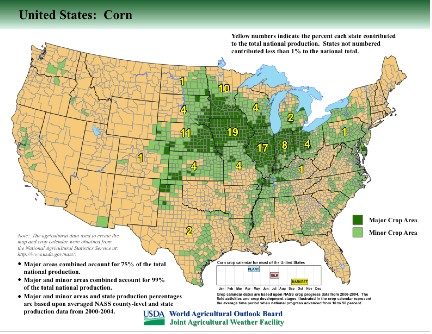
Climate change is moving U.S. corn production north

The Corn Belt is moving north, proving to food producers across the country that this summer's drought was not a fluke. The most corn since 1937 was planted this year, but growers in Kansas planted the fewest in three years, turning instead to crops that are less water-intensive, including wheat and sorghum. But in Manitoba, corn acreage has almost doubled over the past decade.
(Click on map for larger version)
This shift is "a glimpse of a future altered by climate change that will affect worldwide production," the Sydney Morning Herald of Australia reports. Changes are happening faster than plants can adapt, said Axel Schmidt, a former International Center for Tropical Agriculture scientist.

Agriculture businesses are adapting. Agribusiness Cargill Inc. is investing more in northern facilities in anticipation of increased production there. DuPont Co. is developing genetically modified corn seed that could withstand drought, and boosting research in sorghum and other crops.

U.S. corn was worth $76.5 billion last year, more than twice the value of soybeans and five times that of wheat. Most ethanol comes from corn, most livestock eats it, and high-fructose corn syrup is used in a mass array of products. While climate change will likely move its production north, the Midwest will probably remain the corn belt just because of its good soil and generally favorable weather, Illinois' Heritage Grain Cooperative manager Jerry Rowe told the Herald. (Read more)

Tuesday, October 16, 2012

Restaurants hit with higher food prices caused by drought; small, local eateries struggle most

This summer's oppressive drought scorched Midwestern crops, raising the cost of feed, dairy and meat. Those high prices are impacting the size of restaurant menus across the U.S., with small, local eateries feeling the pinch the most. The cost of food now rivals labor as the top expense for most restaurants, Tiffany Hsu of the Los Angeles Times reports. Owners are reducing menu offerings, shrinking portion sizes and considering staff cuts. (L.A. Times photo by Francine Orr: patrons eat at Smokin' Jonny's BBQ in Gardena, Calif.)

Restaurant prices have been rising for more than a year, with wholesale food costs increasing by 8.1 percent in 2011, Hsu reports. The increases will continue, but at a quicker pace, because the price of corn, which is a key component in livestock feed, powdered sugar, salad dressing, and more, jumped by 60 percent this summer. Chicken and turkey prices rose by 5.3 and 6.9 percent, respectively, and eggs now cost 18 percent more. Analysts expect overall food prices to rise from between 5 to 20 percent by year's end.

Big chains are able to weather drought price hikes well, but small restaurants will suffer, Hsu reports. "The smaller mom-and-pop restaurants are going to get hit with the drought very shortly," Motley Fool analyst Don Krueger told Hsu. It's forcing small restaurant owners to make tough decisions. Restaurant consultant Kian Abedini told Hsu more restaurants are using small plates and tapas dishes to save money. He's also noticed cheaper cuts of meat on menus, along with more curry and rice dishes. Pickled items are showing up as well because they're less expensive than fresh foods, Abedini said.(Read more)

Monday, October 15, 2012

Farmers more likely to be depressed amid harvest

There is an increased risk of depression among farmers during harvest season, and one doctor who treats a lot of them says it's important for them to take breaks to reduce stress, Julie Harker of Brownfield Agriculture News reports. Weather and other harvest-time pressures can increase farmers' stress, which can lead to increased risk of accidents and more, Harker heard from Dr. David Schwarts of Waukon, Iowa.

Schwartz said there is an increased risk of depression during this time of year, but many farmers don't seek help because they tend to think they are "tougher than that," he told Harker. Schwartz said he's seen an increase in cases of depression at his clinic this year because of the drought. He said family physicians can treat depression, but often farmers can reduce stress by "taking time out for enjoyable activities," Harker reports. (Read more) To listen to Harker's interview with Schwartz, click here.

Thursday, October 11, 2012

California poultry company files for bankruptcy; will be eighth poultry firm to fold in the last year

Zacky Farms LLC, a California poultry company that dates to the 1920s, filed for bankruptcy this week. High feed costs following this summer's oppressive drought led to the decision, P.J. Huffstutter of Reuters reports. The company employs about 1,500 people in southern California, and listed between $50 and $100 million in assets, with debts in the same range.

The bankruptcy filing showed that the company's largest unsecured creditors are feed company Western Milling, to whom Zacky Farms owes about $6.6 million, and poultry company Foster Farms LLC, which is owed about $1.2 million. "Zacky Farms will be the eighth poultry firm to be sold, entered into Chapter 11 bankruptcy or shut down altogether since 2011, according to data from trade group National Chicken Council," Huffstutter reports. (Read more)

Huffstutter advises in an email that Zacky's is ranks about among poultry companies in revenue, and about 10th among turkey packers.

Tuesday, October 9, 2012

Drought lowers Great Lakes levels, stifles shipping

The severe drought in the Midwest has lowered levels in the Mississippi River and in Lakes Michigan and Huron, stifling the shipping industry that depends on them. According to the Army Corps of Engineers, the lakes are down almost a foot from last year, and in the next few months could break a record low set in 1964. (Associated Press photo: Freighter passes port re-opened after dredging)

Water levels near ports on the lakes determine how much coal, iron, grain and other cargo can be shipped, Joe Barrett and Caroline Porter of The Wall Street Journal report. "This is very much an industry where inches count," Lake Carriers' Association Vice President Glen Nekvasil said. He told Barrett and Porter that lower lake levels means ships are carrying about 1,200 to 1,500 fewer tons per load, a loss that is very hard to recover.

Low water also highlights the need for more dredging of ports to keep them clear of sediment, the reporters write. The Corps of Engineers has identified at least $200 million worth of dredging needs in the lakes' channels and harbors. (Read more)

Friday, October 5, 2012

Drought has produced mixed pumpkin harvest; fewer, but some that made it are big and pretty

This year’s devastating drought has reduced the number of pumpkins in many Ohio patches, but some say the summer’s abundant heat and sunshine has also produced some particularly big and rather good looking specimens. Mary Vanac of The Columbus Dispatch reports the good news that pumpkins actually like it hot. “Overall, there should be a good-size, quality harvest,” said Lisa Schacht, co-owner of Schacht Family Farm and Market in Canal Winchester and president of the Ohio Produce Growers and Marketers Association. (Columbus Dispatch photo by Jonathan Quilter)

Those who are wondering about how Thanksgiving dinner is going to be affected may have to wait a little longer, however. Roz O'Hearn, spokeswoman for Nestle USA, maker of the famous Libby-brand pumpkin that makes the famous Libby pumpkin pie, said it was too early to tell if the supply or price of canned pumpkin is at risk. “Our harvest is under way now,” O’Hearn told Vanac. “The many thousands of acres of pumpkin we grow are located right in the midst of the drought-stricken area, 50 miles out in any direction from Morton, Ill., where we pack the pumpkins we pick.” Libby’s did not irrigate its pumpkin fields, she said, so yields will be down this year. Ohio's pumpkin crop represented more than 10 percent of the U.S. pumpkin crop last year.

Monday, October 1, 2012

Pork producers struggle through drought, sending more young female hogs than ever to slaughter

More female hogs than ever are being sent to slaughter because producers can't afford high feed prices caused by this summer's oppressive drought. Sows are building blocks of herds, so slaughtering them not only shrinks herds but expands the pork supply, sending prices plummeting, P.J. Huffstutter and Theopolis Waters of Reuters report. Producers are left to either use savings to survive, or sell herds and leave the business. (Photo by John Gress)

Just under 10 million head of hogs were sent to slaughter in August, the most ever for that month, according to data analyzed by Reuters. But, the U.S. Department of Agriculture in its quarterly inventory of hogs and pigs on Friday said the number increased slightly through Sept. 1. There were 67.5 million head, up 3 percent from June 1.

Still, large producers are "scouring the Midwest to snap up whatever feed they can find, or are sinking tens of millions of dollars into importing [feed] from Brazil," Huffstutter and Theopolis report.

Monday, September 24, 2012

Water-conservation PSAs do a drip-drip-drip on Internet as drought recovery slowly begins

This summer's massive drought has infiltrated the national consciousness and now resonates within our video culture. YouTube has become inundated with public-service announcements about water conservation, Felicity Barringer of The New York Times reports. Making a video seems to be "the school project du jour," she writes, but others stand out.

"Often, contributions to the art form show someone cavalierly overusing water in the sink or shower and are supplemented by statistics about the amount of water wasted every year. One variant features water wardens — like the 'Saturday Night Live' comedians Horatio Sanz and Rachel Dratch — dropping in on the bathrooms and kitchens of unsuspecting water spendthrifts," Barringer reports. There is one featuring toddlers from France, and another from Malaysia. Some use music; "Sesame Street" characters assist on others.

This following comes from the University of North Carolina, Greensboro:


Here's another from Kennesaw State University in Georgia:

Tuesday, September 18, 2012

Seed companies develop drought-resistant corn

This summer's ravaging drought destroyed corn crops across the Midwest and Great Plains, creating a slew of problems for farmers, consumers and livestock producers. Agriculture biotechnology companies have been pouring millions into drought-resistant genetically modified corn seeds that can withstand an extended dry period. (Los Angeles Times photo by Ricardo Lopez: Researcher examines drought-resistant corn)

Monsanto recently got approval for its DroughtGard seed corn, and other seed makers, including Pioneer Hi-Bred International Inc. and Syngenta, have  begun selling drought-tolerant but conventionally bred corn varieties. Companies are also trying to develop drought-resistant soybean, cotton and wheat strains that can "thrive in a world that's getting hotter and drier," reports Richard Lopez of the Los Angeles Times.

The majority of seed corn is already genetically modified to repel pests and create higher yields, and there are public concerns arising about the "unforeseen consequences of this genetic tinkering," Lopez reports. But researchers say creating drought-tolerant or resistant seeds is a priority, especially in the wake of this year's oppressive and costly drought. "We don't need to stigmatize these approaches," Kent Bradford, head of the Seed Biotechnology Center at the University of California, Davis.  (Read more)

Monday, September 17, 2012

Drought is likely to cost consumers next year

The massive drought that hit many U.S. farmers hard this summer will be felt by consumers next year in the form of higher food prices, according to The Food Institute. A family of four will likely spend $351.12 more on food in 2013, about $6.75 a week. The data was gathered by calculating the actual financial effect of the drought, which reduced corn yields, causing feed prices to rise, making livestock producers unable to afford it.

The increase will be felt most at meat counters, Lisa Keefe of Meatingplace reports. Annual costs of meat will rise about $44 next year for a family of four and about $30 for a two-person home. Beef costs would account for almost one-third of those estimates. Fresh produce will be the next most expensive, adding about $23.44 to a family's annual grocery spending. "These spending predictions could vary as substitutions are made in one category or another," Keefe reports, adding that consumers could choose to spend more on canned and frozen products to offset higher prices for fresh meat and produce. (Read more)

More than half of Georgia in exceptional or extreme drought, but governor seems to deny it exists

Georgia has been dealing with extreme to exceptional drought through the summer at the same level or worse than states in the Midwest and Great Plains, but its farmers' plight has been largely ignored by the news media, and at least publicly by its own governor. The state has spent more years in drought than in normal conditions since 1999, and more than half of it is now in extreme or exceptional drought. Yet, Republican Gov. Nathan Deal says there is no drought and hasn't yet declared one. (U.S. Department of Agriculture map: Red shows exceptional drought, dark red shows exceptional)

Environmentalists, scientists and farmers say drying rivers, streams and reservoirs and rainfall data are proof of the drought, but the state's resistance to more drastic measures to remedy drought "stems from its desire to protect its business-friendly image," Neela Banerjee of the Los Angeles Times reports. "Atlanta is the brightest symbol of the 'New South,' and the Southern miracle depends on the use of natural resources, and the key resource is water," said Flint Riverkeeper Executive Director Gordon Rogers. Georgia's political agenda is largely set by Atlanta and surrounding areas, inhibiting attention to issues facing smaller, more rural communities to the south, Banerjee reports.

When the drought of 2007-08 hit Atlanta hard, Banerjee reports the government took "dire steps" to ensure adequate water supplies, but the state is downplaying the current drought. The state Environmental Protection Division's official position is that asking urban residents to conserve water would not help the drought-riddled part of the state, even though hydrologists say it would increase stream flows and improve water quality, which typically deteriorates during drought. Deal has annexed the state climatologist's office from the University of Georgia into his administration, leaving some to charge that it reduces the office's independence. (Read more)

Friday, September 14, 2012

Drought expands slightly; weather patterns indicate little or no relief should be expected in early 2013

The worst drought in more than 50 years has expanded slightly for the third consecutive week, according to the U.S. Drought Monitor. Exceptional drought, the most severe category, now covers 6.2 percent of the U.S., up from 6.1 percent last week. All levels of drought increased to 64.2 percent from 63.4, the highest percentage this year.
There were "minor improvements" in the Midwest, Northeast, mid-Atlantic, Arizona and the Great Basin, Brian Sullivan of Bloomberg reports. Drought has caused corn and soybean prices to rise as the size of harvests shrunk, creating hardship for livestock and dairy producers who could no longer afford feed. It has also caused Mississippi River levels to drop in some places, making river travel difficult to impossible. (Read more)

Relief from drought conditions may be years away. Iowa State University extension climatologist Elwynn Taylor said the La Nina weather pattern causing the drought will likely stick around through early 2013. An El Nino pattern that would bring enough rain to quench U.S. soil isn't anywhere on the horizon, Jeff Caldwell of Agriculture.com reports. "If weather patterns respond to a neutral or to an early 2013 development of La Nina," Taylor said, "it will be likely that the U.S. corn yield will fall below the 30-year trend line for a fourth consecutive year." (Read more)

Wednesday, September 12, 2012

Mayors along Mississippi want feds to pay attention to the river's issues

More than 20 mayors from cities and towns along the length of the Mississippi River, from Minnesota to Louisiana, will gather in St. Louis Thursday and Friday to discuss a plan to bring national attention to problems with the river at a time when budgets are tight and money to address the issues is scarce, reports Bill Lambrecht of the St. Louis Post-Dispatch.

Many river communities suffered a "one-two punch" recently as drought dried fields and hindered river traffic, then Hurricane Isaac flooded those fields, drowning much of the livestock of small-scale producers. But local officials were concerned about lack of attention to a laundry list of river issues, including crumbling ports and aging locks and dams, long before this summer, Lambrecht reports.

About 40 mayors have signed onto a new initiative to argue the river's case collectively to Congress, the Army Corps of Engineers, the U.S. Department of Agriculture and the Environmental Protection Agency. The mayors will first pressure Congress to pass the Farm Bill, which contains drought and disaster relief. Then, they intent to ask for more robust flood insurance legislation. Lambrecht reports they plan to present a detailed platform of the river's needs early next year. (Read more)

Friday, September 7, 2012

Hurricane Isaac helps some drought-stricken areas, leaves others behind

Even though Hurricane Isaac re-hydrated much of the very parched Midwest last weekend, meteorologists and agriculture experts say a large portion of the U.S. remains "desiccated with ponds still too shallow to water cattle, fields too dusty for feeding and crops beyond the point of salvage," John Eligon of The New York Times reports.

The drought has actually worsened in some places, shifting the greatest exceptional-drought area to the Central Plains, from South Dakota to North Texas. "Isaac's rains were like Chapter 1 in the drought relief book," said National Oceanic and Atmospheric Administration meteorologist David Miskus. "We still need a lot more rain to go here to really eliminate this drought." States including Iowa, Nebraska, Kansas, South Dakota and Oklahoma got very little rain, and conditions could get worse because of a forecast of hot temperatures this week. Miskus said many of those areas will remain in or be upgraded to extreme and exceptional drought. (U.S. Department of Agriculture Drought Monitor map, Sept. 7)
Click map for larger version
Areas from Arkansas through Missouri to Illinois saw anywhere from two to eight inches of rain, which was a welcome sign for farmers preparing to plant wheat, Eligon reports. In Illinois, 72 percent of pastures were rated in poor to very poor condition this week compared to 90 percent last week, and poor to very poor fields in Arkansas dropped 12 percentage points to 72 percent, according to the USDA. (Read more)

Thursday, September 6, 2012

Gas drillers and farmers in West fight over water

Increased natural-gas drilling, which uses water-intensive hydraulic fracturing to obtain gas, has started a race for water in the West between companies and farmers. A single well can require five million gallons of water, and companies are snatching up what they need at water auctions, farm ponds, irrigation ditches and municipal fire hydrants, often leaving farmers high and dry in the arid landscape, reports Jack Healy of The New York Times. (NYT photo by Matthew Staver: Water tanker is filled to supply drilling site)

Environmentalists and farmers are concerned the deep pockets of energy companies will give them the edge in getting water rights, and this summer's drought amplified those concerns, Healy reports. "I don't think in reality that the farmer can compete with oil and gas companies for that water," Colorado corn and alfalfa farmer Peter Anderson told Healy. "Their return is a hell of a lot better than ours."

In average years, farmers pay about $30 for an acre-foot of water from local or state governments. Right now, oil and gas companies are paying as much as $1,000 to $2,000 for equal amounts, and farmers say they can't afford to match those bids, causing them to lose access to water they may need. Industry officials say the effects on water supplies are exaggerated because companies don't and can't "snap up the rights to streams and wells at the expense of farmers or homeowners," Healy reports. Officials say they lease surplus water from cities or buy treated wastewater, and in some cases buy water rights directly from farmers or others. (Read more)

Tuesday, September 4, 2012

Drought is undermining home foundations

This year's oppressive drought is causing problems for thousands of homeowners across the Midwest. Soil has been sucked dry of moisture, causing homes to sink into the earth, cracking foundations and walls that must undergo repairs. Drought related home damage has been reported is 40 states, and the total amount of damage could reach $1 billion, Jim Salter of The Associated Press reports. (AP photo by Jeff Roberson: Repairmen fix drought damage in Missouri)

Repairs usually cost thousands, can run into six figures, and often aren't covered by insurance. Home-repair businesses, especially those dealing with basements and foundations, can barely keep up with demand. Homes in the central U.S., from Louisiana up through the Dakotas, are bearing the brunt of such damage, but damage is being reported throughout the country. Dayton-based Basement Health Association board member Dan Jaggers told Salter this year's drought has been the worst for homes since the 1950s. (Read more)

Tuesday, August 28, 2012

Isaac could bring some help to worst drought area

Tropical Storm Isaac is expected to become a Category 1 hurricane and may cause widespread damage along the Gulf Coast, but as it moves inland, weakens and dumps its moisture, it could be a welcome visitor to one of the most drought-parched regions of the U.S., notes Ron Scherer of The Christian Science Monitor. (Map from The Weather Channel shows where storm could go)

"Although it is probably too late to help this year’s harvest, agricultural experts say the rain could help recharge the soil for next year’s crop in Illinois, Indiana, and Ohio," especially winter wheat, Scherer writes. "It could also add needed water to the river systems that drain into the Mississippi. And by adding moisture to the air, the storm may also set the stage for more rain in the future in some drought-affected areas."

Scherer quotes Dale Mohler, senior meteorologist for Accuweather: “Everyone will welcome this rain. The benefits outweigh the negatives.” But Bill Lapp, president of Advanced Economic Solutions, an agricultural consulting firm, said the rain will come not only too late for this year's crops, high winds "may knock down crops already weakened by the minimal moisture, increasing the harvest losses," Scherer reports.

Crop insurance companies expect big losses

The insurance industry is expecting its largest-ever loss in agriculture as the Midwest's worst drought since 1956 brings billions of dollars in claims from corn and soybean farmers.

University of Illinois agricultural economists estimate the drought will trigger gross indemnities of about $30 billion, with an underwriting loss of $18 billion, Javier Blas and Alistair Gray of the Financial Times report. The U.S. government will take on about $14 billion of that, and private sector insurers will likely incur a loss of $4 billion. Economists Gary Schnitkey and Bruce Sherrick said some crop insurers are owned by public companies "who may not have realized the scope of losses that their crop insurance subsidiaries could generate." (Read more)

Meanwhile, the corn harvest is at its fastest pace ever because farmers planted early and the drought accelerated corn's maturity. About 6 percent of U.S. corn was harvested as of yesterday, compared to just 4 percent last week and none at this time last year, according to a Department of Agriculture report. About 26 percent of the crop was rated as mature, up from about 16 percent last week. Jeff Wilson of Bloomberg reports the trend increases the risk that wind and rain, perhaps from the remnants of Tropical Storm Isaac, will knock ears off stalks or blow plants over.

Pentagon to buy six-month advance supply of meat from struggling livestock producers, on Obama order

The Defense Logistics Agency is buying a six-month advanced meat supply, estimated at more than $100 million, for its Department of Defense customers by order of President Obama to give some relief to the drought-riddled livestock industry. The DLA asked its top three vendors to buy, store and distribute beef, pork, lamb, chicken and catfish.

The vendor Subsistence provided hundreds of millions of pounds of meat to the U.S. military and other DOD agency across the world in 2011, reports Rita Gabbett of Meatingplace. Subsistence officials are negotiating with prime vendors on storage and distribution fees, estimated to cost between $2.4 and $3.3 million.