Showing posts with label crops. Show all posts

Thursday, October 18, 2012

Crop insurance payouts likely to hit $15 billion; drought news gets only slightly better

The long, dry, hot summer will cost U.S. taxpayers big -- a record $15 billion. That is the amount that the Farm Bill's privately run crop-insurance program will pay to farmers affected by this year's losses. The program's runaway costs are in focus as Congress looks for ways to cut government spending, making crop insurance an even bigger target for reforms than it already might have been. Lawmakers return to Washington next month. (Read more)

As for the drought itself, there was some relief, at last, from one coast to another as storm systems pushed through some very dry parts of the nation this week. Still, 62.4 percent of the nation is still experiencing "moderate" drought, down from 63.5 percent a week earlier, according to Thursday's Drought Monitor, a weekly compilation of data gathered by federal and academic scientists. Reuters is reporting that "the portion of the United States under 'exceptional' drought' -- the direst classification -- fell to 5.8 percent, from 6.2 percent a week earlier." The worst news is still reserved for the High Plains -- some parts of Kansas, Nebraska and the Dakotas -- where drought classified as "severe" or worse covered more than 87 percent of the region. (Read more)

Wednesday, October 17, 2012

Climate change is moving U.S. corn production north

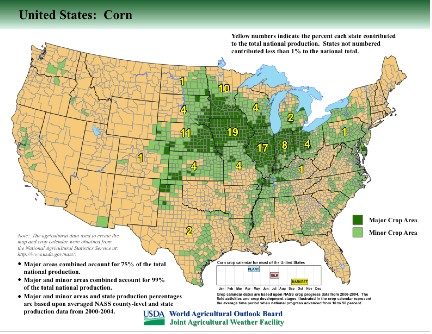
The Corn Belt is moving north, proving to food producers across the country that this summer's drought was not a fluke. The most corn since 1937 was planted this year, but growers in Kansas planted the fewest in three years, turning instead to crops that are less water-intensive, including wheat and sorghum. But in Manitoba, corn acreage has almost doubled over the past decade.
(Click on map for larger version)
This shift is "a glimpse of a future altered by climate change that will affect worldwide production," the Sydney Morning Herald of Australia reports. Changes are happening faster than plants can adapt, said Axel Schmidt, a former International Center for Tropical Agriculture scientist.

Agriculture businesses are adapting. Agribusiness Cargill Inc. is investing more in northern facilities in anticipation of increased production there. DuPont Co. is developing genetically modified corn seed that could withstand drought, and boosting research in sorghum and other crops.

U.S. corn was worth $76.5 billion last year, more than twice the value of soybeans and five times that of wheat. Most ethanol comes from corn, most livestock eats it, and high-fructose corn syrup is used in a mass array of products. While climate change will likely move its production north, the Midwest will probably remain the corn belt just because of its good soil and generally favorable weather, Illinois' Heritage Grain Cooperative manager Jerry Rowe told the Herald. (Read more)

Tuesday, October 16, 2012

Restaurants hit with higher food prices caused by drought; small, local eateries struggle most

This summer's oppressive drought scorched Midwestern crops, raising the cost of feed, dairy and meat. Those high prices are impacting the size of restaurant menus across the U.S., with small, local eateries feeling the pinch the most. The cost of food now rivals labor as the top expense for most restaurants, Tiffany Hsu of the Los Angeles Times reports. Owners are reducing menu offerings, shrinking portion sizes and considering staff cuts. (L.A. Times photo by Francine Orr: patrons eat at Smokin' Jonny's BBQ in Gardena, Calif.)

Restaurant prices have been rising for more than a year, with wholesale food costs increasing by 8.1 percent in 2011, Hsu reports. The increases will continue, but at a quicker pace, because the price of corn, which is a key component in livestock feed, powdered sugar, salad dressing, and more, jumped by 60 percent this summer. Chicken and turkey prices rose by 5.3 and 6.9 percent, respectively, and eggs now cost 18 percent more. Analysts expect overall food prices to rise from between 5 to 20 percent by year's end.

Big chains are able to weather drought price hikes well, but small restaurants will suffer, Hsu reports. "The smaller mom-and-pop restaurants are going to get hit with the drought very shortly," Motley Fool analyst Don Krueger told Hsu. It's forcing small restaurant owners to make tough decisions. Restaurant consultant Kian Abedini told Hsu more restaurants are using small plates and tapas dishes to save money. He's also noticed cheaper cuts of meat on menus, along with more curry and rice dishes. Pickled items are showing up as well because they're less expensive than fresh foods, Abedini said.(Read more)

Friday, October 12, 2012

Central Kentucky's few remaining small tobacco farmers having difficulty finding harvest labor

The good news for some Kentucky tobacco-growing counties is that this year's crop is one of the better they've seen in a while. The bad news is that the migrant labor that was once abundant in those parts isn't as available as before. Leslie Moore of the Central Kentucky News-Journal reports that in Taylor County, "finding workers to cut and house this season’s predicted 2,500 pounds of tobacco has been a labor in itself."  (Moore photo)

Pat Hardesty, the county extension agent for agriculture, told Moore the number of migrant workers who help with the harvest has dwindled because there are simply not enough small farms now in the area to keep them employed for long. “Some of our smaller producers have been waiting on crews or they’ve been trying to get local help, which is very difficult,” Hardesty said. “That’s why the migrants are here, because we can’t get enough local labor to get the crop in.” He said migrant workers aren't taking jobs away from Americans: “I promise you, if a tobacco producer here in Taylor County could get local, dependable help, there wouldn’t be migrants here.” Local farmer Aaron Newcome agreed that finding steady local help this year has been difficult. On any given day, he told Moore he has no idea how many workers will show up or how long they will stay.

As a killing frost loomed, Hardesty explained to Moore that speed is of the essence. If frost hits tobacco, the crop's quality is reduced and acres of it can be wasted.

News-Journal stories are behind a paywall. To get a 30-day free trial subscription, go here.

Thursday, October 11, 2012

Lots of money spent on agriculture research, but not very much on rural community development

The amount spent on agricultural biotechnology research has exploded over the past 30 years, but very little is spent on understanding how rural people and communities can survive, according to new research from the Department of Agriculture's Economic Research Service.

"We spend billions of dollars trying to understand how crops and animals live, but only a smidgen on how humans and their communities can grow and develop," Bill Bishop of the Daily Yonder writes. It's understandable, he writes, that private businesses invest money in research and development that will earn high private returns, according to the economists who wrote the report, at least. However, a 2001 survey found that three-quarters of private crop breeding investments went to just three commodities: corn, soybeans and cotton, Bishop reports.

From 1980 to 2010, research spending by seed and biotech companies increased to more than $2 billion from $100 million. There was no increase in spending on social and community development research. "And that may be one reason why we know a heck of a lot about how to grow corn in a drought but not so much about how to develop rural communities that thrive," Bishop writes. "No wonder we have bountiful harvests and troubled towns." (Read more)

Friday, October 5, 2012

Drought has produced mixed pumpkin harvest; fewer, but some that made it are big and pretty

This year’s devastating drought has reduced the number of pumpkins in many Ohio patches, but some say the summer’s abundant heat and sunshine has also produced some particularly big and rather good looking specimens. Mary Vanac of The Columbus Dispatch reports the good news that pumpkins actually like it hot. “Overall, there should be a good-size, quality harvest,” said Lisa Schacht, co-owner of Schacht Family Farm and Market in Canal Winchester and president of the Ohio Produce Growers and Marketers Association. (Columbus Dispatch photo by Jonathan Quilter)

Those who are wondering about how Thanksgiving dinner is going to be affected may have to wait a little longer, however. Roz O'Hearn, spokeswoman for Nestle USA, maker of the famous Libby-brand pumpkin that makes the famous Libby pumpkin pie, said it was too early to tell if the supply or price of canned pumpkin is at risk. “Our harvest is under way now,” O’Hearn told Vanac. “The many thousands of acres of pumpkin we grow are located right in the midst of the drought-stricken area, 50 miles out in any direction from Morton, Ill., where we pack the pumpkins we pick.” Libby’s did not irrigate its pumpkin fields, she said, so yields will be down this year. Ohio's pumpkin crop represented more than 10 percent of the U.S. pumpkin crop last year.

Tuesday, October 2, 2012

Common use of genetically modified crops leading to rise in pesticide, herbicide use

Use of genetically modified crops has become commonplace in agriculture, but has led to an increase in use of pesticides and herbicides, according to a new study. Weeds and pests have have adapted to the modified crops and become resistant to the chemicals used to protect them, so farmers have been forced to spray crops with increasing amounts of the chemicals. The use of pesticides increased by 404 million pounds from 1996 to 2011. Herbicide use increased by 527 million pounds, and insecticide use by 123 million pounds.

Charles Benbrook, lead author of the Washington State University study, said it "undermines the value of both herbicide-tolerant crops and insect-protected crops," Carey Gillam of Reuters reports. Monsanto's Roundup Ready seeds were a hit with farmers, who enjoyed the benefits of being able to spray their entire crop, killing weeds and bugs without hurting their crops. However, more than two dozen weed species have become resistant to Roundup.

The amount of herbicide needed to fight "superweeds" is increasing by about 25 percent every year, Benbrook said. The annual increase has risen to 90 million pounds in 2011, up from 1.5 million in 1990. Insecticide use dropped 28 percent from 1996 to 2011, but is now rising, Benbrook said. (Read more)

Monday, October 1, 2012

Climate change keeping pests alive through winter

Climate change is not only causing crop-killing drought, but its increasing the longevity of at least one species of pest that can devastate potato, tomato, pepper and about 40 other crops. The potato-tomato psyllid, right, sucks plants dry and can spread "zebra chip" disease in potatoes that causes potato chips to have a burnt flavor, Gabriela Quiros of Quest. That disease has cost producers in three states about $8 million so far. (University of California photo by Jack Clark)

Farmers have dealt with psyllids for more than 100 years, but rises in temperature are allowing them to survive through winter. "Our temperatures have increased by 2 to 3 degrees Fahrenheit, and that seems to be enough to keep them from being frozen out during the winter,” said University of California, Riverside entomologist John Trumble. If pests can live through winter, they can attack crops early in the growing season, which could leave to even more widespread loss of crops because of the bugs, Trumble said. (Read more)

Thursday, September 20, 2012

What will really happen if there's no Farm Bill by Sept. 30? Not that much

Congress is not going to pass a new Farm Bill before its election recess, which is set to begin next week. That means that 2008 funding for programs including the Supplemental Nutrition Assistance Program (generally known as food stamps) and direct payments to farmers will technically expire on Sept. 30. In theory, some "fairly scary things" will happen, reports Julie Rovner of National Public Radio. But in reality, "almost none of the changes would happen right after Sept. 30," at which time, Congress could have passed a new bill.

Technically, federal price supports will revert back to 1949 levels without a new bill or an extension of the old one. That would mean the government would "pay huge bonuses" for certain crops, but not for others, because some commodities were added after to the list after 1949. It also would raise prices for commodities such as milk and soybeans. But, Montana State University economics professor Vincent Smith told Rovner the real reason Farm Bill supporters are pushing for a new bill has more to do with budget politics than the actual mechanics of it.

"They want to have a Farm Bill now that locks Congress and the taxpayer into obligations based on either the Senate or the House bill," Smith told NPR. "What they're concerned about is that, if serious deficit-reduction talks take place, then a lot more money than was initially identified to come out of the farm bill by the 'supercommittee' a year and a bit ago will have to come out of the Farm Bill."

"We actually have until about Jan. 1 before we run into a lot of administrative problems with this bill reverting to some very high prices," Mary Kay Thatcher, director of congressional affairs for the American Farm Bureau Federation, told Rovner. The 2008 measure covers all of this year's crops, even if they haven't been harvested yet. The first crop that would be affected by new price supports would be winter wheat, which is harvested in the Spring, Rover reports. (Read more)

Tuesday, September 18, 2012

Seed companies develop drought-resistant corn

This summer's ravaging drought destroyed corn crops across the Midwest and Great Plains, creating a slew of problems for farmers, consumers and livestock producers. Agriculture biotechnology companies have been pouring millions into drought-resistant genetically modified corn seeds that can withstand an extended dry period. (Los Angeles Times photo by Ricardo Lopez: Researcher examines drought-resistant corn)

Monsanto recently got approval for its DroughtGard seed corn, and other seed makers, including Pioneer Hi-Bred International Inc. and Syngenta, have  begun selling drought-tolerant but conventionally bred corn varieties. Companies are also trying to develop drought-resistant soybean, cotton and wheat strains that can "thrive in a world that's getting hotter and drier," reports Richard Lopez of the Los Angeles Times.

The majority of seed corn is already genetically modified to repel pests and create higher yields, and there are public concerns arising about the "unforeseen consequences of this genetic tinkering," Lopez reports. But researchers say creating drought-tolerant or resistant seeds is a priority, especially in the wake of this year's oppressive and costly drought. "We don't need to stigmatize these approaches," Kent Bradford, head of the Seed Biotechnology Center at the University of California, Davis.  (Read more)

Friday, September 14, 2012

Drought expands slightly; weather patterns indicate little or no relief should be expected in early 2013

The worst drought in more than 50 years has expanded slightly for the third consecutive week, according to the U.S. Drought Monitor. Exceptional drought, the most severe category, now covers 6.2 percent of the U.S., up from 6.1 percent last week. All levels of drought increased to 64.2 percent from 63.4, the highest percentage this year.
There were "minor improvements" in the Midwest, Northeast, mid-Atlantic, Arizona and the Great Basin, Brian Sullivan of Bloomberg reports. Drought has caused corn and soybean prices to rise as the size of harvests shrunk, creating hardship for livestock and dairy producers who could no longer afford feed. It has also caused Mississippi River levels to drop in some places, making river travel difficult to impossible. (Read more)

Relief from drought conditions may be years away. Iowa State University extension climatologist Elwynn Taylor said the La Nina weather pattern causing the drought will likely stick around through early 2013. An El Nino pattern that would bring enough rain to quench U.S. soil isn't anywhere on the horizon, Jeff Caldwell of Agriculture.com reports. "If weather patterns respond to a neutral or to an early 2013 development of La Nina," Taylor said, "it will be likely that the U.S. corn yield will fall below the 30-year trend line for a fourth consecutive year." (Read more)

Friday, September 7, 2012

Hurricane Isaac helps some drought-stricken areas, leaves others behind

Even though Hurricane Isaac re-hydrated much of the very parched Midwest last weekend, meteorologists and agriculture experts say a large portion of the U.S. remains "desiccated with ponds still too shallow to water cattle, fields too dusty for feeding and crops beyond the point of salvage," John Eligon of The New York Times reports.

The drought has actually worsened in some places, shifting the greatest exceptional-drought area to the Central Plains, from South Dakota to North Texas. "Isaac's rains were like Chapter 1 in the drought relief book," said National Oceanic and Atmospheric Administration meteorologist David Miskus. "We still need a lot more rain to go here to really eliminate this drought." States including Iowa, Nebraska, Kansas, South Dakota and Oklahoma got very little rain, and conditions could get worse because of a forecast of hot temperatures this week. Miskus said many of those areas will remain in or be upgraded to extreme and exceptional drought. (U.S. Department of Agriculture Drought Monitor map, Sept. 7)
Click map for larger version
Areas from Arkansas through Missouri to Illinois saw anywhere from two to eight inches of rain, which was a welcome sign for farmers preparing to plant wheat, Eligon reports. In Illinois, 72 percent of pastures were rated in poor to very poor condition this week compared to 90 percent last week, and poor to very poor fields in Arkansas dropped 12 percentage points to 72 percent, according to the USDA. (Read more)

Wednesday, September 5, 2012

Researcher says nanomaterials could have 'profound' negative effect on food crops

Nanomaterials, which are created by manipulating matter on an atomic and molecular scale, may be harming the quality and yield of food crops, University of California researchers concluded in a report released in the online edition of Proceedings of the National Academy of Sciences.

The materials are being used in many consumer products,which  including shampoos, gels, hair dyes and sunscreens, which are washed into the environment. Researcher John Priester told Bobbie Mixon of the National Science Foundation that as their uses increase, the likelihood of nanomaterials contaminating food crops rises. "Conventionally treated wastewater is a primary source of normally nutrient-rich organic materials applied to agricultural soil, and farmers beneficially use this treated water and the biosolids from it as fertilizer," Mixon reports. "As nanomaterials become more prevalent, there is concern about nanomaterials buildup in soils and possible nanomaterials entry into the food supply."

There had been no previous study of the affects of nanomaterials on a soil-based crop, so researchers grew soybeans, a major global commodity, in soil containing high amounts of nanomaterials. They found that two nanomaterials -- cerium oxide powder and zinc oxide -- "could profoundly alter soil-based food crop quality and yield," Mixon reports. (Read more)

Friday, August 31, 2012

Wal-Mart joins sustainable agriculture alliance

Wal-Mart Stores Inc., the world's largest retailer, has joined an alliance of other Fortune 500 companies who say they want to make agriculture more sustainable. The Field to Market alliance was started three years ago by the non-profit Keystone Center to improve agricultural productivity and reduce the use of natural resources. It includes farm groups, grain handlers and food makers, but Wal-Mart is the first retailer in the group and now its largest member, writes Michael Hirtzer of Reuters. "We have pretty ambitious goals to sell products that are sustainable and this is directly within that framework," Rob Kaplan, Wal-Mart's senior manager of sustainability, said of the new partnership.

"Field to Market studies major crops and works with farmers to make agriculture more environmentally friendly," Hirtzler reports. "A report the group released earlier this summer highlighted how six crops -- corn, cotton, potatoes, rice, soybeans and wheat -- that are now being produced more efficiently than they were in the last three decades. On one project sponsored by Field to Market, General Mills Inc. worked with 25 wheat growers in Idaho to learn how to maximize the use of fertilizer and other products used in farming, such as seed, insecticides and herbicides."

Wal-Mart reports it is seeking to eliminate 20 million tons of greenhouse gas emissions from its global supply chain by the end of 2015. Last year, the company told Reuters it turned 1.2 million pounds of cooking oil recovered from its stores into biodiesel, soap and a supplement for cattle feed. Other members of the alliance include Kellogg, Cargill, Coca-Cola and the National Corn Growers Association.

Tuesday, August 28, 2012

Crop insurance companies expect big losses

The insurance industry is expecting its largest-ever loss in agriculture as the Midwest's worst drought since 1956 brings billions of dollars in claims from corn and soybean farmers.

University of Illinois agricultural economists estimate the drought will trigger gross indemnities of about $30 billion, with an underwriting loss of $18 billion, Javier Blas and Alistair Gray of the Financial Times report. The U.S. government will take on about $14 billion of that, and private sector insurers will likely incur a loss of $4 billion. Economists Gary Schnitkey and Bruce Sherrick said some crop insurers are owned by public companies "who may not have realized the scope of losses that their crop insurance subsidiaries could generate." (Read more)

Meanwhile, the corn harvest is at its fastest pace ever because farmers planted early and the drought accelerated corn's maturity. About 6 percent of U.S. corn was harvested as of yesterday, compared to just 4 percent last week and none at this time last year, according to a Department of Agriculture report. About 26 percent of the crop was rated as mature, up from about 16 percent last week. Jeff Wilson of Bloomberg reports the trend increases the risk that wind and rain, perhaps from the remnants of Tropical Storm Isaac, will knock ears off stalks or blow plants over.

Friday, August 24, 2012

Drought likely to add delectability to Midwest wine

The ever-optimistic are out there. And they are growing grapes. Most of the grapes in Glenn Warnebold's vineyard in Missouri's picturesque wine country this year are about two-thirds of their usual size. Others have been reduced to raisins by the drought that burned up many crops across the Midwest this summer. Yet, writes Jim Suhr of the Associated Press, Warnebold figures it could be a good year with the drought concentrating the fruit's flavors and sugar, which will turn to alcohol during fermentation. His red Norton and white Chardonel grapes, while small, hold the promise of standout wine from a region better known for corn and soybeans. "The fruit will be better, overall, for reds and whites, then last year, when it was wet," said Tony Debevc, who has a 170-acre Ohio vineyard. "If it continues to be dry like this, the wine industry will be better overall. And personally, we can expand in the red category, and it wouldn't necessarily be a bad thing."

But Suhr notes that not all is rosy. The drought has still stressed the vines, making them less likely to survive a harsh winter and produce next season. The harvest will almost certainly be smaller too. Warnebold figures he will get 2,500 cases of wine this year -- 1,500 less than what he typically might expect -- from his six-acre vineyard atop a bluff overlooking the Missouri River.

For those who understand this kind of talk: This year's wines from America's heartland "will be nice, fruity and very approachable and soft on the palate," predicted Diego Meraviglia, vice president and education director for the California-based North American Sommelier Association. But he believes the drought has cost some grape varieties complexities that may hinder the wines' abilities to age, meaning "you have to drink them within a year or they'll go bad." Warnebold, for the record, was none too impressed with that analysis. "I've been to a lot of wine conferences with a lot of wine experts, and I've never heard that theory before," he said. Brad Beam, an Illinois Grape Growers and Vintners Association enologist, downplayed the debate, saying "a lot of our wine is best drunk on the young side anyway." No matter. Seems it might be long debate, with a lot of talk about the drought conditions being more or less a common thing in these parts from here on in. That talk, of course, has the winemakers discussing whether to irrigate or not, and if so, how much, and, then, how much better their reds can get.
(Read more)

Thursday, August 23, 2012

Western farmers report shortage of farm laborers, blame more stringent border controls

There's a shortage of farm labor in the West, and many blame stronger border controls and a stagnant guest-worker program. The Western Growers Association reports its members are experiencing a 20 percent drop in laborers this year. (Getty Images photo)

The lack of workers is forcing farmers to pay more for the labor they do get and to not harvest some crops, reports Jane Wells of CNBC. California farmer Craig Underwood said some of his crops have been "left in the field" because there weren't enough people to pick them. He's also paying pickers about $9.25 an hour to harvest peppers, Wells reports. Underwood also said much of his workforce is aging and they aren't being replaced because "migratory flows between Mexico and the United States have come to a halt." (Read more)

Wednesday, August 22, 2012

Marijuana's resistance to drought makes it an easier target for police this year

The drought is making marijuana crops a lot easier to spot, reports The Courier-Journal of Louisville. Indiana State Police got an early start to the annual marijuana eradication season this week, Sgt. Jerry Goodin told reporter Charlie White that the browning of drought-stricken corn makes the resilient green pot plants interspersed between them “stick out like a sore thumb.” (C-J photo by White)

In Kentucky, State Police Lt. Brent Roper said his agency started cutting outdoor marijuana plants last month. The drought hasn't affected the number of crops they've seized this year, he said, but "It does help when the corn starts browning," which is happening even in some of the state's moderate-drought areas. Roper's agency destroyed more than 120,000 plants through the end of July this year, compared with about 91,000 in the same period last year. Indiana and Kentucky continue to be among the top states for outdoor pot seizures, according to federal statistics. (Read more)

Thursday, August 16, 2012

Would Obama's order to Pentagon to buy more meat raise prices for producers? Analysts disagree

The Obama administration has ordered the Pentagon to buy more beef, pork and lamb to try and help ranchers through the severe drought, prompting the Defense Department to determine whether it can afford to buy more. The military buys millions of pounds of meat every year to feed troops around the world.

Some analysts say the move would only help Obama politically, but others say it could be an opportunity for the Pentagon to pay less for meat it will eventually need and can freeze. Drought has forced up the price of corn, which livestock producers use as supplemental feed, and since they aren't able to make livestock heavier faster, they are forced to sell sooner than usual, Jennifer Rizzo of CNN reports. This causes more meat to be available, making prices drop, which also reduces the profit that ranchers have available to buy feed. Rizzo reports the mandate to buy more meat is an attempt to raise prices by taking more meat off the market.

Iowa State University economist Bruce Babcock told Rizzo the impact of these purchases is suspect. "The purchase is delaying the day of reckoning because ... it will raise their prices somewhat now and it will allow them to purchase more feed, but that feed cost isn't going to go down for a year," Babcock said. The livestock industry has to shrink by reducing herd sizes in order to afford corn in the future, he said. American Farm Bureau Federation economist Bob Young told Rizzo that even though the purchase would only make a small dent in the market, the move will ultimately help ranchers. (Read more)

Tuesday, August 14, 2012

To help livestock producers and limit meat prices, U.N. wants feds to halt mandated ethanol production

The United Nations is calling on the United States to halt its mandate for ethanol production in order to lower corn prices, which would help struggling livestock producers and mitigate increases in meat prices. Recent oppressive drought caused the U.S. Department of Agriculture to estimate a large decrease in the size of the U.S. corn crop last week, which forced prices to almost $9 a bushel.

About 40 percent of U.S. corn will be used for ethanol production as part of the government mandate, Javier Blas and Gregory Meyer of the Financial Times report. But UN Food and Agriculture Organization Director-General Jose Graziano wrote in a Financial Times opinion piece that a temporary suspension of ethanol production "would give some respite to the market and allow more of the crop to be channelled towards food and feed uses." (Read more)