Showing posts with label global warming. Show all posts

Wednesday, October 17, 2012

Climate change is moving U.S. corn production north

The Corn Belt is moving north, proving to food producers across the country that this summer's drought was not a fluke. The most corn since 1937 was planted this year, but growers in Kansas planted the fewest in three years, turning instead to crops that are less water-intensive, including wheat and sorghum. But in Manitoba, corn acreage has almost doubled over the past decade.
(Click on map for larger version)
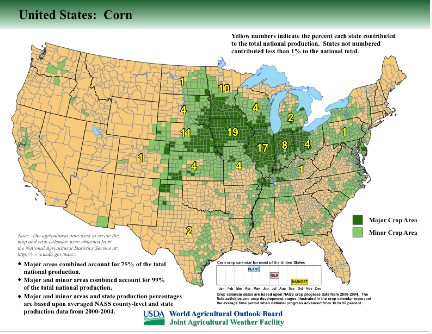
This shift is "a glimpse of a future altered by climate change that will affect worldwide production," the Sydney Morning Herald of Australia reports. Changes are happening faster than plants can adapt, said Axel Schmidt, a former International Center for Tropical Agriculture scientist.

Agriculture businesses are adapting. Agribusiness Cargill Inc. is investing more in northern facilities in anticipation of increased production there. DuPont Co. is developing genetically modified corn seed that could withstand drought, and boosting research in sorghum and other crops.

U.S. corn was worth $76.5 billion last year, more than twice the value of soybeans and five times that of wheat. Most ethanol comes from corn, most livestock eats it, and high-fructose corn syrup is used in a mass array of products. While climate change will likely move its production north, the Midwest will probably remain the corn belt just because of its good soil and generally favorable weather, Illinois' Heritage Grain Cooperative manager Jerry Rowe told the Herald. (Read more)

Belief in climate change soars among conservatives but most still don't think it is caused by humans

Belief in climate change has climbed recently, making a rebound from a sharp drop in 2009, according to a Pew Research Center poll. About 67 percent of Americans now believe temperatures are rising, with acceptance stretching across all age groups and political party affiliations, including more skeptical senior citizens and Republicans, Evan Lehmann of Energy and Environment News reports.

Forty-eight percent of Republicans agree that there is "solid evidence" that Earth's temperature has increased over several decades. That's a 5-percentage-point climb among Republicans since last year, and a 13-point rise since 2009. The biggest jump among Republicans came from conservatives, 43 percent of whom now believe in climate change, an increase of 12 points since last year. Fifty-eight percent of Republican moderates believe in it.

However, far fewer Republicans believe that climate change is man-made. About 38 percent of GOP moderates say human activity, including the burning of fossil fuels, causes climate change, and only 16 percent of conservatives agree with that. (Read more)

Monday, October 1, 2012

Climate change keeping pests alive through winter

Climate change is not only causing crop-killing drought, but its increasing the longevity of at least one species of pest that can devastate potato, tomato, pepper and about 40 other crops. The potato-tomato psyllid, right, sucks plants dry and can spread "zebra chip" disease in potatoes that causes potato chips to have a burnt flavor, Gabriela Quiros of Quest. That disease has cost producers in three states about $8 million so far. (University of California photo by Jack Clark)

Farmers have dealt with psyllids for more than 100 years, but rises in temperature are allowing them to survive through winter. "Our temperatures have increased by 2 to 3 degrees Fahrenheit, and that seems to be enough to keep them from being frozen out during the winter,” said University of California, Riverside entomologist John Trumble. If pests can live through winter, they can attack crops early in the growing season, which could leave to even more widespread loss of crops because of the bugs, Trumble said. (Read more)

Friday, September 28, 2012

Three of eight Americans don't believe in science of climate change; debate more cultural than scientific

There is no denying that a strong scientific consensus about the existence of climate change exists, especially since scientists have documented a build-up of greenhouse gases and their findings have been endorsed by a large body of domestic and international scientific agencies. But what doesn't exist in the U.S. is a social consensus about climate change. Studies have shown that Americans' belief in the scientific findings of climate change has mostly declined over the last five years.

Between April 2008 and October 2009, belief in climate science dropped to 57 percent from 71, according to the Pew Research Center. This February, it had risen to 62 percent, which means 38 percent of Americans still do not trust it. "Such a significant number of dissenters tells us that we do not have a set of socially accepted beliefs on climate change," Andrew Hoffman, right, the Holcim Professor of Sustainable Enterprise at the University of Michigan, writes for the Stanford Social Innovation Review. He says the debate is not so much about science as about culture, worldviews and ideology.

"Acceptance of the scientific consensus is now seen as an alignment with liberal views consistent with other 'cultural' issues that divide the country -- abortion, gun control, health care, and evolution," Hoffman writes. This partisan divide on the issue is a recent phenomenon, something that wasn't seen during the 1990s. Hoffman examined "the climate change debate through the lens of the social sciences," because he says "we need to understand the social and psychological processes by which people receive and understand the science of global warming."

He writes there are two "overriding conclusions" about the climate change debate: Climate change is not a "pollution" issue, and it is an existential challenge to our contemporary world views. He outlines three possible ways in which the ideological debate will manifest: the "Optimistic Form," in which "people do not have to change their values at all," the "Pessimistic Form," in which "people fight to protect their values," and the "Consensus-Based Form," in which "a reasoned societal debate, focused on the full scope of technical and social dimensions of the problem and the feasibility and desirability of multiple solutions," are discussed. (Read more)

Tuesday, September 25, 2012

Coal and the vote: Worried about Obama regulations, more ads, money and a new plant?

"A handful of utility companies are determined to buck the trend toward natural gas and break ground on what could be the last new conventional coal-fired power plants in the U.S.," Tennille Tracy of The Wall Street Journal reports. (Getty Images photo: Miners at Romney rally in southeastern Ohio)

"The moves come as the presidential campaigns spar over the future of coal power," and as they worry about an April deadline to begin construction, created by the Obama administration's limits on greenhouse-gas emissions. "They say separate government rules on mercury emissions are making it tough to hit that deadline," because the mercury rules are not due to be final until March.

Tracy notes that Republican Mitt Romney is running a TV commercial in coal states with "mournful images of coal miners facing the industry's decline. . . . With some parts of battleground states like Ohio reliant on coal jobs, the White House has started to defend itself more vigorously against the 'war on coal' allegation" being made by Republicans and coal interests. (Read more)

Also weighing in this week: Time magazine with an usual look at the debate through the eyes of controversial Ohio coal executive Robert E. Murray who "may be Obama's biggest headache in a state where he leads by about 4 points." Time's Michael Scherer gives Murray and the pro-coal alliance which has spent millions to defend Obama lots of space to vent about the president's policies. 

Monday, September 24, 2012

Scientists' survey of last year concludes that Fox, Wall Street Journal misled on climate change

A new study contends that Fox News and the Wall Street Journal, both owned by Rupert Murdoch's News Corp., have greatly misled their audiences about climate change. The Union of Concerned Scientists concluded that 93 percent of Fox broadcasts and "Wall Street Journal Editorial Report" TV programs about climate change from February through July, and 81 percent of Journal editorial pages from August 2011 through July 2012, were misleading.

The survey defined inaccurate information about climate change as citations that "questioned either the reality of climate change or the fact that recent climate change is largely due to human activities, or they advanced other arguments that dismissed established climate science."  Tim McDonnell of Mother Jones writes, "The climate change debate in America is still mired in bickering over whether the problem even exists or not." (Read more)

Wednesday, September 19, 2012

Western wildfires expected to increase as climate keeps warming

With two months left in fire season, this year is likely to be one of the worst on record for wildfires in the West. The area burned this year is 30 percent more than in an average year, with fires consuming more than 8.6 million acres, according to the National Integrity Fire Center(Climate Central map shows current wildfires)

Also, what defines a "typical" wildfire year in the West is changing, as spring and summer temperatures continue rising and snowpack continues to shrink. Several studies have shown that the risk of fires will increase as the climate continues to change.

For every degree Celsius the temperature rises, the size of area burned in the West could quadruple, according to the National Research Council. Temperatures in the West have been estimated to increase from 3.6 to 9 degrees FahrenheitClimate Central reports. In a 42-year analysis of U.S. Forest Service records for 11 Western states, Climate Central found that compared to an average year in the 1970's, there were seven times more fires in the past decade greater than 10,000 acres each year. There were more than 100 fires on average per year from 2002 to 2011, compared to less than 50 during the 1970's. (Read more)

To see Climate Central's full western wildfire report, click here. The group has also created an interactive map that shows currently burning wildfires, which can be found here.

Wednesday, August 29, 2012

Meteorologists make official stance unequivocal: Humans are main cause of climate change

The American Meteorological Society (AMS) has firmed up its definition of the relationship between climate change and weather events. The group has issued a statement that says the warming world is a fact beyond reproach, and that human activity -- despite some natural variability -- is the main force behind such changes. (KUSA-TV image)

"Warming of the climate system now is unequivocal," reads the statement. "Observations show increases in globally averaged air and ocean temperatures, as well as widespread melting of snow and ice and rising globally averaged sea level." The dominant cause of the warming since the 1950s is human activities, it went on, adding that their scientific finding is based on "a large and persuasive body of research." Read the complete AMS statement here.

A 2010 George Mason University study of working television meteorologists found that only 54 percent believed in climate change or global warming, 25 percent said it wasn't and 21 percent were not sure. About one-third (31 percent) said global warming was caused mainly by human activity. Read findings of the study here.

AMS Executive Director Keith Seitter explained that the society's most current climate change statement is "the result of hundreds of hours of work by many AMS members over the past year. It was a careful and thorough process with many stages of review, and one that included the opportunity for input from any AMS member before the draft was finalized." The statement continues: "It is clear from extensive scientific evidence that the dominant cause of the rapid change in climate of the past half century is human-induced increases in the amount of atmospheric greenhouse gases, including carbon dioxide (CO2), chlorofluorocarbons, methane, and nitrous oxide. The most important of these over the long term is CO2, whose concentration in the atmosphere is rising principally as a result of fossil-fuel combustion and deforestation." (Read more)
 

Monday, July 30, 2012

A leading climate-change denier switches, says earth is warming and humans are the main cause

In what is being described as both "a bombshell" and "a man-bites-dog" story, a leading skeptic of climate change has dramatically reversed his position after a study he conducted with money from an even larger critic of climate science, the Charles G. Koch Charitable Foundation. On the opinion pages of The New York Times, Richard Muller, left, is unequivocal about his new position: "Call me a converted skeptic. Three years ago I identified problems in previous climate studies that, in my mind, threw doubt on the very existence of global warming. Last year, following an intensive research effort involving a dozen scientists, I concluded that global warming was real and that the prior estimates of the rate of warming were correct. I’m now going a step further: Humans are almost entirely the cause."

He continues: "The careful analysis by our team is laid out in five scientific papers now online at BerkeleyEarth.org. That site also shows our chart of temperature from 1753 to the present, with its clear fingerprint of volcanoes and carbon dioxide, but containing no component that matches solar activity. Four of our papers have undergone extensive scrutiny by the scientific community, and the newest, a paper with the analysis of the human component, is now posted, along with the data and computer programs used. Such transparency is the heart of the scientific method; if you find our conclusions implausible, tell us of any errors of data or analysis." Muller's opinion page piece is here.

Michael E. Mann, director of the Earth System Science Center at Penn State, said Muller’s conversion might help shape the thinking of the "reasonable middle" of the population "who are genuinely confused and have been honestly taken in" by attacks on climate science. The Los Angeles Times's Neela Banerjee writes that Koch Foundation spokeswoman Tonya Mullins said the support her foundation provided, along with others, had no bearing on results of the research. "Our grants are designed to promote independent research; as such, recipients hold full control over their findings," Mullins said in an email. "In this support, we strive to benefit society by promoting discovery and informing public policy."

Wednesday, July 11, 2012

Scientists confirm human role in climate change, and become more forceful in challenging skeptics

Some of the weather extremes recently witnessed around the world have become far more likely because of human-induced global warming, researchers reported Tuesday.  Justin Gillis reports in The New York Times that a new study found "that global warming made the severe heat wave that afflicted Texas last year 20 times as likely as it would have been in the 1960s. The extremely warm temperatures in Britain last November were 62 times as likely because of global warming," the report found. The findings, writes Gillis, "especially the specific numbers attached to some extreme events, represent an increased effort by scientists to respond to a public clamor for information about what is happening to the earth’s climate. Studies seeking to discern any human influence on weather extremes have usually taken years, but in this case, researchers around the world managed to study six events from 2011 and publish the results in six months." The study was released along with a broader report on the state of the world’s climate. Both are to be published soon in the Bulletin of the American Meteorological Society.

Gillis, The Times' environmental reporter, meanwhile, is among the targets of The American Tradition Institute (ATI), a conservative group that is using public records requests to publicize emails between reporters and climate scientists to suggest "collusion" between the media and environmental establishments, reports Greenwire (behind a pay wall, but a free trial can obtained by clicking here).

Scientists are beginning to argue more forcefully to the public that climate-change skeptics are ignoring well-established scientific facts. A dozen scientists at the University of Kentucky Wednesday what is known about the human role in climate change for readers of The Lexington Herald-Leader. The professors list what is recognized among scientists today: Carbon dioxide and other greenhouse gases have increased steadily in the atmosphere since the mid-19th century; that increase is "well-correlated" with fossil-fuel consumption and changes in land use, and the gases trap increasingly more heat, so the surface, oceans and lower atmosphere are warming. (Herald-Leader photo by Charles Bertram)

"Multiple surveys of credentialed climate scientists show at least 96 to 98 percent agreement with these fundamentals," the scientists write, They note that the National Academy of Sciences has published a position statement affirming the fundamentals of human-induced climate change, as have over 100 other scientific societies, including the academies of all major democracies and the American Meteorological Society. The National Aeronautics and Space Administration (NASA), the National Oceanic and Atmospheric Administration (NOAA) and many other federal departments and agencies have been studying climate change for years. An international, interdisciplinary collection of thousands of expert scientists has summarized the evidence for the central role of human activities in causing climate change, in reports of the Intergovernmental Panel on Climate Change.

"As professors and publishing scientists, we are trained skeptics, and we look for credible evidence that refutes the fundamentals on climate change. However, it simply isn't there," the scientists write. "What about all the skeptical 'science' on the Internet? If those authors have the evidence to support what they say, they should submit a manuscript to a credible scientific journal, or present their ideas at a major scientific conference." (Read more)

Sunday, July 8, 2012

Coal trio: Stories on black lung, surface mining and carbon capture and storage all break new ground

Today's newspapers had three important stories about coal, each touching on one of the three main aspects that make it controversial: health and safety in underground mines; environmental damage from surface mines and old deep mines; and the technical obstacles that face carbon capture and sequestration, which could be key to cutting coal's contributions to climate change.

Ken Ward Jr. of the Charleston Gazette and Chris Hamby of the Center for Public Integrity teamed up with NPR News to explain how the main disease of underground mining, black lung, has again become prevalent and why efforts against it have stalled. Today's stories are the start of a package that will continue Monday in the Gazette and on NPR. (Links updated) The stories are part part of "Hard Labor," an occasional series on health, safety and economic threats to U.S. workers.

Ronnie Ellis of Community Newspaper Holdings Inc. reports on the murder of a creek near Hueysville, Ky., where retired state police dispatcher Rick Handshoe, left, had hoped to turn over his home to his daughter. He says blowouts from a reclaimed strip mine and an old underground mine have ruined the creek and put him in fear of a landslide that could kill him and his family. For the story in The Independent of Ashland, a CNHI paper, click here. In a sidebar, state officials say they're taking the complaints seriously but don't have enough evidence to issue citations. (Photo by John Flavell)

James Bruggers of The Courier-Journal in Louisville reports that the idea of stripping carbon dioxide from power-plant emissions and storing it forever in deep rock formations may not be as feasible as experts had thought, because the National Academy of Sciences "suggests that the process could build up enough pressure to cause minor to moderate earthquakes," and a Stanford University geophysics professor has told a Senate committee "that large-scale carbon capture and storage is a risky strategy that will likely fail," Bruggers writes. And he seems to be on to something: James Cobb, director of the Kentucky Geological Survey, told him, “I was convinced we’d be doing some amount of carbon capture and storage in Kentucky. Now, I’m not so sure.”

Thursday, July 5, 2012

Drought, heat and extreme weather are what global warming and climate change look like, scientists say

UPDATE, July 6: The head of the National Oceanic and Atmospheric Administration says extreme weather-related events "have convinced many Americans climate change is a reality," and not a "nebulous concept," The Associated Press reports.

Climate scientists have warned of the effects of global warming and climate change since at least 1988. They warned it would bring increased heat waves, more droughts, sudden downpours, widespread wildfires and terrible storms, all of which are currently happening in the U.S., stifling agriculture, costing billions of dollars in damage and forcing millions to live for days without electricity in the aftermath of a freak wind storm, know as a derecho.

"So far this year, more than 2.1 million acres have burned in wildfires, more than 113 million people in the U.S. were in areas under extreme heat advisories last Friday, two-thirds of the country is experiencing drought, and earlier in June, deluges flooded Minnesota and Florida," The Associated Press reports. It takes intensive scientific study to link individual weather events to climate change, and the extreme conditions in the U.S. aren't being seen elsewhere in the world, but leading climate scientists say that the U.S. is experiencing a microcosm of the very real effects of climate change.


"This is what global warming looks like at the regional or personal level," Jonathan Overpeck, geosciences and atmospheric sciences professor at the University of Arizona, told AP. "The extra heat increases the odds of worse heat waves, droughts, storms and wildfire. This is certainly what I and many other climate scientists have been warning about." The National Center for Atmospheric Research's lead climate scientist, Kevin Trenberth, said the extreme conditions are exactly what he has said would happen as a result of climate change. The Intergovernmental Panel on Climate Change warned of these types of events in March, but not many paid much attention.

The weather patterns aren't just a summer thing; they've been happening since this past winter, AP reports. Since Jan. 1, there have been more than 40,000 high temperature records, but fewer than 6,000 low records, according to the National Oceanic and Atmospheric Administration. Though skeptics believe climate change is a myth, almost all scientists who publish research in the field say it is real, and that the U.S. and the world can expect to see many more instances of extreme weather conditions in the future as a result of climate change. (Read more)

Monday, June 25, 2012

Wal-Mart's 'green wheat' efforts have potential to transform U.S. agriculture, some crops' sustainability

The commercial behemoth Wal-Mart Stores might be looking to transform, yet again, the marketplace. It might be starting this time with American wheat, reports Michael Hirtzer of Reuters.  "As part of efforts to reduce its carbon footprint and burnish its image as an environmentally responsible company, the huge retailer is sending senior employees into the fields for the first time ever, looking for ways to help farmers reduce their use of carbon-intensive fertilizer or improve logistics, writes Hirtzer. "We don't have a lot of visibility in the supply chain, so we started in the field," says Robert Kaplan, a Wal-Mart sustainability manager. "I hadn't seen a wheat field before and I wanted to find out how we go from a green crop in the fields to flour on our shelves."

This May, Hirtzler writes, Kaplan and a colleague were the first Wal-Mart employees ever to attend the annual crop tour across Kansas, the nation's No. 1 winter-wheat state. "The tour has been a rite of passage for traders, analysts, academics and buyers for the past half-century. The aim is simple: Use Wal-Mart's commercial muscle to get its Great Value-branded flour and wheat products from field to shelf more efficiently, using less carbon. In the process, however, Wal-Mart may end up initiating transformative changes in the way U.S. farmers grow wheat, lowering costs and improving yields for a crop that has failed to keep pace with the dramatic improvements in sustainability of other commodities such as corn and cotton."

The point is won, of course, with leverage and the net is an environmental wallop. "As it continues to buy more and more wheat to support its in-house brand, Wal-Mart believes it can use its muscle to bring changes to the agricultural landscape by getting farmers to adopt more progressive techniques and labeling the flour they sell as a sustainable product. In 2010, Wal-Mart's store brands had a 4.4 percent share of the $14.35 billion U.S. packaged and industrial bread market, up from a 3.7 percent market share in 2006, according to research firm Euromonitor International." (Read more)

Friday, June 15, 2012

The West's trees being decimated by pine beetle fungus; some say they're telling us something

North America is witnessing the largest pine-beetle epidemic in recorded history, reports Sophie Quinton of the National Journal. From Canada’s Yukon Territory to New Mexico, pine trees by the hundreds of millions are succumbing to a fungus that the beetles carry. Jeff Mitton, an evolutionary biologist at the University of Colorado (Boulder), has been studying the mountain pine beetle for more than 30 years. “The question is, why has this gotten so much worse?” Mitton said. Among the scientific community, a consensus is growing that changes in climate have propelled the outbreak. (AP photo of Colorado state park)

It's natural that beetles kill, die off, and regenerate, but human activity has helped to set the stage for the current epidemic. Writes Quinton: "Decades of fire suppression have left the West with dense stands of vulnerable, elderly trees. Frigid winters that usually kill the beetles have become, over the past 20 years, the exception rather than the rule. Earlier snow-melt and longer summers have altered the beetles’ range and life cycle; they now attack pines at higher altitudes and latitudes, and they reproduce twice a year instead of once. Earlier springs and a series of dry years have also weakened trees, turning them into ideal beetle food."
The devastation of the forest has been vast. The infected trees first turn a violent red, then they fall, and, finally, the tree falls. "Year by year, communities have watched a scourge advance across mountainsides and through neighborhoods, trees turning from green to red to gray. The beetles now attack 12 pine species, from the high-elevation whitebark pine to the lower-elevation ponderosa and piƱon." The blight has overtaken 3.3 million acres in Colorado alone since the 1990s. “To a large degree, our nation’s parks are the canary in the coal mine when it comes to on-the-ground effects of a warming climate,” U.S. Sen. Mark Udall (D-Colo.) said at a 2009 hearing on climate change at held at Rocky Mountain National Park with Sen. John McCain, R-Ariz. At the same park, John Mack, the chief of resource stewardship told Quinton: “These trees are dead; they just don’t know it.”