Showing posts with label corn. Show all posts

Wednesday, October 17, 2012

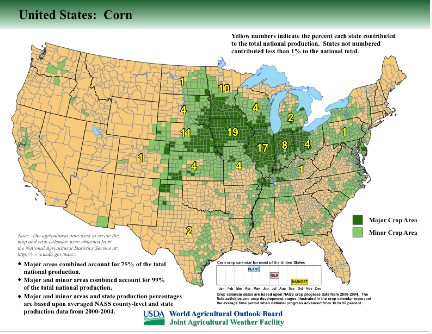
Climate change is moving U.S. corn production north

The Corn Belt is moving north, proving to food producers across the country that this summer's drought was not a fluke. The most corn since 1937 was planted this year, but growers in Kansas planted the fewest in three years, turning instead to crops that are less water-intensive, including wheat and sorghum. But in Manitoba, corn acreage has almost doubled over the past decade.
(Click on map for larger version)
This shift is "a glimpse of a future altered by climate change that will affect worldwide production," the Sydney Morning Herald of Australia reports. Changes are happening faster than plants can adapt, said Axel Schmidt, a former International Center for Tropical Agriculture scientist.

Agriculture businesses are adapting. Agribusiness Cargill Inc. is investing more in northern facilities in anticipation of increased production there. DuPont Co. is developing genetically modified corn seed that could withstand drought, and boosting research in sorghum and other crops.

U.S. corn was worth $76.5 billion last year, more than twice the value of soybeans and five times that of wheat. Most ethanol comes from corn, most livestock eats it, and high-fructose corn syrup is used in a mass array of products. While climate change will likely move its production north, the Midwest will probably remain the corn belt just because of its good soil and generally favorable weather, Illinois' Heritage Grain Cooperative manager Jerry Rowe told the Herald. (Read more)

Thursday, September 20, 2012

Study says Roundup Ready corn causes health problems in rats; some scientists question research

A long-term diet of herbicide-resistant corn caused tumors, organ damage and premature death in rats, according to French researchers who have conducted the first animal feeding test to determine effects of eating genetically modified food over a lifetime, Clive Cookson of The Financial Times reports. The study focused on the most widely planted herbicide-resistant corn, Monsanto's Roundup Ready.

The study, which was published in the peer-reviewed journal Food and Chemical Toxicology, divided 200 rats into groups of 10. Some were fed Roundup Ready corn, some Roundup-laced drinking water and some Roundup Ready corn that had been sprayed with Roundup. Researchers concluded that not only is eating GM corn harmful, but Roundup itself causes health effects even at concentrations below the legal limit for residues in water supplies.

Other scientists have criticized the study's methodology, saying tumor-prone rats were used, there were too few control groups of rats, and the study was also led by Gilles-Eric Seralini, a critic of genetically modified food. (Read more)

Tuesday, September 18, 2012

Seed companies develop drought-resistant corn

This summer's ravaging drought destroyed corn crops across the Midwest and Great Plains, creating a slew of problems for farmers, consumers and livestock producers. Agriculture biotechnology companies have been pouring millions into drought-resistant genetically modified corn seeds that can withstand an extended dry period. (Los Angeles Times photo by Ricardo Lopez: Researcher examines drought-resistant corn)

Monsanto recently got approval for its DroughtGard seed corn, and other seed makers, including Pioneer Hi-Bred International Inc. and Syngenta, have  begun selling drought-tolerant but conventionally bred corn varieties. Companies are also trying to develop drought-resistant soybean, cotton and wheat strains that can "thrive in a world that's getting hotter and drier," reports Richard Lopez of the Los Angeles Times.

The majority of seed corn is already genetically modified to repel pests and create higher yields, and there are public concerns arising about the "unforeseen consequences of this genetic tinkering," Lopez reports. But researchers say creating drought-tolerant or resistant seeds is a priority, especially in the wake of this year's oppressive and costly drought. "We don't need to stigmatize these approaches," Kent Bradford, head of the Seed Biotechnology Center at the University of California, Davis.  (Read more)

Monday, September 17, 2012

Drought is likely to cost consumers next year

The massive drought that hit many U.S. farmers hard this summer will be felt by consumers next year in the form of higher food prices, according to The Food Institute. A family of four will likely spend $351.12 more on food in 2013, about $6.75 a week. The data was gathered by calculating the actual financial effect of the drought, which reduced corn yields, causing feed prices to rise, making livestock producers unable to afford it.

The increase will be felt most at meat counters, Lisa Keefe of Meatingplace reports. Annual costs of meat will rise about $44 next year for a family of four and about $30 for a two-person home. Beef costs would account for almost one-third of those estimates. Fresh produce will be the next most expensive, adding about $23.44 to a family's annual grocery spending. "These spending predictions could vary as substitutions are made in one category or another," Keefe reports, adding that consumers could choose to spend more on canned and frozen products to offset higher prices for fresh meat and produce. (Read more)

Friday, September 7, 2012

Genetically modified corn may be leading to pesticide-resistant corn worms

The Environmental Protection Agency is reviewing one of seed-giant Monsanto's genetically modified corn strains for fear that it might be creating a pesticide-resistant worm that eats corn. The action is a response to a scientific study released last week that found western rootworms on two Illinois farms that had developed resistance to insecticide produced by the seed corn. (ThinkProgress photo)

The worm hinders corn's ability to draw water and nutrients from the soil, and caused about $1 billion a year in damages and pesticide bills before Monsanto's seed was developed about a decade ago. Pesticide-resistant worms were first documented last year, Jack Kaskey of Bloomberg reports. Monsanto spokeswoman Kelly Clauss said studies in Iowa and Illinois don't confirm resistance in the field, and that more data is needed to prove resistance. (Read more)

Tuesday, September 4, 2012

Drought's short-term impact on food prices pales in comparison to global, long-term factors

The massive drought that hindered much of the Midwest's food production caused food prices to rise this summer, and they will probably rise more, but Science Daily reports much broader factors will have a longer and heavier impact on rising food costs than any U.S. drought.

Food marketing professor John Stanton told Science Daily that price increases from drought are short-term, while increasing demand from the rest of the world for crops including corn will affect prices for years. "The biggest cost in a box of corn flakes isn't the corn," Stanton says. "It's everything from the price of oil to transport the product to the marketing and the packaging. So something like the cost of oil will have a much more lasting effect on the price of your cereal than the supply of crops." (Read more)

Friday, August 31, 2012

Wal-Mart joins sustainable agriculture alliance

Wal-Mart Stores Inc., the world's largest retailer, has joined an alliance of other Fortune 500 companies who say they want to make agriculture more sustainable. The Field to Market alliance was started three years ago by the non-profit Keystone Center to improve agricultural productivity and reduce the use of natural resources. It includes farm groups, grain handlers and food makers, but Wal-Mart is the first retailer in the group and now its largest member, writes Michael Hirtzer of Reuters. "We have pretty ambitious goals to sell products that are sustainable and this is directly within that framework," Rob Kaplan, Wal-Mart's senior manager of sustainability, said of the new partnership.

"Field to Market studies major crops and works with farmers to make agriculture more environmentally friendly," Hirtzler reports. "A report the group released earlier this summer highlighted how six crops -- corn, cotton, potatoes, rice, soybeans and wheat -- that are now being produced more efficiently than they were in the last three decades. On one project sponsored by Field to Market, General Mills Inc. worked with 25 wheat growers in Idaho to learn how to maximize the use of fertilizer and other products used in farming, such as seed, insecticides and herbicides."

Wal-Mart reports it is seeking to eliminate 20 million tons of greenhouse gas emissions from its global supply chain by the end of 2015. Last year, the company told Reuters it turned 1.2 million pounds of cooking oil recovered from its stores into biodiesel, soap and a supplement for cattle feed. Other members of the alliance include Kellogg, Cargill, Coca-Cola and the National Corn Growers Association.

Wednesday, August 29, 2012

Amid drought, farm income predicted to be way up

With 2012 corn and soybean supplies expected to be the lowest in almost a decade and their prices at new highs, partly because of an exceptional drought in much of the southern Midwest, U.S. net farm income is set to hit its highest levels since 1973 despite the drought's impact on production, according to Tuesday's U.S. Department of Agriculture farm and cost report.

In real numbers, that means net cash income for farms could exceed $139 billion. Agri-Pulse reports that  "the balance sheet also looks extremely good," with farm equity expecting to increase to an all-time high of almost $2.3 trillion in value. "Debt repayment capacity utilization -- a measure of farm exposure to financial risk -- is forecast to be at its lowest since 1970," the agricultural newsletter explained.

Agri-Pulse is subscription-only, but free trials are offered at www.agri-pulse.com.

California stops funding of corn-derived ethanol

Earlier this week, California lawmakers eliminated all future state funding for the production of ethanol derived from corn after July 2013. Currently, reports the Western Farm Press, "approximately $6 million is provided to a very small group of corn ethanol producers." The new law "would redirect that money away from corn ethanol and towards other forms of renewable energy, including ethanol not derived from corn." The bill had the support of agricultural, environmental and union coalitions that included milk producers, egg farmers, dairies, the state poultry federation, cheese manufacturers, large food companies like Land o' Lakes, the Sierra Club, the Union of Concerned Scientists and the United Food and Commercial Workers. (Read more)

Wednesday, August 22, 2012

What about sorghum? Under-appreciated, drought-tolerant staple crop can also be turned into biofuel

Voice of America photo by Steve Baragona
As the worst drought in decades shrivels U.S. corn supplies, some are seeing the virtues of sorghum, a cereal grain that is a minor part of the U.S. harvest. As the climate changes, experts believe the drought-hardy food and fodder crop may become more popular. Steve Baragona, a Voice of America reporter, found a believer in Nebraska farmer Fred Propkop, above, whose corn and sorghum crops were sown side by side. One is green and lush, the other brown and lifeless.

Years like this one are why University of Nebraska researcher Ismail Dweikat is a passionate advocate for sorghum, an under-appreciated crop. In hot, dry regions of Africa, sorghum is a staple food. Its waxy leaves and deep roots are better suited for dry climates than corn, and Dweikat says that's going to be increasingly important. More droughts are expected worldwide this century as climate change warms the planet.

Sorghum also has potential as a biofuel crop. Dweikat says sweet sorghum, grown for its sugar cane-like stalks rather than for grain, can be turned into ethanol more efficiently than corn. (Read more)

Tuesday, August 21, 2012

Drought increases hay prices, making it even more difficult for livestock producers to feed herds

The price of bales of hay has more than doubled this year, with average prices reaching record levels. The price increase has made hay a major commodity in drought-stressed areas of the U.S., "far out-pacing the rally in corn and soybeans prices," Gregory Meyer of the Financial Times reports. The increase is also putting more stress on ranchers who are struggling to feed their herds.

Hay supplies per animal are at the lowest level in more than 25 years, Department of Agriculture economists told Meyer. This will increase meat and dairy prices as ranchers shrink herds because they can't afford to feed them. Ranchers would typically be grazing cattle now and mowing hay supplies for winter, but corn-price increases and poor pasture conditions are forcing many to use existing hay stores. The U.S. faces its smallest hay harvest since 1976, Meyer reports.

The rise of hay prices has been "largely unnoticed outside the cattle industry," but its price increase is significant, Meyer reports. At an auction in Iowa last week, hay sold for $300 per short ton, a 150 percent increase from last August. In Missouri, prices rose by 70 percent, according to the Agricultural Marketing Service. Hay has been delivered to Iowa from as far as Manitoba, Canada. (Read more)

Friday, August 17, 2012

Corn farmers, meat producers and biofuel makers argue over ethanol quota amid drought

A Kansas ethanol plant reecieves corn.
(NYT photo by Steve Hebert)
Three big agribusiness interests -- corn farmers, meat producers, and biofuel refineries -- are in a political fight to protect their interests amid the ravaging drought. At issue, reports John H. Cushman Jr. of The New York Times, "is whether to suspend a five-year-old federal mandate requiring more ethanol in gasoline each year, a policy that has diverted almost half of the domestic corn supply from animal feedlots to ethanol refineries, driven up corn prices and plantings and created a desperate competition for corn as drought grips the nation’s farm belt."

Meat producers, writes Cushman, "are demanding that the Obama administration waive the ethanol quota to ease rising feed prices. But ethanol producers worry that the loss of the quota will undermine the ethanol industry and do little for corn farmers but drive down the price of their stunted harvest. The meat industry, backed by several governors, lawmakers and even international food agencies, argues that the quota has distorted grain markets by sucking up corn when ranchers can least afford it. But the ethanol industry says that its corn consumption is down 12 percent since the start of the summer and that weekly ethanol production is at a two-year low. As corn prices have risen, refineries have scaled back production, idled dozens of plants and sold ethanol inventories. As a result, the industry may consume 10 percent less of this summer’s crop than last year’s, government and industry officials said." (Read more)

Thursday, August 16, 2012

Would Obama's order to Pentagon to buy more meat raise prices for producers? Analysts disagree

The Obama administration has ordered the Pentagon to buy more beef, pork and lamb to try and help ranchers through the severe drought, prompting the Defense Department to determine whether it can afford to buy more. The military buys millions of pounds of meat every year to feed troops around the world.

Some analysts say the move would only help Obama politically, but others say it could be an opportunity for the Pentagon to pay less for meat it will eventually need and can freeze. Drought has forced up the price of corn, which livestock producers use as supplemental feed, and since they aren't able to make livestock heavier faster, they are forced to sell sooner than usual, Jennifer Rizzo of CNN reports. This causes more meat to be available, making prices drop, which also reduces the profit that ranchers have available to buy feed. Rizzo reports the mandate to buy more meat is an attempt to raise prices by taking more meat off the market.

Iowa State University economist Bruce Babcock told Rizzo the impact of these purchases is suspect. "The purchase is delaying the day of reckoning because ... it will raise their prices somewhat now and it will allow them to purchase more feed, but that feed cost isn't going to go down for a year," Babcock said. The livestock industry has to shrink by reducing herd sizes in order to afford corn in the future, he said. American Farm Bureau Federation economist Bob Young told Rizzo that even though the purchase would only make a small dent in the market, the move will ultimately help ranchers. (Read more)

Tuesday, August 14, 2012

To help livestock producers and limit meat prices, U.N. wants feds to halt mandated ethanol production

The United Nations is calling on the United States to halt its mandate for ethanol production in order to lower corn prices, which would help struggling livestock producers and mitigate increases in meat prices. Recent oppressive drought caused the U.S. Department of Agriculture to estimate a large decrease in the size of the U.S. corn crop last week, which forced prices to almost $9 a bushel.

About 40 percent of U.S. corn will be used for ethanol production as part of the government mandate, Javier Blas and Gregory Meyer of the Financial Times report. But UN Food and Agriculture Organization Director-General Jose Graziano wrote in a Financial Times opinion piece that a temporary suspension of ethanol production "would give some respite to the market and allow more of the crop to be channelled towards food and feed uses." (Read more)

Monday, August 13, 2012

Week's start on drought news: Wells dry up, crop insurance helps, pot shrivels, some areas gain

A cornfield in Bloomsdale, Mo., where wells
wells are going dry. (St. Louis Post-Dispatch)
"Everyone, most everything, needs water," Rick Montgomery of The Kansas City Star wrote Sunday in the first installement of his three-part series, "Chasing the Drought." "We just can’t always expect it to be there, not as the world’s population grows and its moisture content stays the same."

So begins the week's reporting on what is fast becoming the topic none of us can escape.

“This year’s drought is a great opportunity to look at the plans in place and better prepare for the next drought,” Michael Hayes, executive director of the National Drought Mitigation Center at the University of Nebraska told Montgomery. The reporter has traveled through seven Midwest states and "met with farmers, beef producers, worried weather experts, park managers and policy wonks" to find out how each would try to avert some of this pain down the road, if it can be averted. (More here)

Abandoned Main Street in post-irrigation
Happy, Texas (Scott Tong photo)
How much impact? Today, 36 states are projecting water shortages next year. For regulators, it's hard to limit the use of the essential resources, especially in states like Texas, where groundwater is part of your private property. American Public Radio's Marketplace visited Happy, Tex., a small town in the Panhandle that knows what it's like to run out of water. (Read more)

You can add residential water wells to the list of casualties claimed by the Drought of 2012, reports the St. Louis Post-Dispatch. "For months, farmers have been forced to drill deeper wells to water parched crops and feed livestock. But in recent weeks, homeowners across the state have reported that they can't perform basic tasks such as doing laundry or washing dishes, let alone even think about watering their flower beds. It's a difficult problem to quantify, because most private wells go unmonitored."

While the government has slashed its estimate of the soybean yield, made only a month ago, to the lowest level since 2003 and its estimate of the corn yield to the lowest level since 1995, Agriculture Secretary Tom Vilsack says 85 percent of farmers are covered by crop insurance, The New York Times reports.

It's safe to bet that these farmers aren't covered: Lauren Pack of the Dayton Daily News and John Caniglia of The Cleveland Plain Dealer report that the state's marijuana crop has suffered horribly in the drought. "The potent plant that thrives in fields and wooded acres across Ohio has suffered through an unusually brutal summer," he writes. In many places, plants are a fraction of the 4- or 5-foot height that is normal for this point of the growing season. Give it time; it's a weed, remember? (Photo from KEVO-TV, Brownsville, Tex., with story by Tina McGarry)

Of course, the drought is good news for farmers in places where it is absent, because it has driven up prices, but those effects can be broader and indirect, in areas where grains are not major crops. In western North Carolina, award-winning editor Jonathan Austin of the Yancey County News found a way to make the national story local in a region that is getting plenty of rain: "Some area farmers may want to consider taking a chance by buying some of the cattle flooding the market in the Midwest. The impact of the drought on food prices could also lead more residents to begin shopping locally," according to North Carolina State University's Arnold Oltman, a professor of agriculture and resource economy. Austin also reports the region's "availability of water may prove to be an economic boon to microfarmers, beef growers and others who look to the land for at least some of their income." (Read more)

Friday, August 10, 2012

Despite lower crop forecasts, Vilsack insists U.S. will remain leader in food aid and food exports

UPDATE: In his weekly address, President Obama says his administration’s has an "all-hands-on-deck" approach to the drought, and lists steps it has taken, including opening more federal land for haying and grazing; giving farmers, ranchers, and small businesses access to low-interest emergency loans; and providing assistance to get more water to livestock and restore land affected by the drought. The audio and video of the address will be available at www.whitehouse.gov at 6 a.m. ET, Saturday, August 11.
The government slashed its expectations for U.S. corn and soybean production for the second consecutive month Friday, predicting what could be the lowest average corn yield in more than 15 years as the worst drought in decades grips major farm states. The Associated Press reports that Agriculture Secretary Tom Vilsack insisted that U.S. farmers and ranchers will remain resilient and the country will continue to meet demand as the global leader in farm exports and food aid. For a more thorough reading of the USDA Drought Monitor, go here.

Saturday, August 4, 2012

Drought one of worst in history, but not necessarily economic disaster, Kansas City Fed bankers write

"Severe drought has ruined one of the most promising harvests in U.S. history," but a weather disaster doesn't mean economic disaster, Federal Reserve Bank of Kansas City Vice President Jason Henderson and economist Nathan Kauffman write in the latest edition of the bank's quarterly publication, The Main Street Economist.

Though the U.S. Department of Agriculture recently cut estimates of the corn crop by 12 percent and the soybean crop by 8 percent, but "USDA’s price and yield projections suggest that U.S. corn revenues could rise 12 percent above June estimates and approach last year’s record highs." (Chart based on data from Commodity Research Bureau.) "Similarly, total soybean revenues are now projected to increase 3 percent above June 2012 estimates. A similar revenue pattern emerged during the 1988 drought. Still, final revenue estimates for 2012 will hinge on future weather patterns, final production losses and price responses to harvest expectations."

Individual farmers' situations depend on their crop choices, marketing strategies, the weather and crop insurance, the report says, but livestock producers are worse off: "Estimates suggest that over 70 percent of all beef cows are in states with pasture conditions rated as poor to very poor. With two-thirds of U.S. hay production areas experiencing drought, alfalfa prices have jumped 15 percent since May. In an attempt to limit losses, ranchers weaned calves earlier than usual and increased the placement of feeder cattle into feedlots. Combined with the increased shipments of feeder cattle from Mexico, the influx of cattle into feedlots contributed to a 12 percent decline in feeder cattle prices since mid-June. . . . USDA expects feedlot operations to lose more than $200 per head this fall. . . . Hog and poultry enterprises are also bracing against rising feed costs and falling profits." But if short-term losses reduce livestock head count, prices are expected to rebound.

Henderson is the bank's vice president and Omaha branch executive. Kauffman is an economist. Their report also addresses the drought's effect on transportation, meatpacking, ethanol, food prices and all consumer prices. To read it, click here.

Monday, July 23, 2012

Faced with high grain prices from drought, meat producers are importing cheaper, foreign corn

Oppressive drought is inflicting much hardship on farmers across the U.S., forcing ranchers to shrink cattle herds and corn and fresh meat prices to soar. With all new estimates predicting no quick end to the dry weather, some livestock producers are beginning to import cheaper corn from overseas. (Photo: Corn & Soybean Digest)

Meat companies, including top pork producer Smithfield Foods, are importing Brazilian corn, something that "is an unusual thing," U.S. Grains Council Global Strategies Director Erick Erickson told Gregory Meyer and Samantha Pearson of the Financial Times. Bulk corn hasn't been imported to the U.S. since 2008, according to ports database Piers, and then it was in seed form, not for animal feed. Experts say meat companies can buy Brazilian corn at a $12 per ton less than U.S. corn, Meyer and Pearson report. 

This doesn't mean the U.S. is being forced to stop corn exports; the Department of Agriculture estimates 40 percent of globally traded corn will come from the U.S. But international merchants still selling last year's U.S. corn crop are "growing nervous" about slowing exports, Meyer and Pearson report. (Read more)

Thursday, July 12, 2012

Corn harvest estimate lowered drastically in wake of Midwest drought; grain prices soar

The worst Midwest drought in 25 years is damaging crops more than previously estimated, forcing the federal government to lower the estimate for what was expected to be a record harvest. The Department of Agriculture said the corn crop will average 146 bushels an acre, a 20-bushel drop from last month's estimate, and the biggest drop since the drought of 1988.

The scaled-back estimate has sent corn and soybean prices soaring by more than a third over the past month, Charles Abbott of Reuters reports, which could most impact the world's poor if the drought continues. Traders had expected USDA to be more conservative in its news estimate, but were shocked by the new numbers. The chairman of the World Agriculture Outlook Board said the 12 percent cut was the largest he had ever seen. USDA cut its corn harvest projection to 13 billion bushels for 2012/2013, the lowest yield since 2003. As a result, it reduced corn ending stock forecasts by 37 percent. Soybean estimated yields were cut almost 8 percent to 40.5 bushels per acre, the second lowest since 2003. (Read more)

"Agricultural economists said their main concern was the U.S. drought as the corn and soya crops enter their critical development phase," Emiko Terazono and Javier Blas of The Financial Times report. The USDA said in its report about the estimates that "the drop reflects sharply declining crop conditions resulting from limited rainfall since early April, coupled with excessive heat across much of the producing area in late June and early July."

Monday, July 9, 2012

Studies: In drought conditions, organic farming methods give crops better water-holding capacity

Corn in the legume-based, left, and conventional plots six weeks after planting during the 1995 drought. The conventional corn is showing signs of water stress.
Rodale Institute photo  
As the Midwestern drought has hung on and more states are reporting damage to their impending corn crop, Tom Philpott of Mother Jones reflected on a recent Nature study that found that industrial agricultural methods were found to produce higher yields than farms that used organic methods. (He notes he was not convinced by the study but he continues on that, in any case, "under conditions of extreme weather, things absolutely change. "Soils managed with organic methods have shown better water-holding capacity and water infiltration rates and have produced higher yields than conventional systems under drought conditions and excessive rainfall," Philpott reports. In other words, he explains, organically managed soils deal with water better -- both in conditions of drought and heavy storms, the frequency of which is also expected to increase as the climate changes. Soil rich in organic matter  -- well-decayed remnants of plants and other living creatures -- bolster soil in weather extremes by helping store water in times of scarcity and by holding together and not eroding away during heavy rains.

And why would organically managed soils contain more organic matter? It quite likely, Philpott writes, that this has to do "with the ways conventional and organic farmers feed the soil. If you're a conventional farmer, you probably fertilize annually with synthetic nitrogen fertilizer in the form of anhydrous ammonia. This is isolated plant food, free of any organic matter. (It's the equivalent of taking a vitamin pill—pure nutrients without actual food.) The only organic matter your soil gets comes from the crop residues that you leave in your field. This brings the advantage of convenience—crop nutrients come from tanks that can efficiently be sprayed on to fields. And it also gives crops a quick jot of ready-to-use nitrogen. If you're an organic farmer, you don't have the luxury of blasting your soil with straight nitrogen. To replenish nutrients, you have to have physical stuff that contains nitrogen bound up in organic matter—think compost and manure. You can also grow legume cover crops that trap nitrogen from the air and deliver it to the roots of plants in a form that can be taken into the soil. In this case, too, you're adding a nice dose of organic matter along with nitrogen, in the form of the plants that rot in the ground when the cover crops does. And, like conventional farmers, you get the benefit of crop residues left in the field. As a result of these difference, organically managed soils trap more carbon in the soil—and all of that carbon allows these soils to hold in water and nutrients better. (Note that carbon stored in soil in a stable fashion is carbon that isn't in the atmosphere trapping heat and causing the planet to warm. So organically managed soils don't just help farmers adapt to climate change—they also help help mitigate climate change.)"

The oldest U.S. tests plots comparing organic and conventional farming, the Rodale Institute's fields in Pennsylvania, bear this out. (See the institute's latest report here.) In the latest report on its side-by-side experiment, which started 1981, Rodale found that "organic corn yields were 31 percent higher than conventional in years of drought." Researchers theorize that this is because the organic fields continue storing more carbon year after year, while the conventional ones have "shown a loss in carbon in more recent years." Another long-term study, Iowa State University's Long-Term Agroecological Research Experiment, found similar results.