Showing posts with label renewable energy. Show all posts

Friday, October 12, 2012

Proposed monster wind farm in Wyoming, which could power 1 million homes, gets federal approval

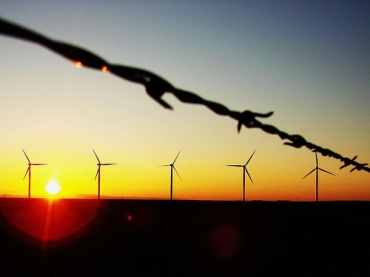
Potentially the largest wind farm in the U.S. was approved this week. Wyoming's Chokeberry and Sierra Madre Wind Energy Project could eventually provide electricity to 1 million homes, said Interior Secretary Ken Salazar, when as many as 1,000 turbines are up and running. The project is set to begin groundwork next year. The Associated Press reports that turbines could go up over a three-year period within an area covering 350 square miles south of Rawlins in south-central Wyoming. Most of that area is overseen by the Bureau of Land Management. (Photo: Site of the future wind farm)

The officials in Carbon County, where the project is based, conditionally approved the wind farm after hearing public comment. The matter now goes to a state board for review, Jeremy Fugleberg of the Casper Star-Tribune reports. Commissioner Leo Chapman credited the developer, a subsidiary of Denver-based Anschutz Corp., for its work to study the birds at risk in the project area and its willingness to answer any questions thrown its way for the unanimous approval by the council and for the community's mostly favorable feeling toward the project. Chapman said such work and openness -- "things sometimes not shown by other wind project developers in the county --  helped the commissioners to approve the project." See also The Wyoming News report, here.

Wednesday, October 10, 2012

Feds pick preliminary route for major power line

A proposed electrical transmission line that would cross 1,100 miles from Wyoming into Idaho and provide improved electricity to the southern parts of those states and beyond has received federal approval for its latest route. The Bureau of Land Management has chosen the route because it largely avoids wildlife habitats, national trails and archeaologically and culturally significant areas. When built, the Gateway West Transmission Line Project will be the first major transmission line constructed in the region decades. (Gateway West map: Preferred route, with alternatives; for interactive version, click here)
Gateway West tried to keep the preferred route on federal land as much as possible to avoid potential right-of-way easements across privately owned land and reduce concerns about obstructed views from residents in nearby areas, Scott Streater of Energy and Environment News reports. If completed in 2018, the joint project of Rocky Mountain Power and Idaho Power will stretch from Glenrock, Wyo., to a substation 30 miles southwest of Boise. It will carry mostly wind-generated electricity to load centers across the West.

Environmentalists, local government leaders and private landowners have voiced concerns about the project since it was proposed five years ago. Concerns have ranged from damage to historic trails, raptor nests and U.S. Air Force safety. BLM spokeswoman Beverly Gorny said the preferred route is partly based on suggestions from more than 2,600 public comments submitted after a draft environmental impact statement was released last year. The BLM continues to study alternate routes for the line's 10 segments. A final route will be chosen after another EIS and public comment period are conducted by the end of the year. A final decision about the project will be made next year, Gorny said. (Read more)

Monday, October 8, 2012

Wind farm in Eastern Washington could revitalize rural community, be example to others

The small farming town of Oakesdale, Wash., just south of Spokane, population 420, looks much like other small towns and rural communities across the country: boarded-up storefronts, empty restaurants, few opportunities. Now city officials hope a $200 million wind farm just west of town will provide a boost to the local economy, Kaitlin Gillespie of The Spokesman-Review reports. (S-R photo by Derek Harrison)

First Wind, a Boston-based energy company, owns the Palouse Wind Project, a 58-turbine facility that will supply power to about 30,000 people. The four-year project is expected to be completed by Thanksgiving, though 37 turbines will be producing power by the end of next week. The project is "blowing in more than renewable energy," Gillespie writes. It's bringing business and tax revenue to Whitman County. The wind farm will generate $790,000 a year in property taxes, for a total of $13.8 million over its 30-year lifespan. The project created more than 100 jobs during construction and will provide 10 permanent positions. (Read more)

Monday, September 24, 2012

Wind energy installations could stop if federal tax break isn't renewed

Installations of new wind turbines could stop without renewal of an energy-production tax credit that expires at the end of the year, according to the American Wind Energy Association. Some wind-energy installations have already shut down, and there will likely be a rush to complete projects before the cut-off date, Matthew Wald of The New York Times reports.

The importance of subsidies is highlighted in the Shepherds Flat wind farm in north-central Oregon (Department of Energy photo), which officially opened Saturday. The $1.9 billion project was financed with a $1.3 billion federal loan. Wind was one of the largest recipients of federal subsidies for electricity production in 2007, receiving much more than coal or  natural gas.

Extension of the wind subsidy is unclear. Congress did not act to extend it before it recessed for the election season, and it's unlikely it will be discussed during the lame-duck session after the election. (Read more)

Saturday, September 8, 2012

Study says wind energy development increases personal income and creates jobs in rural counties

After all the cheerleading and naysaying on the matter, at last, a systematic analysis of how wind energy development affects rural counties has been done. That study, in the current issue of Energy Economics, shows that wind energy development increases both personal income and employment in the county where the development is located. The paper was authored by Jason P. Brown and John Pender of the U.S. Department of Agriculture's Economic Research Service, Ryan Wiser and Ben Hoen of the Lawrence Berkeley National Laboratory and Eric Lantz of the National Renewable Energy Laboratory.

The Daily Yonder breaks down the complexities to explain that "the economists looked at wind capacity installed in 12 states from 2000 to 2008. The states included Iowa, Kansas, Minnesota, Nebraska, North Dakota, South Dakota, New Mexico, Oklahoma, Texas, Colorado, Montana, and Wyoming. In all, the study area included 1,009 counties. Their findings concluded that for every megawatt of wind power capacity installed, total county personal income increased by $11,150 over the 2000 to 2008 period. And, for every megawatt of wind energy installed in a county, one half of a job was created." (Read more)

Friday, August 24, 2012

Romney would give states control over drilling on federal land, provide less support for renewable energy

Romney talks energy in Hobbs, N.M.
(NYT photo by Jim Wilson)

Mitt Romney proposed an end to a century of federal control over oil and gas drilling and coal mining on government land Thursday, in an energy plan that also calls for less support for renewable energy.

"The federal government owns about 28 percent of the 2.27 billion acres of land in the United States. But as of March 2012, only about 37 million acres were under lease for oil and gas operations, of which about 16.3 million acres have active oil and gas production or exploration, according to the Interior Department," Eric Lipton and Clifford Krauss of The New York Times write. "Under President Obama, officials in Washington have played a bigger role in drilling and mining decisions on federal lands in the states, and such involvement rankles many residents and energy executives, who prefer the usually lighter touch of local officials."

"The Romney campaign acknowledged that such a significant policy change would require the approval of Congress, the Times reports. "Getting such legislation passed, even if Republicans controlled the House and the Senate, would be very difficult, given certain opposition by Democrats and perhaps even some Republicans."  (Read more)

The National Journal reported month that some farmers are uneasy with the GOP ticket’s "opposition to renewable-energy policies that have helped them economically." Romney opposes a wind-energy tax credit "that has helped farmers bring in thousands of dollars in extra income by leasing their land to wind producers." His running mate, Rep. Paul Ryan, R-Wis., opposes the mandate for a certain amount of ethanol production, which has driven up demand — and probably prices — for corn. "Romney stands by his support of the ethanol mandate," but "Ryan’s record of full-throated opposition to it rubs corn and crop farmers the wrong way," Coral Davenport writes. "In addition, Ryan’s budget roadmap proposes deep cuts in renewable-energy and nutrition programs that help farmers." (Read more)

Friday, August 17, 2012

Corn farmers, meat producers and biofuel makers argue over ethanol quota amid drought

A Kansas ethanol plant reecieves corn.
(NYT photo by Steve Hebert)
Three big agribusiness interests -- corn farmers, meat producers, and biofuel refineries -- are in a political fight to protect their interests amid the ravaging drought. At issue, reports John H. Cushman Jr. of The New York Times, "is whether to suspend a five-year-old federal mandate requiring more ethanol in gasoline each year, a policy that has diverted almost half of the domestic corn supply from animal feedlots to ethanol refineries, driven up corn prices and plantings and created a desperate competition for corn as drought grips the nation’s farm belt."

Meat producers, writes Cushman, "are demanding that the Obama administration waive the ethanol quota to ease rising feed prices. But ethanol producers worry that the loss of the quota will undermine the ethanol industry and do little for corn farmers but drive down the price of their stunted harvest. The meat industry, backed by several governors, lawmakers and even international food agencies, argues that the quota has distorted grain markets by sucking up corn when ranchers can least afford it. But the ethanol industry says that its corn consumption is down 12 percent since the start of the summer and that weekly ethanol production is at a two-year low. As corn prices have risen, refineries have scaled back production, idled dozens of plants and sold ethanol inventories. As a result, the industry may consume 10 percent less of this summer’s crop than last year’s, government and industry officials said." (Read more)

Thursday, June 14, 2012

The ethanol slowdown has begun; corn prices expected to decline at least 20 percent

After a visit to Walhalla, N.D., where Archer Daniels Midland Co. had just closed an ethanol producing plant that was the town's largest employer, Mark Peters writes in The Wall Street Journal that America's ethanol boom is stalling. Further, Peters reports that "the effects are starting to spread across a Farm Belt that had grown accustomed to soaring growth." Annual U.S. production of ethanol more than tripled from 2005 to 2011, driving up crop prices and pumping money into rural communities from Nebraska to North Dakota. Now, the demand for the corn-based fuel additive appears to have topped out. The amount used in gasoline is near federal mandates, and gasoline consumption is declining. According to the U.S. Energy Information Administration's May forecast, after 15 straight years of growth, ethanol production this year will fall slightly and will be roughly flat next year. (Most of the story is behind a paywall.)

"The ethanol industry expanded based partly on expectations that gas consumption would keep rising, and that ethanol's share of that would continue to grow," Peters writes. "Instead, gas demand this year is projected to be 6.7 percent below its peak in 2007, and efforts to expand ethanol's share face challenges." U.S. plants now face excess capacity, producing less than 14 billion gallons of ethanol a year, with capacity of 14.7 billion gallons, according to the Renewable Fuels Association, an ethanol trade association.

What does this mean for farmers? Writes Peters: "The slump is weighing on prices American farmers get for corn, which rose to record highs in recent years based partly on ethanol demand. The ethanol industry now consumes about 40 percent of corn produced in the U.S., up from around 14 percent in 2005. The Agriculture Department projects corn prices for this year will decline at least 20 percent to an average of $4.20 to $5 a bushel, partly because of flat demand from ethanol producers."

Monday, June 11, 2012

Obama makes pitch to rural voters in eight states

If President Obama shows up in an interview on your local television news tonight, you can be certain (with two exceptions) that he considers your state, and probably your TV market, important to his re-election. The markets include Green Bay, Roanoke, Jacksonville, Sioux City, Colorado Springs and Reno, plus Fresno, Calif., and Greenville, S.C. -- in a solid blue state and a solid red state, perhaps included so the White House can say it wasn't all political.

Obama scheduled interviews "in mostly Republican-friendly parts of swing states to promote his Democratic administration’s efforts for rural communities," Margaret Talev reports for Bloomberg News. He also announced "investment of about $2 billion through 2016 for rural businesses" and touted a report from the Council of Economic Advisers, the White House Rural Council and the U.S. Department of Agriculture: "Strengthening Rural Communities: Lessons from a Growing Farm Economy."

The "lessons" are a but hard to discern, but the report says "A strong agricultural economy is critical to a strong rural economy," that progress in the farm economy is driven by innovation, more exports, promotion of diverse industries, "supporting rural communities" and "building a clean energy economy," a section that touts Obama's efforts in that area. To download a PDF of the 32-page report, click here.

Bill Bishop of the Daily Yonder analyzed the report, saying it's mostly about agriculture, leaving out the environment, worker safety, education and the hearings the administration had across the country about the lack of competition in the agriculture business. "Four times in the first four sentences, we are told that people who live in rural America are 'hard working' or 'work hard' or are accustomed to 'hard work.' Alright already," Bishop writes. "It's also not very hard to see how members of the Obama administration sees rural America. To them, it's one big farm."