Showing posts with label politics. Show all posts

Friday, October 19, 2012

Rural voters oppose 'Obamacare', except when label is dropped and law is called by its real name

Party labels affect what rural voters think about the Patient Protection and Affordable Care Act, according to the latest National Rural Assembly and Center for Rural Strategies poll of rural voters in nine swing states, reports Bill Bishop of the Daily Yonder, which the center publishes.

When asked if they approved or disapproved of the "Affordable Care Act, sometimes called Obamacare," 60 percent of rural voters said they opposed the law, and 34 percent said they favored it. Without reference to "Obamacare," voters were asked if they approved or disapproved of the law, which "would give states the opportunity to extend Medicaid coverage to cover more low income families with health insurance, with the federal government picking up 90 percent of the costs," and 45 percent said they approved, while 42 percent disapproved.

Bishop concludes that partisanship is the culprit for such results. "Partisanship overwhelms issues in today's politics," he writes. "Voters are willing to change their beliefs -- even their religious affiliation ... in order to stay with their political tribe." (Read more)

Farm Bill includes conservation provisions important to hunters and the economy

Many Americans probably don't realize that the Farm Bill contains provisions for wildlife conservation programs, and that this has caused more than just farmers to press Congress for a vote on the bill. Hunters, anglers and conservationists have also been petitioning for passage of the stalled legislation. In a Politico opinion piece this week, Dale Hall, former director of the U.S. Fish and Wildlife Service and current CEO of Ducks Unlimited, writes about why conservation programs are so important.

"The Farm Bill's Conservation Reserve Program and Wetlands Reserve Program not only have a positive impact on wildlife populations but also help conserve soil and keep our streams, rivers and lakes clean," Hall writes. The incentive-based programs allow conservation groups to work with farmers  to create benefits for all stakeholders: wildlife, farmers, ranchers, the environment and hunters and fishers, "which generates significant financial support for out nation's economy," Hall says. Hunters, fishers and wildlife watchers spent $145 billion on wildlife-related recreation last year, according to the Fish and Wildlife Service.

Three aspects of the Farm Bill are of particular concern to conservation groups, Hall writes: maintaining and strengthening effective wetland protections, a national "sodsaver" provision to protect native prairies, and preserving conservation programs. (Read more)

Laid-off Appalachian miner blames politicians, but not those you might think, for region's woes

Thousands of Central Appalachian coal miners have been laid off since January as coal companies decrease operations in the region and move to more lucrative mining areas, including the Powder River Basin in Wyoming. There are several reasons for this, the biggest of which is cheap natural gas. Mimi Pickering and Sylvia Ryerson of radio station WMMT in Whitesburg, Ky. recently interviewed Letcher County miner Gary Bentley, to collect his thoughts.


Bentley, 29, lost his job with Arch Coal Inc. in June, and after months of searching, was hired at a mine in Owewnsboro, Ky., five and a half hours from Whitesburg in the western part of the state. He worked for Arch for 10 years, and is a Letcher County native. The layoffs are unlike anything he's seen, he told Ryerson and Pickering, and he doesn't think it's fair.

"People come in here and they make billions of dollars, and they've been doing it for hundreds of years here, and now when they're leaving, they're just leaving us with nothing," Bentley said. He was lucky to find work in Kentucky, he said, because many other miners he worked with had to get jobs in Alabama, Pennsylvania, West Virginia and even Australia. It's also been slightly easier for him because he has a high school diploma. Some older miners he knows have no more than a sixth-grade education, and were hired before mining companies began requiring at least a high school education.

Bentley said local politicians want to blame Central Appalachian coal's decline on the federal government because of increased Environmental Protection Agency regulations, but what he saw at EPA hearings in Pikeville, Ky., showed him a different story. "I was real disappointed with our local, state and regional politicians because I felt like they all wanted to get up there and point fingers and say 'It's this person's fault, it's this person's fault. They're trying to destroy our industry; they're destroying Eastern Kentucky,'" Bentley said. "But at the same time, they're in the position. Why weren't they doing more to stand up for the region? Why weren't they doing more to try and bring in other industry?"

Bentley continued: "Anybody with any sort of intelligence that keeps up on the coal industry saw the declines coming. ... So, I feel that the political leaders really failed us by not having a back up plan for this area and for these communities. ... We need real answers and real solutions, not just a bunch of hot wind." To listen to Bentley's full interview, click here.

Thursday, October 18, 2012

NRA using Obama's remark about possible renewal of assault weapon ban as rallying point in swing states

The National Rifle Association is using President Obama's Tuesday-night debate reference to a possible reintroduction of an assault weapons ban as a pro-Mitt Romney rallying cry to gun owners in swing states. Dan Freeman of the Houston Chronicle reports, "The NRA has fielded 25 paid organizers deployed to 13 states including battlegrounds that may determine the election's outcome such as Florida, Ohio, Colorado, Wisconsin, Virginia and Nevada. In addition, an army of 4,300 volunteers is making hundreds of thousands of phone calls, distributing thousands of fliers and visiting events and places where gun owners congregate, Andrew Arulanandam, NRA director of public affairs said."

Obama, asked about about limits on AK-47 assault rifles, replied, "What I'm trying to do is to get a broader conversation about how do we reduce the violence generally." Then he mentioned the possibility of reinstating the assault-weapon ban that was passed by a Democratic Congress in 1994 but expired in 2004 when the Republicans were in control. Dan Gross, president of the Brady Campaign to Prevent Gun Violence responded to the NRA challenge: "The president has a lot more to gain by voicing the concerns of the public on this issue than he had to lose. This is a conversation the American public wants to have." (Read more)

Wednesday, October 17, 2012

Belief in climate change soars among conservatives but most still don't think it is caused by humans

Belief in climate change has climbed recently, making a rebound from a sharp drop in 2009, according to a Pew Research Center poll. About 67 percent of Americans now believe temperatures are rising, with acceptance stretching across all age groups and political party affiliations, including more skeptical senior citizens and Republicans, Evan Lehmann of Energy and Environment News reports.

Forty-eight percent of Republicans agree that there is "solid evidence" that Earth's temperature has increased over several decades. That's a 5-percentage-point climb among Republicans since last year, and a 13-point rise since 2009. The biggest jump among Republicans came from conservatives, 43 percent of whom now believe in climate change, an increase of 12 points since last year. Fifty-eight percent of Republican moderates believe in it.

However, far fewer Republicans believe that climate change is man-made. About 38 percent of GOP moderates say human activity, including the burning of fossil fuels, causes climate change, and only 16 percent of conservatives agree with that. (Read more)

Swing-state rural voters prefer Republican Farm Bill

Since the failure of the Republican-led House to pass a Farm Bill before the September 30 deadline, Democrats running for office in rural districts have been using it as ammunition. Whether that makes rural voters pick Democrats on election day is yet to be seen, but in the latest National Rural Assembly and Center for Rural Strategies poll of rural voters in nine swing states, voters preferred the Republican approach over the Democratic one, 61 to 27 percent.

The poll described the Democratic position this way: "Democrats have said allowing the Farm Bill to expire is devastating for rural America. The Farm Bill supports rural development programs, invests in renewable energy industry, and provides an important safety net for farmers and producers. It would especially help those suffering for record drought. The Supplemental Nutrition Assistance Program, also called food stamps, not only helps feed people, but 14 cents per dollar of the money from this program goes into the pockets of farmers."

It described the Republican position like this: "Republicans have said they want to pass a Farm Bill that is helpful to farmers and rural communities. Eighty percent of the current Farm Bill goes to fund the food stamp program, which is in dire need of reform. The number of people on food stamps has increased by 59 percent under President Obama, and the program is filled with waste and fraud. Many other provisions of the Farm Bill are badly outdated. We need a modern Farm Bill focused on helping farmers."

Voters polled said the Republican approach was closer to their view by a 34-point margin. "We should point out that not many rural voters actually have anything to do with farming," reports Bill Bishop of the Daily Yonder, which is published by the center. Only 7 percent of those polled said they or someone in their family made more than half their income from farming, and 12 percent said they received less than half of it from farming. Eight of 10 said no one in their families made any income from agriculture. (Read more)

Tuesday, October 16, 2012

Swing-state rural voters prefer Romney by 22 pts.

Mitt Romney is now leading President Obama in rural swing states by a 22-point margin, according to a National Rural Assembly poll released today. Rural voters polled last week said they preferred Romney to Obama by 59 to 37 percent. In a similar poll from September, Romney led by 14 points. The poll questioned voters in rural counties in nine states: Colorado, Florida, Iowa, Nevada, New Hampshire, North Carolina, Ohio, Virginia and Wisconsin. (Daily Yonder photo: Romney speaks in Lebanon, Ohio)

"The poll documents a continuing -- in fact, accelerating -- collapse of support for President Obama among rural voters," Bill Bishop of the Daily Yonder reports. Rural voters were "staunchly Republican" in 2000 and 2004, when George W. Bush won the rural vote by almost 20 points. Obama lost the rural vote in 13 swing states in 2008 by just a little more than 2 percentage points, Bishop writes. North Star Opinion Research's Dan Judy told Bishop the September poll showed Romney was "under-performing" among rural voters, but now that he's surged ahead, Judy said he thinks "it's fair to say his lead among these rural voters is what's helping him in swing states overall."

The poll asked which candidate would do a better job handling a range of issues, from the economy to medicare. "Voters thought Romney would do a better job than Obama in addressing every issue -- often by enormous margins," Bishop reports. Judy told Bishop he expects these margins to stand through the election because rural voters have "innate conservatism" that will push them to vote Republican. (Read more)

Federal criminal justice spending 'steadily declining;' How dependent is your local agency?

The U.S. Department of Justice has reduced funding for state and local criminal justice agencies by 43 percent over the last two years, according to a National Criminal Justice Association and Vera Institute of Justice report. Failure to resolve the national budget crisis could make things worse, the report says. This likely has a disproportionate impact on rural agencies who have less resources and oftentimes depend on federal money to operate.

Agencies "on the front lines of the justice system, including police," fear that cuts in spending would practically end federal criminal justice funding by 2021, reports Ted Gest of The Crime Report. Federal funding for state and local anti-crime efforts is "at a historically low level," the report said, with more than three-fourths of agencies surveyed saying their federal aid has been steadily declining. Fourteen percent of survey respondents said their federal grants have been cut by more than half. (Read more)

Monday, October 15, 2012

Delta political leaders thrash three Ark. politicians for expressing racial and religious prejudice

A group of political leaders in the eight-state federal Delta region, stretching from southern Illinois to the mouth of the Mississippi, has condemned three Arkansas politicians for derogatory statements they made about Muslims and African Americans. The Mississippi Delta Grassroots Caucus, which supports and works with the federal Delta Regional Authority, said the statements "are the prejudiced views of a tiny minority and do not reflect the point of view of the vast majority of people in Arkansas." About 30 to 40 percent of the MDGC is African American, and the group says it has strong ties to the Muslim community.

The statements in question came from three state Republicans: Rep. Jon Hubbard, who said African Americans benefitted from slavery and criticized those who chastised him by saying "this reeks of Nazi-style political intimidation;" state House candidate Charlie Fuqua, who wrote in the book God's Law that all Muslims should be expelled from the U.S.; and state Rep. Loy Mauch, who said in a 2001 editorial that Abraham Lincoln was a terrorist. (Read more)

Thursday, October 11, 2012

Va. not getting full story about coal's influence on presidential race in the state, media critic writes

Coal is at the center of this year's presidential election, with both camps touting their love of the industry and the central Appalachian region where the Obama administration's co-called "war on coal" seems to rage the fiercest. However, news outlets haven't kept up with coverage of just how big a role coal is playing in the race, Tharon Giddens of the Columbia Journalism Review reports from Virginia, like Ohio a swing state where coal can swing votes.

Both candidates have used messages about coal. Mitt Romney ran two ads criticizing President Obama's alleged over-regulation of the industry the day after Alpha Natural Resources announced mine closures and layoffs. He also made a stop in Abingdon in southwestern Virginia, near the coalfield, last week. Obama continuously touts his advocacy for "clean coal" as part of his energy strategy.

"Coal has recently moved to the center of the message war in this swing state," Giddens reports. "The political story around coal in Virginia is rich -- but most of the coverage to date has been less so, and not only because ... most news outlets here aren't doing enough to fact check the ads on the airwaves." Giddens writes that they have largely failed to recognize that while Obama's didn't do well in coal country in 2008, in a tight race, every vote counts. "Coal miners are an eye-catching stand-in for the white working class," and both campaigns are trying to target that demographic, he writes. There's been very little push-back by reporters against "the narrative about regulations forcing layoffs at Alpha," when industry experts say the industry's layoffs are stem mainly from low demand, caused by cheap natural gas and a warm winter, which left big stockpiles of coal.

"The problem is that the context, perspective and expertise on display in some of the stronger opinion pieces has been mostly lacking in the political reporting on coal, whether it’s being done in southwestern Virginia or the state’s metropolitan centers," Giddens reports. "Even setting aside environmental concerns, as the candidates have mostly done while they present themselves as friends to coal, the news coverage hasn’t done enough to dig into the campaigns’ messages, explore coal’s influence on the race, or use this opportunity to explore the story of a changing industry and region." (Read more)

Ohio Democrats allege Murray and his coal company illegally forced employees to donate to Republicans

The Ohio Democratic Party asked federal and state prosecutors Monday to investigate whether the CEO of the largest privately owned coal company in the U.S. illegally coerced employees to contribute to Mitt Romney and other Republican candidates, Jim Provance of the Toledo Blade reports. ODP Chairman Chris Redfern asked that Murray Energy Corp. and Robert Murray, left, be investigated for extortion, money laundering and racketeering.

The complaint claims Murray contributed $720,000 to Ohio candidates and millions to federal candidates through the company's political action committee, including Romney, U.S. Senate candidate Josh Mandel and Gov. John Kasich. The Blade said it could not reach Murray Energy's attorney for comment. The complaint also alleges Murray and the company forced employees to contribute to the company's political action committee through automatic payroll deductions and required attendance at fundraisers.

Murray hosted a rally for Romney on Aug. 14 at his company's Century Mine in Beallsville in southeast Ohio. Romney was surrounded by miners as he spoke. Some of those miners later told a West Virginia radio talk show host that Murray closed the mine for the day and required miners to attend the rally without pay. The company said there was no requirement. (Read more)

Wednesday, October 10, 2012

All journalists should take apart those misleading political ads; here's another tool to help you do it

By Al Cross
Institute for Rural Journalism and Community Issues

With less than a month until the hugely important Election Day for federal, state and local offices, the airwaves are being clogged with commercials from campaigns, party committees, so-called "super PACs" and other outside players, and most of them are playing fast and loose with the truth.

Pointing out lies and misrepresentations is the duty of journalists, including rural journalists. You may think that you need to stick to local coverage, but you should should remember that many if not most of your audience has no easy access to daily newspapers that pick apart the ads for federal and state office -- and that there and many sources from which to glean facts and analysis about ads that are running on your local airwaves. The voters you serve deserve the best possible information, and you are the only source for many of them to get it. Please do not forsake this responsibility.

Previously, we have noted the services FactCheck.org, Politifact.com and The Washington Post's Fact Checker column, which we have found reliable, with only very rare and minor errors. In addition to fact-checking, now there is a service that can help you track the volume and sponsors of ads: Political Ad Sleuth, a searchable database of political ad buys across the nation, as well as a crowd-sourced research tool for journalists. The site has data on where presidential, congressional and issue ads are running and who is paying for them.

The site is based on online ad files from the Federal Communications Commission, which cover the top 50 media markets, plus files uploaded by volunteers in smaller markets. If you are in such a market, you can become one of those volunteers and return the favor. Learn how you can help here.
A tutorial about political ad files and the site itself is here. To contact the nonpartisan Sunlight Foundation, which operates the site, click here.

Tuesday, October 9, 2012

Good pay, independent culture, dislike of Obama make Appalachian coal miners 'proud to be scabs'

"As recently as the 1980s, plenty of coalfield residents thought Big Coal was the problem. But these days, in . . . Central Appalachia — southern West Virginia, southwestern Virginia, eastern Kentucky and eastern Tennessee — coal mining is overwhelmingly popular, despite well-documented risks to workers’ health and community safety," reports Gabriel Schwartzman of In These Times, a liberal, labor-oriented managzine. (Photo by Schwartzman: Supervisory miner gets coffee before work)

Schwartzman spent this summer in the region trying to determine why the previous Democratic and union stronghold has turned so sharply to the right, and doesn't mince words in presenting his conclusion: "At $108,000 a year, nothing in Appalachia compares to miners' wages," he writes. Those wage increases are linked to increased mechanization and smaller workforces, and have changed the political and financial nature of that workforce, he reports. One miner in Pike County, Kentucky, told him he would lose everything if "coal was shut down" because no job in the region could pay him as much.

The union battles for higher wages, better safety and benefits of 30 years ago were largely lost, ultimately ending with the United Mine Workers of America abandoning strikes, Schwartzman writes. Companies raised wages without unions, but cut many jobs with increased mechanization. A major unionized company in the region, Patriot Coal, is now bankrupt and unable to pay miners' pensions.

Miners with jobs told Schwartzman the non-union life is good. "We are scabs. We're proud to be scabs," one surface miner at Camp Branch mine in West Virginia told him. They are loyal to their companies, and that loyalty extends to families, friends and businesses supported by coal miners, Schwartzman reports. But an Energy Information Administration forecast of a 58 percent decline in Central Appalachian coal production by 2035 is reason for many to worry. Though the current decline is being caused mainly by competition from cheap natural gas and the decreased viability of Appalachian coal, miners tend to believe increased environmental regulation is the cause.

Schwartzman reports intimidation and threats received by those who advocate for safer mining practices or oppose mountaintop-removal mining. "Social media is used as a mobilizing tool against 'tree huggers,'" Schwartzman reports. "Aside from calling rallies and protests, post like this August 6 one appear regularly on Citizens for Coal's Facebook page: 'Just saw a post saying tree hugger in Gilbert eating at Wallys restaurant.'"

Many miners expressed to Schwartzman the need to vote out President Obama, even though his administration increased mine safety inspections, probably reducing miner injuries; increased health care for black-lung victims, and increased investments in clean-coal technology. Schwartzman writes that coal companies stir up anti-Obama rhetoric, but the Christian right and the National Rifle Association also play a role. "Those forces play upon values of autonomy and independence that run deep here," Schwartzman writes. "For 150 years, these values have helped Appalachians survive outsiders exploiting their mountain resources. Now those values have become aligned with out-of-state coal companies against environmentalists and liberals." (Read more)

Neither party has supported policies that will help the coal miner, Betty Dotson-Lewis writes for the Daily Yonder.

Monday, October 8, 2012

Did a pastor in your area endorse a candidate from the pulpit Sunday? It's a national story

In a move that could put their tax-exempt status at risk and result in fines, an estimated 1,500 pastors nationwide endorsed presidential candidates Sunday. The move was a challenge to the law prohibiting political endorsements by religious and other tax-exempt organizations, policed by the Internal Revenue Service. (Bloomberg News photo)

The goal of "Pulpit Freedom Sunday" was "to defy this rule and prompt the IRS to take action against a church that could become the basis for a court case to test whether the amendment infringes on constitutional rights to free religious and political speech," reported Jennifer Hawes of The Post and Courier in Charleston, S.C. The event was first organized four years ago by the Christian group Alliance Defending Freedom. All participants pledged to film their sermons and send them to the IRS.

Rev. Steven Baines, religious outreach director for Americans United for Separation of Church and State, told Hawes the political action "opens the door to politicizing our pulpits." The risk is that churches and pastors could become political fronts, he said. "They have freedom of speech. They can preach about their values, and we encourage pastors to preach about their values. But they cannot relate those to a particular candidate or party."

Participating pastors said they were taking part because their messages shouldn't be filtered through the IRS. But the average voter doesn't want pastors politicizing their sermons, according to a decade's worth of Pew Research Center polls, Hawes reported. In a July survey, 66 percent of people polled said churches and other places of worship should not endorse candidates. Even 90 percent of Protestant pastors polled in a May LifeWay survey said they shouldn't endorse from the pulpit. (Read more)

Presidential candidates don't focus on rural issues

"As they campaign, presidential candidates Barack Obama and Mitt Romney pretty much ignore rural-specific issues," even though they have plenty of opportunity to focus on those issues, Don Davis of the Grand Forks Herald reports, noting that some major swing states that are frequent stops on campaign trails are "heavy on agriculture."

The House Agriculture Committee ranking Democrat, Rep. Collin Peterson of Minnesota, told Davis that the gist of each candidate's stance on agriculture is this: Mitt Romney favors fewer regulations, as do many rural residents; Obama is better at supporting the Farm Bill, which includes disaster relief for farmers and funding for rural development projects. University of North Dakota economics professor David Flynn told Davis rural people are "'forced' to back the candidate of their favorite parties ... because neither delivers enough information for them to make good decisions."

"Neither candidate is laying out any specifics regarding rural-specific policies, even the consequences of other policy ideas such as energy on rural economies," Flynn said. "There is no attention being paid to it. At some level, it is a disservice." Ed Schafer, former agriculture secretary and a member of Romney's Agriculture Advisory Team, said the candidates miss an opportunity to talk about the strength of U.S. farming when they don't focus on rural issues. Obama focuses on renewable energy when talking farm issues, but other parts of the farm-sector "can't get an ear anywhere," Schafer said.

"Rural America is not on the front burner for one main reason: votes," Davis writes. Center for Rural Strategies President Dee Davis said the issues facing rural America are complex and not easy to solve, and candidates know they get most of their votes from urban areas. (Read more)

Feds pencil another non-Appalachian county into their efforts to fight drug traffic in the region

When the Appalachian Regional Commission was created in 1965, it included for political and other reasons many counties that were not part of the poor, mountainous region but resembled it economically. Since then, Congress has added several such counties to the officially recognized region to make them eligible for ARC help. Some truly Appalachian counties grumbled that the pool of money was being diluted, and they are doing likewise now that the Obama administration has placed Kentucky's central crossroads town in the Appalachia High Intensity Drug Trafficking Area, "a jurisdiction set up to fight the drug trade in the mountains," reports Roger Alford of The Associated Press, who once reported for the wire service from Eastern Kentucky.

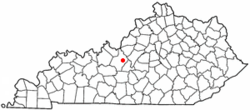
"This is a place of rolling countryside, cattle farms and cropland," Alford writes."That's why some eyebrows arched when the Obama administration penciled Hardin County into Appalachia." (Wikipedia map locates Elizabethtown in Hardin County; map below shows the ARC territory, which is not affected by the anti-drug jurisdiction's boundaries.)
The Office of National Drug Control Policy said it added Hardin County at the request of U.S. Sen. Mitch McConnell of Kentucky, the Senate Republican leader. McConnell told the AP, "The argument I made is that, even though this is not technically an Appalachian county, it's not too far away from Appalachia and it's right here with two interstates going north and south and east and west, and clearly is a transit point" for drugs. Louisville and Bowling Green, metropolitanm areas north and south of Elizabethtown on Interstate 65, had already been added to the area. At the same time it added Hardin County, the drug office also added Brooke, Hancock, Marshall and Ohio counties in northern West Virginia.

Some Central Appalachian political leaders say adding western counties to the list will make it harder for federal money to reach eastern counties that need it more. "Bringing on more counties only makes our situation less hopeful," Harlan County Judge-Executive Joe Grieshop told Alford. (Read more)

Wednesday, October 3, 2012

Dairy farmers struggled through drought, now battle armyworms; will suffer without Farm Bill

Dairy farmers will lose up to 10 percent of their monthly income from milk beginning in October because the Milk Income Loss Contract expired when the Farm Bill wasn't renewed on Sept. 30. MILC is a program that provides dairy farmers with payments when the price of producing milk is more than the price for which it's sold. (Oklahoma Farm Report photo)

MILC payouts were cut to 34 percent, from 45 percent, when the Farm Bill expired, Melissa Miller of the Southeast Missourian in Cape Girardeau reports. High feed and gas prices have forced farmers to sell their least productive cows to slaughter, and some small farmers are considering leaving the business. Miller writes that the armyworm is adding to farmers' misery. The pest strips pasture grass, which often replaces expensive feed. Dairy Farmer John Schoen told Miller most farmers are likely losing $10,000 to $15,000 a month.

"Dairy is one of the few commodities that will get hit immediately by this [Farm Bill expiration] because we're on a monthly schedule," Jefferson County Farm Bureau president Michael Kiechle told Ted Booker of the Watertown Daily Times in far upstate New York. "We probably won't get anything now until the crops go in the ground next spring."

Commercial dairy farmers in Maine "depend on subsidies in the [Farm Bill] to help them get through tough times," reports Jay Field of Maine Public Broadcasting. They are selling milk for less than it costs to produce it because of high gas and feed prices. One farmer told Field he will spend $6,000 more on fuel this year, and is barely covering operating costs right now.

Tuesday, October 2, 2012

Harry Potter's J.K. Rowling takes a stab at rural life and politics in her first novel for grownups

The self-made literary master of the fantasy world of teenage witches and wizards has turned her attention to the real-life drama of rural politics in a new book out this month. The Casual Vacancy, J.K. Rowling's first adult novel, explores the inner workings of small-town political and personal life in the fictional English village of Pagford, after the death of one of its council members. Though the story is set in England, it could resonate in the U.S. with those familiar with small-town politics. After all, it's our mother country.

Rowling has created "an old-fashioned novel, a thoughtful, angry and densely plotted story in the 19th-century tradition," in which Pagford "is small but its class and racial divisions run deep," Isabel Berwick of The Financial Times reports. The novel explores class divisions between "the posh houses" and inhabitants of Church Row and the Fields, "a sink estate on the outskirks of the neighboring town, Yarvil." The plot centers around the council chair's campaign to fill the vacancy with his son, and then use the council to relieve Pagford of any duty to the Fields. (Read more)

Friday, September 28, 2012

Three of eight Americans don't believe in science of climate change; debate more cultural than scientific

There is no denying that a strong scientific consensus about the existence of climate change exists, especially since scientists have documented a build-up of greenhouse gases and their findings have been endorsed by a large body of domestic and international scientific agencies. But what doesn't exist in the U.S. is a social consensus about climate change. Studies have shown that Americans' belief in the scientific findings of climate change has mostly declined over the last five years.

Between April 2008 and October 2009, belief in climate science dropped to 57 percent from 71, according to the Pew Research Center. This February, it had risen to 62 percent, which means 38 percent of Americans still do not trust it. "Such a significant number of dissenters tells us that we do not have a set of socially accepted beliefs on climate change," Andrew Hoffman, right, the Holcim Professor of Sustainable Enterprise at the University of Michigan, writes for the Stanford Social Innovation Review. He says the debate is not so much about science as about culture, worldviews and ideology.

"Acceptance of the scientific consensus is now seen as an alignment with liberal views consistent with other 'cultural' issues that divide the country -- abortion, gun control, health care, and evolution," Hoffman writes. This partisan divide on the issue is a recent phenomenon, something that wasn't seen during the 1990s. Hoffman examined "the climate change debate through the lens of the social sciences," because he says "we need to understand the social and psychological processes by which people receive and understand the science of global warming."

He writes there are two "overriding conclusions" about the climate change debate: Climate change is not a "pollution" issue, and it is an existential challenge to our contemporary world views. He outlines three possible ways in which the ideological debate will manifest: the "Optimistic Form," in which "people do not have to change their values at all," the "Pessimistic Form," in which "people fight to protect their values," and the "Consensus-Based Form," in which "a reasoned societal debate, focused on the full scope of technical and social dimensions of the problem and the feasibility and desirability of multiple solutions," are discussed. (Read more)

Tuesday, September 25, 2012

Presidential candidates talk policy in Farm Bureau survey, but don't fully answer some questions

The answers are in to the American Farm Bureau Federation presidential candidate questionnaire. In it, candidates Mitt Romney and Barack Obama give their views on several issues, including energy, environment and farm policy, with all questions revolving around agriculture.

Here are excerpts from the extensive questionnaire. The full-length version is available here

AFBF: Agriculture is an energy-intensive industry and volatile prices significantly affect the cost of growing crops. What policies will you support to meet our energy needs and strengthen energy security? What role do you see for agricultural-based biofuels in the nation’s energy supply?

Obama: U.S. biofuel production is at its highest level in history. Last year, rural America produced enough renewable fuels like ethanol and biodiesel to meet roughly 8 percent of our needs, helping us increase our energy independence to its highest level in 20 years. We are increasing the level of ethanol that can be blended into gasoline, and the new Renewable Fuel Standard helped boost biodiesel production to nearly 1 billion gallons in 2011, supporting 39,000 jobs.

Romney: I have a vision for an America that is an energy superpower, rapidly increasing our own production and partnering with our allies, Canada and Mexico, to achieve energy independence on this continent by 2020. . . . America’s energy resources can be a long-term competitive advantage for American agriculture and their development is key to the success of the industry.

AFBF: A new Farm Bill will be enacted and implemented over the next four years during a time of significant evolution in agriculture. What policy and risk management tools do you propose to ensure that agriculture is a profitable, competitive and viable industry? 

Obama: I understand the need for a strong farm safety net. That’s why I increased the availability of crop insurance and emergency disaster assistance to help over 590,000 farmers and ranchers keep their farms in business after natural disasters and crop loss. My administration expanded farm credit to help more than 100,000 farmers struggling during the financial crisis to keep their family farms and provide for their families. And as farmers continue to go through hard times because of this drought, we are expanding access to low-interest loans, encouraging insurance companies to extend payment deadlines and opening new lands for livestock farmers to graze their herds. And I know that any Farm Bill passed this year . . . needs to have adequate protections for America’s farmers. That’s why I have called for maintaining a strong crop insurance program and an extended disaster assistance program.  . . . Instead of making farmers pay more for crop insurance, we will do it by cutting subsidies to crop insurance companies and better targeting conservation funding.

Romney:  I support passage of a strong Farm Bill that provides the appropriate risk-management tools that will work for farmers and ranchers throughout the country. In the near term, my immediate priority should be given to enacting disaster relief for those not traditionally covered by crop insurance as this year’s drought has worsened. . . .  Other nations subsidize their farmers, so we must be careful not to unilaterally change our policies in a way that would disadvantage agriculture here in our country. In addition, we want to make sure that we don’t ever find ourselves in a circumstance where we depend on foreign nations for our food the way we do with energy. Ultimately, it is in everyone’s interest is achieve a level playing field on which American farmers can compete.

AFBF: U.S. agriculture has a long history of relying on temporary workers to help plant and harvest crops, tend orchards and manage livestock. What would you do to solve agriculture’s labor shortage problem? 

Obama: We must design a system that provides legal channels for U.S. employers to hire needed foreign workers. This system must protect the wages and working conditions of U.S. workers and only be used when U.S. workers are not available. I have called on Congress to pass and implement the AgJOBS Act, which allows farmers to hire the workers they rely on, and provides a path to citizenship for those workers. But we cannot wait for Congress to act, which is why my administration is already taking action to improve the existing system for temporary agricultural workers. We are also standing up a new Office on Farmworker Opportunities at the U.S. Department of Agriculture, the first office for farmer workers in the agency’s history.

Romney: Our current system for issuing visas to temporary, seasonal workers is broken. Too often, harvest or tourist season passes before temporary worker visas are approved. Indeed, in 2006 and 2007, 43 percent of all applications for temporary agricultural workers were not processed on time. As president, I will make the system for bringing in temporary agricultural workers and other seasonal workers functional for both employers and workers ... A legal immigration system that works will provide a lawful alternative to workers who would otherwise enter illegally and employers who face the choice of either reducing operations or turning to illegal labor to address labor shortage problems.