Showing posts with label prescription drugs. Show all posts

Monday, October 8, 2012

Feds pencil another non-Appalachian county into their efforts to fight drug traffic in the region

When the Appalachian Regional Commission was created in 1965, it included for political and other reasons many counties that were not part of the poor, mountainous region but resembled it economically. Since then, Congress has added several such counties to the officially recognized region to make them eligible for ARC help. Some truly Appalachian counties grumbled that the pool of money was being diluted, and they are doing likewise now that the Obama administration has placed Kentucky's central crossroads town in the Appalachia High Intensity Drug Trafficking Area, "a jurisdiction set up to fight the drug trade in the mountains," reports Roger Alford of The Associated Press, who once reported for the wire service from Eastern Kentucky.
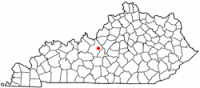
"This is a place of rolling countryside, cattle farms and cropland," Alford writes."That's why some eyebrows arched when the Obama administration penciled Hardin County into Appalachia." (Wikipedia map locates Elizabethtown in Hardin County; map below shows the ARC territory, which is not affected by the anti-drug jurisdiction's boundaries.)
The Office of National Drug Control Policy said it added Hardin County at the request of U.S. Sen. Mitch McConnell of Kentucky, the Senate Republican leader. McConnell told the AP, "The argument I made is that, even though this is not technically an Appalachian county, it's not too far away from Appalachia and it's right here with two interstates going north and south and east and west, and clearly is a transit point" for drugs. Louisville and Bowling Green, metropolitanm areas north and south of Elizabethtown on Interstate 65, had already been added to the area. At the same time it added Hardin County, the drug office also added Brooke, Hancock, Marshall and Ohio counties in northern West Virginia.

Some Central Appalachian political leaders say adding western counties to the list will make it harder for federal money to reach eastern counties that need it more. "Bringing on more counties only makes our situation less hopeful," Harlan County Judge-Executive Joe Grieshop told Alford. (Read more)
Thursday, October 4, 2012

Access and cultural issues make alcohol, prescription pills rural drugs of choice

"Alcohol and non-heroin opiates are the drugs of choice in rural populations ... while heroin and cocaine top the list in urban areas, according to a new report from the Substance Abuse and Mental Health Services Administration," reports Aaron Levin of Psychiatric News. Methamphetamine usage was about the same in rural and urban areas, "despite the common assumption that meth is largely a rural problem," Levin writes. Rural people also use slightly more marijuana.

Higher use of alcohol and non-heroin opiates, or prescription painkillers, in rural areas may reflect access issues, SAMHSA's Center for Substance Abuse Treatment director H. Wesley Clark said. "Illegal drugs may be harder to conceal in the pipeline to rural areas, or legal substances may be less stigmatized." Rural people steal about 67 percent of the prescription pills they abuse from friends or family. The rest come from doctors, University of New Mexico psychiatry professor Snehal Bhatt told Levin.

About 67 percent of rural users started using before 18, compared to 53 percent of urban users. This probably leads to higher rates of rural youth binge drinking and driving drunk, according to a University of Southern Maine study. "Rural youth, their families and peers are less likely to disapprove of youth drinking than urban youth, risk factors that are associated with greater likelihood of adolescent alcohol use," researcher John Gale wrote in the study. (Read more)

Friday, September 7, 2012

Western N.C. county hopes its prescription-drug task force will address high rate of overdoses

One hundred people die every day from drug overdoses, according to the Centers for Disease Control, and almost three out of four of those are due to prescription drugs, according to the National Institutes of Health. Prescription drug abuse is an epidemic that began in Appalachia, and as one western North Carolina county deals with the issue,  a local newspaper is putting it on the public agenda.

Wikipedia map
Yancey County (Wikipedia map) has "one of the worst rates" of unintentional overdoses of prescription drugs in the U.S., said Yancey Mitchell Prescription Drug Abuse Task Force chair Mechelle Akers. The task force presented information to the Yancey County Commission this week, reports Jonathan Austin of the Yancey County News. In 2008 to 2010, the county had 13 overdose deaths. Akers, who is a pharmacist, said the numbers exceed North Carolina and Yancey's neighboring counties' overall rates.

Seventy percent of those who overdose from prescription drugs get them from family members or friends, Akers said. The "flood of painkillers has swamped law enforcement," Austin reports. There were 102 drug arrests in 2002, and 800 last year. Angel Light Counseling addiction specialist John Williams told Austin: "Addiction to drugs is the largest problem our society faces, and legally prescribed medication constitute a large percentage of this problem. With the economy the way it is, people are more depressed and worried. They seek some kind of relief. They turn to something that alters their consciousness to reduce their worry." (Read more)

Monday, August 20, 2012

Anti-pill-mill law makes some Ky. doctors stop, or threaten to stop, writing prescriptions

Fighting prescription drug abuse, which has become epidemic in Appalachia and many other rural areas, isn't a simple matter of passing a law. Kentucky, one of the most over-medicated states, is learning that as some doctors are putting up their prescription pads, or threatening to stop prescribing, because they find a new law aimed at "pill mills" to be confusing and overreaching, reports Mike Wynn of The Courier-Journal in Louisville.

"Patients who have never been a problem are bound up in all of this," Greg Hood, Kentucky chapter governor of the American College of Physicians, told Wynn. "There are so many unintended consequences." Hood's group and the Kentucky Medical Association are trying to determine how many clinics are declining to write prescriptions, but neither is advocating that approach. According to state offices of the Drug Enforcement Administration, only three in-state doctors have voluntarily surrendered their DEA registration — required for prescribing controlled substances — in recent weeks for reasons related to the new law. (Read more)

Tuesday, July 17, 2012

As prescription drug abuse worsens, America's war on drugs is less a foreign fight than a domestic one

Policeman in Tegulcigalpa, Honduras
(NYT photo by Tomas Munita)
Surprising hardly anyone in rural America, the rest of the country is waking up to the fact that the drugs most likely to land us in emergency rooms cannot be interdicted at a border. Studies show that prescription painkillers, and stimulants to a lesser extent, are the nation’s biggest drug problem.

Of the 36,450 overdose deaths in the United States in 2008, Damien Cave and Michael S. Schmidt of The New York Times report, 20,044 involved a prescription drug, more than all illegal drugs combined. And while cocaine and heroin have been concentrated in big cities, prescription drug abuse is everywhere. “Today there is drug use in every county in Ohio, and the problem is worse in rural areas,” said Mike DeWine, the attorney general of Ohio.

So far, government and the health care industry response has been slow, Cave and Schmidt write. But momentum for a broader change in domestic drug policy appears to be building. Drug Enforcement Agency officials say they have recently created 37 “tactical diversion squads” focusing on prescription-drug investigations, with 26 more to be added over the next few year. The move has been prompted in part by the realization that drug interdiction in Mexico and Central America not only wasn't working but wasn't the problem, says Morris Panner, a former counternarcotics prosecutor in New York and at the American Embassy in Colombia, who is now an adviser at Harvard University’s Kennedy School of Government.

The Times reporters note that the decades-old priority shift would have immediate impact throughout Mexico and Central America: "With the drug wars in Mexico inflaming violence, some argue that the money now used for interdiction could be better spent building up the institutions — especially courts and prosecutors’ offices — that would lead to long-term stability in Mexico and elsewhere." (Read more)

Thursday, July 12, 2012

When OxyContin became harder to crush, heroin filled the painkiller void for many, study finds

In an effort to stem the tide of OxyContin addiction in the country's rural regions, its creator, Purdue Pharma, changed the formula to make the opioid pill harder to crush and abuse, but this has caused "an unexpected, and dangerous, shift to heroin," a new study concludes, reports Alex Crees of Fox News.

Researchers in the medical school at Washington University in St. Louis surveyed more than 2,500 patients from 150 drug treatment centers across the U.S. The number of people who reported OxyContin as their primarily abused drug dropped from 35.6 percent before the formula change to 12.8 percent afterward. But many are simply turning to heroin or other, stronger opioids. Researcher Theodore Cicero said heroin is similar to OxyContin and this is likely the biggest reason for turning to street drug. He said heroin is also cheap and readily available.

The study, published in New England Journal of Medicine, is preliminary and does not have exact percentages on how many people switch from OxyContin to heroin. (Read more)