Showing posts with label federal spending. Show all posts

Thursday, October 18, 2012

In southwest Oregon, as subsidy cuts hit policing, citizens form a general posse and do it themselves

An old police car has been parked on the
highway through O'Brien since the
sheriff's budget has been cut. (AP)
"There's no room in the county jail for burglars and thieves. And the sheriff's department in a vast, rural corner of southwest Oregon has been reduced by budget cuts to three deputies on patrol eight hours a day, five days a week," reports Jeff Barnard of The Associated Press. "People in this traditionally self-reliant section of timber country aren't about to raise taxes to put more officers on the road." Instead, folks are "mounting flashing lights on their trucks and strapping pistols to their hips to guard communities themselves. Others have put together a virtual neighborhood watch, using Facebook to share tips and information. 'I believe in standing up for myself rather than waiting for the government to do something for me,' said Sam Nichols, who organized a posse of about a dozen fed-up residents who have started patrolling the rural community of O'Brien, which has about 750 residents.'" They call themselves Citizens Against Crime -- CAC, for short.

O'Brien sits in Josephine County, a county which recently lost $12 million in federal timber subsidies. The jail, sheriff's patrols, prosecutors, probation officers and juvenile programs have all been drastically cut. The jail can house 69 inmates -- so few that recently small-time offenders have been let loose only to be repeatedly picked up for new crimes. In O'Brien, "We all know each other, and we're all related," said Carol Dickson, who helped to start the CAC about three months ago and posts regularly. "People know who's doing this," she said of recent spate of property crime in the area. "They are getting tired of it. They are speaking up, and they are saying, 'Enough.'"

The local police think the citizens involved are smart about this venture, that it's not vigilantism and that everyone understand the dangers. But policing expert Dennis Kenney, a professor at John Jay College of Criminal Justice at New York University, says neighborhood watch efforts can turn into problems when volunteers "decide that instead of supplementing law enforcement, they are going to replace law enforcement." He told AP that "people drawn to this sort of thing are the kinds of personalities more likely to take it too far." However, Nichols says what his group is doing is "not vigilantism at all. If it was, we would have taken care of a couple of problems a long time ago. Because we knew who they were, and where they lived."

The group is earning its keep. Members have reported a wildfire and a break-in since their watch began. The police log in the Grants Pass Daily Courier shows five thefts or burglaries in O'Brien from January through July, but none since August. (Read more)

Tuesday, October 16, 2012

Federal criminal justice spending 'steadily declining;' How dependent is your local agency?

The U.S. Department of Justice has reduced funding for state and local criminal justice agencies by 43 percent over the last two years, according to a National Criminal Justice Association and Vera Institute of Justice report. Failure to resolve the national budget crisis could make things worse, the report says. This likely has a disproportionate impact on rural agencies who have less resources and oftentimes depend on federal money to operate.

Agencies "on the front lines of the justice system, including police," fear that cuts in spending would practically end federal criminal justice funding by 2021, reports Ted Gest of The Crime Report. Federal funding for state and local anti-crime efforts is "at a historically low level," the report said, with more than three-fourths of agencies surveyed saying their federal aid has been steadily declining. Fourteen percent of survey respondents said their federal grants have been cut by more than half. (Read more)

Monday, October 15, 2012

Rural areas are more dependent on public radio, TV

In the first presidential debate, Mitt Romney said he would cut federal funding for public broadcasting. Public television and radio outlets, including PBS and National Public Radio, received just $445 million of the 2012 budget, about .014 percent. In The Washington Post, Brad Plumer reflected on the importance of public broadcasting, and argued that if the budget is cut, rural areas would suffer the most.

"The usual arguments in favor of public broadcasting focus on the facts that a) public television and radio are highly educational and b) that this government spending mainly benefits rural areas with few other media options," Plumer writes. The government doesn't actually give money to PBS or NPR, he notes; it gives it to the Corporation for Public Broadcasting, which parcels out the money based on a formula. A lot of it goes to TV programming, the rest goes to 581 local TV and radio stations across the U.S.

PBS would lose just 15 percent of its budget, and NPR just 2 percent if Congress eliminated the public broadcasting budget. But local stations in many rural areas might be forced to close or drastically cut back their programming because more than 50 percent of their funding comes from the government. Plumer says that would be bad for children in rural areas who have only three options for educational programming: Nick Jr., Disney Jr. and PBS. "For families that can't afford cable, PBS is the only option," Plumer wrote. "The big worry is that an end to government funding would leave pockets of the country without public radio and TV, replaced by commercial stations that are less affordable, more saturated with advertising, and less educational." (Read more)

Thursday, October 11, 2012

Lots of money spent on agriculture research, but not very much on rural community development

The amount spent on agricultural biotechnology research has exploded over the past 30 years, but very little is spent on understanding how rural people and communities can survive, according to new research from the Department of Agriculture's Economic Research Service.

"We spend billions of dollars trying to understand how crops and animals live, but only a smidgen on how humans and their communities can grow and develop," Bill Bishop of the Daily Yonder writes. It's understandable, he writes, that private businesses invest money in research and development that will earn high private returns, according to the economists who wrote the report, at least. However, a 2001 survey found that three-quarters of private crop breeding investments went to just three commodities: corn, soybeans and cotton, Bishop reports.

From 1980 to 2010, research spending by seed and biotech companies increased to more than $2 billion from $100 million. There was no increase in spending on social and community development research. "And that may be one reason why we know a heck of a lot about how to grow corn in a drought but not so much about how to develop rural communities that thrive," Bishop writes. "No wonder we have bountiful harvests and troubled towns." (Read more)

Tuesday, October 9, 2012

As dams crumble, states can't keep up with inspections and repairs; look up your local dams

"The number of deficient dams in the U.S. — those with structural or hydraulic issues that increase the risk of failure — is rising dramatically, outpacing the rate at which they can be fixed. But as austerity continues across governments, funds for inspection and upkeep are static or shrinking in most states," Jim Malewitz of Stateline reports. Last year, there were just 422 full-time state employees overseeing more than 87,000 dams in the entire country. Of those dams, 11,388 were listed as "high-hazard," which means they are likely to fail and cause deaths. Many dams exist in rural areas, where rivers have been dammed to create water supplies for urban areas. (Interior Department photo: employees inspect leaking dam)

There's little help on the way from state legislatures, and dam safety advocates hope federal legislators will pick up the slack. When it returns after the election the U.S. Senate will be asked to reauthorize the 2006 National Dam Safety Act, an annual $14 million program that expired a year ago. That program helped states retain staff, educate dam owners and buy essential equipment.

Most dams were built before 1970, including more than 2,000 that are more than 100 years old, and are very prone to damage that could cause failure. State dam inspectors have a hard time keeping up. Alabama doesn't have a safety program, leaving its more than 2,000 dams un-inspected. South Carolina employs fewer than two full time-equivalent workers to oversee its 2,380 dams.

With so many dams to inspect, states classify them by estimated hazard, but changing demographics can lead to faulty classifications. "Suburban development has pushed into rural areas where engineers long ago planned dam construction with only agriculture in mind," Malewitz explains. "Those dams were considered low-hazard; failure meant only flooded land -- not inundated homes or businesses or threatened lives." (Read more)

To look up dams in your area on the Corps' National Inventory of Dams, click here.

Monday, October 8, 2012

Feds pencil another non-Appalachian county into their efforts to fight drug traffic in the region

When the Appalachian Regional Commission was created in 1965, it included for political and other reasons many counties that were not part of the poor, mountainous region but resembled it economically. Since then, Congress has added several such counties to the officially recognized region to make them eligible for ARC help. Some truly Appalachian counties grumbled that the pool of money was being diluted, and they are doing likewise now that the Obama administration has placed Kentucky's central crossroads town in the Appalachia High Intensity Drug Trafficking Area, "a jurisdiction set up to fight the drug trade in the mountains," reports Roger Alford of The Associated Press, who once reported for the wire service from Eastern Kentucky.

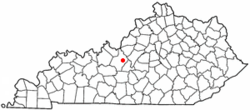
"This is a place of rolling countryside, cattle farms and cropland," Alford writes."That's why some eyebrows arched when the Obama administration penciled Hardin County into Appalachia." (Wikipedia map locates Elizabethtown in Hardin County; map below shows the ARC territory, which is not affected by the anti-drug jurisdiction's boundaries.)
The Office of National Drug Control Policy said it added Hardin County at the request of U.S. Sen. Mitch McConnell of Kentucky, the Senate Republican leader. McConnell told the AP, "The argument I made is that, even though this is not technically an Appalachian county, it's not too far away from Appalachia and it's right here with two interstates going north and south and east and west, and clearly is a transit point" for drugs. Louisville and Bowling Green, metropolitanm areas north and south of Elizabethtown on Interstate 65, had already been added to the area. At the same time it added Hardin County, the drug office also added Brooke, Hancock, Marshall and Ohio counties in northern West Virginia.

Some Central Appalachian political leaders say adding western counties to the list will make it harder for federal money to reach eastern counties that need it more. "Bringing on more counties only makes our situation less hopeful," Harlan County Judge-Executive Joe Grieshop told Alford. (Read more)

Thursday, October 4, 2012

USDA beginning farmer grants awarded in 24 states

The U.S. Department of Agriculture announced earlier this month it would give more than $18 million to beginning farmer programs in 24 states through its Beginning Farmer and Rancher Development Program. The money will go to groups that provide education, training, technical assistance and outreach programs to farmers or ranchers who've been working for less than 10 years.

The University of Kentucky College of Agriculture has been awarded a $561,000 grant for its KyFarmStart training program for those who are considering a farming career. Program director Lee Meyer told UKnow's Carol Spence that Kentucky's farm population is aging, with 30 percent of farmers over 65, higher than the national average of 57. "To keep farming viable in the state, we have to be able to replace these people," he said.

Rural Community Development Resources in Yakima, Wash. is another grant recipient, getting $562,500 to help Latino farmers in the Yakima Valley become interested farming. The grant will help the nonprofit host educational workshops about farm and financial management and expand its Center for Latino Farmers into the Wenatchee area to meet increasing demand, RCDR business counselor and loan specialist Maria Garcia told David Lester of the Yakima Herald-Republic.

A beginning farmer program in North Carolina received $180,000 and will give up to $8,000 each to farmers who create innovative opportunities in production, processing and marketing through the Tobacco Communities Reinvestment Fund. The program is administered by the Rural Advancement Foundation International-USA. The program is designed to keep farmers farming and maintain an economic base for North Carolina's traditional tobacco farming communities. (Read more)

Tuesday, September 18, 2012

Federal grants will improve telehealth services for rural veterans in Virginia, Montana and Alaska

A disproportionate number of veterans are in rural areas, and telehealth could soon improve their health care, which is often lacking because of limited resources or long-distance travel to Department ofVeterans Affairs  hospitals. The Department of Health and Human Services has partnered with the VA to provide almost $1 million to rural veterans' health care providers to improve VA telehealth and HHS state health information exchanges. The three states with the highest rates of rural veterans -- Virginia, Montana and Alaska -- will each receive about $300,000.

The VA said its telehealth system, once it's fully integrated nationwide, will be capable of providing at least 1.2 million medial consultations annually for veterans who would otherwise have to travel long distances to be treated, Robert Longley of About.com reports. Under the Honoring America's Veterans Act signed by President Obama last month, the VA is authorized to waive co-payments for veterans who use telehealth services. (Read more)

Monday, September 10, 2012

The poor and near-poor are more numerous now, and deserve coverage; here are thoughts and tips

With the national poverty rate at 15 percent, higher than at any time since 1993, and millions more Americans near the poverty line, you'd think there would be more coverage of them and the problems they face each day. For whatever reason, there is not, and a group of journalists with some experience in covering the subject got together over the weekend to talk about improving coverage of it.

The conference at Washington and Lee University in Lexington, Va., was called "The New American Poverty: Reporting the Recession's Impact," but it included a lots of basics and history on the subject -- and some useful comments at the start, from poverty researchers and some folks who run programs for the poor and disadvantaged in Lexington and Rockbridge County.

Jeri Schaff, services director for the Valley Program for Aging Services, said she couldn't recall ever seeing a news story addressing the daily struggle faced by many old people (hers don't like the "seniors" label, she said), especially in rural areas. The coverage of poverty tends to focus on cities, she said.

"Rural poverty is very different than urban poverty," said Suzanne Sheridan, director of the Rockbridge Area Free Clinic. The big difference, she said in an interview, is lack of resources: supermarkets, public transportation, health care, even a reliable water supply.

Paul Overberg of USA Today gave an excellent presentation on using Census Bureau data to cover poverty. For his handout on using the bureau's American Community Survey data, click here. For other help in covering rural poverty, go to www.onpoverty.org, a recently revised Washington and Lee site for journalists; www.CoveringPovery.org, with tutorials from the University of Georgia; and www.EconomicHardship.org, whose owners include author Barbara Ehrenreich, who has written best-selling books about the poor and near-poor. For more details on the conference, click here.

Friday, August 31, 2012

Transportation spending in Western states varies widely

This year's federal transportation budget is $105 billion, and about 80 percent is spent on highways. Almost 40 percent of Americans who depend on public transportation live in rural areas, and "given the West's size and far-apart cities, you might also expect this road-centricity to be more pronounced here," reports Brendon Bosworth of High Country News.

Pedestrian and bicycling infrastructure spending in the West is below the national average, but Bosworth writes "the diferences in the spending of state and federal transport dollars between Western states" says a lot about their priorities. (Read more)

Thursday, August 30, 2012

Medicaid dental coverage is first to go when states can't tighten eligibility rules; has big rural impact

Many states have cut optional benefits for poor adults enrolled in Medicaid, rather than tighten eligibility requirements at a time when more people need the program, and dental services are often first to go. The problem likely won't improve under President Obama's health-care overhaul because it requires dental coverage just for children. The cuts probably affect rural residents disproportionately since many rural places are facing dentist shortages, according to the Pew Center on the States.

In about half the states, Medicaid dental care now covers only pain relief and emergencies, according to a recent Kaiser Commission on Medicaid and the Uninsured report. Other states cover preventative exams and cleaning, but not fillings and root canals, Abby Goodnough of The New York Times reports. Some states are also cutting vision, chiropractic and podiatry coverage, and requiring co-payments for prescription drugs. (Times photo by Gretchen Ertl)

Many adults on Medicaid are turning to community health centers for dental care. In Massachusetts, which has long been a state with very generous Medicaid, community clinics received 22,000 new dental patients in the first six months after dental coverage was dropped. And in states where Medicaid still covers dental care, "finding dentists who accept Medicaid can be next to impossible," Goodnough writes, because reimbursements have also been cut and dentists have dropped out of the program or refuse to join. (Read more)

Budget cuts strangle Forest Service's ability to fight 'catastrophic' forest fires, Idaho paper says

The U.S. Forest Service hasn't been exempt from budget cuts in recent years, and the editorial staff of The Idaho Statesman outlines some reasons why taking money from the agency is leaving it with little resources to fight massive forest fires that have been devastating the West in recent years.

"Congress raided $200 million from a Forest Service’s firefighting fund in 2011, and grabbed another $240 million this year," the staff writes. "That leaves the Forest Service looking for ways to reduce firefighting costs — before they eat into the rest of the agency’s budget." The Service decided to aggressively fight fires "from the outset" this year in the hope it can save money by ending fires early. That approach "is the Forest Service's equivalent of kicking the can down the road," they write.

Stopping small fires could stop larger fires in the short run, but they write, it leaves forests with lots of undergrowth that increases the risk of "catastrophic fire" later. "And so, in a delicious little government irony, the Forest Service is making decisions that might compromise the health of the forest -- in order to preserve its budget for initiatives such as 'forest health,' the use of logging and prescribed burns to thin out fire-prone lands." (Read more)

Friday, August 24, 2012

Regulator's OK means full speed ahead on USPS plan to cut hours of post offices, mostly rural

The U.S. Postal Service’s regulatory overseer has endorsed the agency’s plan to shorten hours at thousands of mostly rural post offices. USPS offered the plan to reduce hours at roughly 13,000 offices as it dropped one to shutter thousands of them. Here's a USA Today map of the offices that would be affected; for an interactive version, click here.
Postal Regulatory Commission Chair Ruth Goldway said she believed the proposal would ensure sufficient postal access nationwide. Postmaster General Patrick Donahoe has said the move would save the service roughly $500 million a year, through both the shorter hours and reduced benefits costs. An agency spokeswoman told The Hill that USPS was pleased with the regulator’s decision and would move full speed ahead on implementing the service changes. (Read more) The reduced hours appear likely to be in place before the end of the year. 

Tuesday, August 21, 2012

Budget cuts have put strain on national parks, and seem likely to put even more

National parks have been struggling for more than a decade against a tide of federal budget cuts that have left them short-staffed and with little money for upkeep and repairs. Construction and maintenance projects have been put on hold, and Juliet Eilperin of The Washington Post reports "the signs of strain" are starting to show at parks across the country. (Photo: Gettysburg National Military Park)

Chatham Manor, the 241-year-old Georgian house that was a Union headquarters near Fredericksburg, Va., during the Civil War, is marred by overgrown gardens and a greenhouse with broken windows and rotting wood frames. The 469-mile Blue Ridge Parkway, which stretches from Virginia to North Carolina, has a $385 million backlog of projects and hasn't been able to fill 75 positions since 2003. New Mexico's Bandelier National Monument doesn't have money to hire someone to protect its archeological ruins.

Eilperin reports parks have been pulling from maintenance and acquisition budgets to run day-to-day operations for years. National Park Service Director Jonathan Jarvis told Eilperin his employees have been "entrepreneurial" in finding ways around budget cuts, but are "kind of running out of ideas at some point here." Park managers say they are scared about next year's federal budget and what might happen if a budget deal isn't reached by January. The current proposal from the House Appropriations Committee would cut 218 full-time jobs or 763 seasonal employees at the parks. (Read more)

Monday, August 20, 2012

Columnist points out rural America's heavy reliance on Social Security, Medicare and Medicaid

The latest offering from syndicated agricultural columnist Alan Guebert, right, delves directly into politics, starting with Mitt Romney's choice of U.S. Rep. Paul Ryan as a running mate. The Wisconsin Republican's "biggest reform ideas take dead aim at America’s three costliest social programs, Medicare, Medicaid and Social Security," Guebert writes. "Any change in either or all will have profound effects across farm country because rural America relies more heavily on all three than the nation’s urban areas. According to a November 2011 study by the National Academy of Social Insurance, 9.3 percent of 'total personal income' in rural counties comes from Social Security. By contrast, Social Security is just 5 percent of total personal income in urban America.

"Moreover," Guebert notes, "Social Security is the economic lifeblood of many rural counties. For example, Orangeburg County, S.C., gained $232 million of income -- or about $1 billion in overall economic activity -- in 2009 through Social Security. The story is the same for Medicare and Medicaid’s impact on farm and ranch country. While one in six, or 49 million, Americans, receive Medicare benefits, 12 million -- or one in four of those beneficiaries -- live in rural America. And that number is growing; 15 percent of rural America is 65 years old or more while just 12 percent of urban Americans are senior citizens."

Medicaid covers 16 percent of all rural residents and 35 percent of all rural children up to 18. The urban numbers, respectively, are 13 percent and 28 percent. Six out of 10 rural nursing home residents receive some form of Medicaid, and it is estimated that 56 percent of all rural physician income and 60 percent of all rural hospital cash flow is tied to Medicare and Medicaid. (To see all the documents used in this story, go here.)

Friday, August 17, 2012

Rural districts face hurdles in applying for $400 million in federal Race to the Top grants

A little over two months remain for school districts to apply for $400 million in Race to the Top federal education grants. Michele McNeil of Education Week doubts that many rural districts will apply. "Not only is the 116-page application complex and demanding," she writes, but more than half the nation's districts are not eligible to apply on their own because their enrollments are too small. To apply, a district or a group of districts must have at least 2,000 students. Thus does the department continue to maintain its reputation as heavily favoring large, urban districts like the one in Chicago that was run by Education Secretary Arne Duncan.

"The latest data from the National Center for Education Statistics show that 47 percent of the nation's school districts had fewer than 1,000 students in 2009-10, McNeil writes. "Another 24 percent had between 1,000 and 2,499 students. . . . More than half of the nation's schools have fewer than 2,000 kids. And so these districts already face big hurdles in applying for the money." (Read more)

Is your district applying? Why or why not?

UPDATE, Aug. 20: The Department of Education will hold a webinar for potential applicants from noon to 3 p.m. ET. Space is limited, registration is required, and preference is given to school districts. Perhaps your district would let you sit in. For more information, click here.

Wednesday, August 15, 2012

Public-private battle in rural Minn. over broadband service is case study in a nationwide struggle

Cable companies weren't interested when the federal government dangled millions of dollars to expand broadband Internet service and boost economic opportunities in Lake County, Minnesota, on Lake Superior (Wikipedia map). But "They didn't want anyone else to build a system, either," report Jim Spencer and Larry Oakes of the Minneapolis Star-Tribune. "That would mean competition in small parts of the county they already serve, even if it would leave thousands of northeastern Minnesota residents and businesses without broadband. So in 2010, when Lake County applied for federal stimulus funds to build a countywide network, it ran straight into a challenge from industry giant Mediacom and the Minnesota Cable Communications Association. The conflict that ensued is part of a national struggle," one that is repeated over and over in communities across the country, perhaps one you know or cover.

"Public officials and some of their constituents argue that rural broadband is like rural electrification: It's a lifeline for small-town America that the free market will not extend. Economics are at the center of the debate, since both sides acknowledge that running broadband exclusively into remote areas won't pay for itself," the reporters write. "Cable and Internet providers argue that government-backed programs should run broadband only into unserved areas, not locations where private providers already operate. They have lobbied extensively to cut broadband initiatives from the federal budget."

In Lake County, the battle grinds on. Mediacom has charged that "county officials illegally inflated statistics, U.S. senators improperly meddled to keep the project alive," and the Rural Utilities Service of the U.S. Department of Agriculture was negligent. "County officials, the senators and the USDA deny those claims, and an inspector general's investigation found them to have no merit. Yet the fight has moved from the rural shores of Lake Superior to a hearing room on Capitol Hill. It shows no signs of ending, even as Lake County begins to run fiber-optic cable." (Read more

Thursday, August 2, 2012

Northern and Central Appalachia, Corn Belt localities would bear brunt of shorter post-office hours

The folks at USA Today have come up with vivid illustrations of the geographic impact of the reduced hours that the Postal Service is imposing on more than 13,000 rural post offices, as an alternative to its initial plan to close 3,700 of them. Meghan Hoyer reports that many of the communities are "places where businesses depend on the mail and residents use mail delivery for everything from prescriptions to correspondence" because they lack broadband Internet and reliable cell-phone service.

The interactive maps with Hoyer's story show offices that the USPS proposes to open two, four and six hours a day. Here's the composite map (click here for interactive version):
"The cuts would strike a line through Appalachia," Hoyer notes. "The states with counties that have the highest concentration of affected offices are on the Appalachian Trail: Maine, Pennsylvania, New York, Vermont and West Virginia. In Alaska and some Plains states — Kansas, Nebraska and the Dakotas — more than 60 percent of offices are on the block for reductions as counter service drops to six, four or two hours a day. Most urban areas are not slated to be affected." (Read more)

Monday, July 30, 2012

Farm Bill extension would get most cuts from conservation programs, drawing much opposition

UPDATE, July 31: David Rogers of Politico reports "signs that House Republicans may pull back from a one-year extension of farm programs and focus instead on the immediate needs of drought-stricken livestock producers," partly because of Democratic and commodity-group opposition. Rogers calls the extension "highly divisive." (That's true of the Farm Bill itself, which is why GOP leaders are not taking it to the full House.) As for the extension measure, Rogers reports, "Fiscal conservatives and taxpayer groups are upset that the bill walks away from earlier promises to end costly direct cash payments to farmers. Environmentalists are agitated by the fact that the greatest share of the cuts to pay for the disaster aid would come from conservation programs."

Bob Meyer reports for Brownfield, "There are growing indications there are not enough votes in the House and Republican leadership may pull the bill before it is scheduled to come to the floor Wednesday." Rep. Collin Peterson of Minnesota, top Democrat on the House Agriculture Committee, wants the extension only as a path to a conference on a five-year bill, but tea-party Republicans oppose that strategy. (Read more)


The nonpartisan Congressional Budget Office says one-year Farm Bill extension that House Republican leaders will try to pass this week, probably Wednesday, would reduce direct spending next year by $400 million, mainly by cutting conservation programs, "while disaster assistance programs to help livestock producers with the drought would receive increases in the short term," Amanda Peterka reports for Environment & Energy News, a subscription-only service.

Extending the cuts for 10 years, as is done in most federal budget estimates these days, would take $759 million from conservation programs. The Environmental Quality Incentives Program would be cut $350 million, with most of the cuts front-loaded to the near-term; the Conservation Stewardship Program would be reduced by $289 million, $31 million in most years.

Direct subsidy payments to farmers, which would be eliminated under farm bills approved by the House Agriculture Committee and the Senate, would be cut "$29 million a year starting in fiscal 2014, for a total reduction of $261 million over the next decade," Peterka reports. "Disaster assistance would increase by $365 million in fiscal 2013, $235 million in fiscal 2014 and $21 billion in 2015 to help farmers and ranchers devastated by the drought." For the CBO report, click here.

Lists of post offices being 'optimized' and those with expiring leases bear watching

Worried about the future of your post office? The Save The Post Office blog is doing some recon for you. It reports that you need to be concerned your post office is closing if the U.S. Postal Service is moving carriers to another facility — that’s called Delivery Unit Optimization (DUO) — or if its lease will expire in the next year. If both are happening, the blog suggests, you don't hold your breath for great postal service in the future. About 58 post offices are being DUOed this summer and also have leases expiring in the next 12 months, Save the Post Office reports. The list is here.

The blog also notes "that 38 of the 58 post offices being DUOed and with a lease expiring soon are also on the POStPlan list. It’s very likely that in many of these cases, the Postal Service is moving the carriers not in preparation for closing the post office, but because under POStPlan there won’t be a full-time postmaster to supervise the carriers."

The USPS website explains, “Delivery Unit Optimization involves relocating letter carriers out of local post offices, stations and branches and consolidating them into centralized delivery offices that will continue to be served by the same processing and distribution center. The existing retail operation will require less space and the office could then be downsized to a smaller space nearby."

Save The Post Office suggests that those interested should keep an eye on the list of those being DUOed with a lease expiring soon, and to see how many of them "end up being suspended, closed, or relocated. It will be a good indication of whether the Postal Service really plans to preserve post offices under POStPlan, or if it's just a distraction while the Postal Service continues to close them." (Read more)