Showing posts with label toxic substances. Show all posts

Friday, September 21, 2012

Lax rules for disposal of drilling waste lead to injection of other toxic materials into the earth

One of the trucks, after it was enveloped by
flames fed by fumes from injection-well waste.
(Chemical Safety Board photo)
In January 2003, two tanker trucks exploded, killing three workers after fumes from what was supposed to be waste saltwater from injection wells ignited and burned in Rosharon, Tex. What the workers were really unloading, to be buried deep inside the earth, were thousands of gallons of volatile materials, including benzene and other flammable hydrocarbons. "What happened that day at Rosharon," explains ProPublica reporter Abrahm Lustgarten, "was the result of a significant breakdown in the nation’s efforts to regulate the handling of toxic waste."

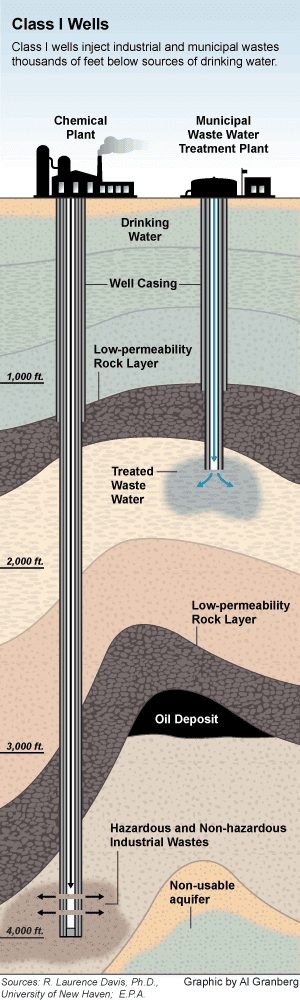
"The site at Rosharon is what is known as a 'Class 2' well," Lustgarten writes. "Such wells are subject to looser rules and less scrutiny than others designed for hazardous materials. Had the chemicals the workers were disposing of that day come from a factory or a refinery, it would have been illegal to pour them into that well. But regulatory concessions won by the energy industry over the last three decades made it legal to dump similar substances into the Rosharon site -- as long as they came from drilling. Injection wells have proliferated over the last 60 years, in large part because they are the cheapest, most expedient way to manage hundreds of billions of gallons of industrial waste generated in the U.S. each year.''

ProPublica has analyzed records summarizing more than 220,000 well inspections conducted between late 2007 and late 2010, including more than 194,000 for Class 2 wells. This most recent installment of by the independent, nonprofit news agency on U.S. injection wells had reporters examining federal audits of state oversight programs, interviewing dozens of experts and exploring court documents, case files, and the evolution of underground disposal law over the past 30 years. The report is exhaustive and includes several links showing that fundamental safeguards are sometimes being ignored or circumvented by use of the Class 2 rules. (Read more) For a state-by-state count of unauthorized, overpressurized and leaking injection wells, go here.

Friday, June 22, 2012

Once assumed safe, chemical waste is leaking from injection wells and sometimes polluting aquifers

Over the past few decades, U.S. industries have injected more than 30 trillion gallons of toxic liquid deep into the earth, using broad expanses of the nation's geology as an invisible dumping ground, writes Abrahm Lustgarten, who won awards for his reporting on the fracking industry, which disposes vast amounts of drilling wastewater in such wells.

"No company would be allowed to pour such dangerous chemicals into the rivers or onto the soil," Lustgarten writes. "But until recently, scientists and environmental officials have assumed that deep layers of rock beneath the earth would safely entomb the waste for millennia. There are growing signs they were mistaken. Records from disparate corners of the United States show that wells drilled to bury this waste deep beneath the ground have repeatedly leaked, sending dangerous chemicals and waste gurgling to the surface or, on occasion, seeping into shallow aquifers that store a significant portion of the nation's drinking water." Recent examples include contaminants from oil and gas drilling wells bubbling up, fountain-like, in Oklahoma and Louisiana, as well as in a dog park in Los Angeles.

Thus begins a fascinating and exhaustive piece by Lustgarten that covers "the more than 680,000 underground waste and injection wells nationwide, more than 150,000 of which shoot industrial fluids thousands of feet below the surface. Scientists and federal regulators acknowledge they do not know how many of the sites are leaking. Federal officials and many geologists insist that the risks posed by all this dumping are minimal. Accidents are uncommon, they say, and groundwater reserves — from which most Americans get their drinking water — remain safe and far exceed any plausible threat posed by injecting toxic chemicals into the ground. But in interviews, several key experts acknowledged that the idea that injection is safe rests on science that has not kept pace with reality, and on oversight that doesn't always work."

"In 10 to 100 years we are going to find out that most of our groundwater is polluted," said Mario Salazar, an engineer who worked for 25 years as a technical expert with the Environmental Protection Agency's underground injection program. "A lot of people are going to get sick, and a lot of people may die." The boom in oil and natural gas drilling is only making matters worse, geologists say. (Read more.)