Showing posts with label Environmental Protection Agency. Show all posts

Tuesday, September 25, 2012

Coal and the vote: Worried about Obama regulations, more ads, money and a new plant?

"A handful of utility companies are determined to buck the trend toward natural gas and break ground on what could be the last new conventional coal-fired power plants in the U.S.," Tennille Tracy of The Wall Street Journal reports. (Getty Images photo: Miners at Romney rally in southeastern Ohio)

"The moves come as the presidential campaigns spar over the future of coal power," and as they worry about an April deadline to begin construction, created by the Obama administration's limits on greenhouse-gas emissions. "They say separate government rules on mercury emissions are making it tough to hit that deadline," because the mercury rules are not due to be final until March.

Tracy notes that Republican Mitt Romney is running a TV commercial in coal states with "mournful images of coal miners facing the industry's decline. . . . With some parts of battleground states like Ohio reliant on coal jobs, the White House has started to defend itself more vigorously against the 'war on coal' allegation" being made by Republicans and coal interests. (Read more)

Also weighing in this week: Time magazine with an usual look at the debate through the eyes of controversial Ohio coal executive Robert E. Murray who "may be Obama's biggest headache in a state where he leads by about 4 points." Time's Michael Scherer gives Murray and the pro-coal alliance which has spent millions to defend Obama lots of space to vent about the president's policies. 

Friday, September 21, 2012

Lax rules for disposal of drilling waste lead to injection of other toxic materials into the earth

One of the trucks, after it was enveloped by
flames fed by fumes from injection-well waste.
(Chemical Safety Board photo)
In January 2003, two tanker trucks exploded, killing three workers after fumes from what was supposed to be waste saltwater from injection wells ignited and burned in Rosharon, Tex. What the workers were really unloading, to be buried deep inside the earth, were thousands of gallons of volatile materials, including benzene and other flammable hydrocarbons. "What happened that day at Rosharon," explains ProPublica reporter Abrahm Lustgarten, "was the result of a significant breakdown in the nation’s efforts to regulate the handling of toxic waste."

"The site at Rosharon is what is known as a 'Class 2' well," Lustgarten writes. "Such wells are subject to looser rules and less scrutiny than others designed for hazardous materials. Had the chemicals the workers were disposing of that day come from a factory or a refinery, it would have been illegal to pour them into that well. But regulatory concessions won by the energy industry over the last three decades made it legal to dump similar substances into the Rosharon site -- as long as they came from drilling. Injection wells have proliferated over the last 60 years, in large part because they are the cheapest, most expedient way to manage hundreds of billions of gallons of industrial waste generated in the U.S. each year.''

ProPublica has analyzed records summarizing more than 220,000 well inspections conducted between late 2007 and late 2010, including more than 194,000 for Class 2 wells. This most recent installment of by the independent, nonprofit news agency on U.S. injection wells had reporters examining federal audits of state oversight programs, interviewing dozens of experts and exploring court documents, case files, and the evolution of underground disposal law over the past 30 years. The report is exhaustive and includes several links showing that fundamental safeguards are sometimes being ignored or circumvented by use of the Class 2 rules. (Read more) For a state-by-state count of unauthorized, overpressurized and leaking injection wells, go here.

Monday, September 17, 2012

Farm groups want Supreme Court to exclude forestry activities from Clean Water Act permitting

A group of farm organizations last week filed a friend-of-the court brief with the U.S. Supreme Court regarding the Clean Water Act's permitting requirements for stormwater runoff from forestry activities, Farm Progress reports. The American Farm Bureau Federation, the National Pork Producers Council and the National Council of Farmer Cooperatives are urging the court to exempt stormwater runoff from forestry activities from Clean Water Act permitting. (American Agriculturist photo)

The Ninth Circuit Court of Appeals last year ruled the Environmental Protection Agency's silviculture rule invalid. The groups explain in their brief that Congress decided in its 1987 Clean Water Act amendments that stormwater from agriculture and forestry "has always been intentionally excluded from federal permit requirements," Farm Progress reports. The groups say the logging shouldn't be considered an industrial activity, which means its stormwater discharges must be approved under the EPA's National Pollutant Discharge Elimination System.

American Farm Bureau General Counsel Ellen Steen said Congress has never allowed EPA to mandate particular forestry practices because Congress "has always recognized that stormwater runoff from these activities . . . is best left to state and local authorities." (Read more)

Thursday, September 6, 2012

Rural electric cooperatives join with coal industry to seek changes in Clean Air Act

Rural electric cooperatives are joining forces with the coal industry to defend its use as a major energy source, giving the industry a strong political ally. The National Rural Electric Cooperative Association is asking for the Clean Air Act to be rewritten to reduce regulations on coal-fired power plant emissions.

NRECA officials Mike Knotts and Glenn English say they want the Clean Air Act to more clearly define "a more certain regulatory environment for utilities, including a future for coal," reports Paul Barton of The Leaf Chronicle in Clarksville, Tenn. The organization has quite a bit of political clout. According to the Center for Responsive Politics, which tracks campaign spending, the NRECA has spent $2.6 million on 2012 elections so far.

Of all the power plants owned by rural cooperatives, 85 percent are coal-fired, and about 80 percent of the co-ops' energy comes from coal. (Read more)

Friday, August 10, 2012

Study: Injection of fracking's waste near faultlines, not drilling, is responsible for quakes

A new study has found that deep injection of oil and gas wastewater appears to be causing more earthquakes than previously thought. Cliff Frohlich, a senior research scientist at the University of Texas' Institute for Geophysics, said that his findings should be taken seriously by drillers especially as the practice spreads to more densely populated areas. His work, reports Mike Soraghan of EnergyWire, was done around the Barnett Shale around Dallas to measure small earthquakes taking place near injection wells. His peer-reviewed study was published in the Proceedings of the National Academy of Sciences.

Soraghan explains that "Frohlich did not find any suggestion that the earthquakes were caused by hydraulic fracturing, or fracking. But fracturing creates millions of gallons of briny, toxic wastewater that drillers must eventually dispose of, usually by injecting it into the type of injection wells Frohlich was studying. That suggests, he said, that earthquakes occur only if there is a fault nearby that is susceptible to being triggered by high volumes of fluid." This suggested to Frolich that drillers could stop the earthquakes by choosing an alternate site to dispose of their wastewater. (Read more)

Monday, July 30, 2012

Analysts blame market, not feds, for coal layoffs; say mid-Appalachia at start of long production drop

Coal train at Cumberland, Ky.
(Herald-Leader photo by Charles Bertram)

The prevailing opinion in Central Appalachia seems to be that federal anti-pollution rules are to blame for the loss of coal jobs — the "war on coal" that officials in the region decry — but independent analysts of the industry say market factors have been more responsible for recent, large layoffs.

Most notably, Bill Estep reports for the Lexington Herald-Leader, they "pointed to historically low prices for natural gas and the unseasonably warm winter, which left power plants with stockpiles of coal. Other factors, such as the slow recovery in manufacturing and the broader economy, also have played parts in the drop in demand for coal." And while that is bad enough news for the region, analysts now say that Central Appalachia is at the front end of a steep, long-lasting drop in coal production. "Some of these mines are not going to come back," said Michael Dudas, a managing director at investment firm Sterne, Agee & Leach, Inc. who follows the coal industry. 

Changes in drilling technology allow companies to unlock vast new sources of natural gas, sending supplies up and prices sharply down. The May price for gas was 43 percent lower than just a year earlier, said Manoj Shanker, one of Kentucky's Education and Workforce Development Cabinet economists. Many U.S. utilities have switched from coal to natural gas for electricity generation as a result.

In April, the national share of electricity generated using natural gas matched coal's share, at 32 percent, for the first time since the U.S. Energy Information Agency began keeping such records in 1973. "The Central Appalachian coalfield, made up primarily of Eastern Kentucky and West Virginia, faces other challenges as well, including competition from cheaper Wyoming coal and relatively high production costs," Estep writes. "It also costs more to produce coal in Eastern Kentucky, in part because the area has been mined for a century. Companies naturally went after the best seams first; those that are left are harder to get at, meaning higher mining costs and lower productivity." (Read more)

Tuesday, June 26, 2012

Farm workers face 'red tape,' fear of retaliation when reporting harm from pesticide use

Farm workers are constantly at risk from pesticides in fields where they work, and even though the Environmental Protection Agency maintains a "Worker Protection Standard" that's supposed to regulate pesticide use, "no one knows the full scope of the environmental perils in the fields," reports Ronnie Greene of iWatch News. (Associated Press photo by Luis M. Alvarez)

The Government Accountability Office said in 1993 that a "lack of data" about the health effects of pesticides "could lead to a 'significant underestimation of both the frequency and the severity of pesticide illnesses,'" Greene reports. Today, the EPA can "still only guess" about the number of pesticide-related illnesses, mostly because farm workers tend to be illegal immigrants who don't want to speak up. States, which have been given EPA-authority to enforce pesticide regulation, don't receive many complaints, according to federal records. Some state officials think the system is broken, but EPA"red tape" is keeping reforms from happening, Greene reports.

Workers fear the price for speaking up may be too great. In 2010, farm workers were fired on the spot and sent back to Mexico after complaining multiple times about pesticides sprayed near them in a tomato field. A farm worker in Florida became ill in 2009, and discovered the pesticide endosulfan, which has since been banned by the EPA, was sprayed less than 24 hours after she started working. When she went to the doctor, she said she wasn't asked about the pesticide. The crux of the issue, Green reports, is this: "Workers have little voice when it comes to pesticides." (Read more)

Friday, June 22, 2012

Once assumed safe, chemical waste is leaking from injection wells and sometimes polluting aquifers

Over the past few decades, U.S. industries have injected more than 30 trillion gallons of toxic liquid deep into the earth, using broad expanses of the nation's geology as an invisible dumping ground, writes Abrahm Lustgarten, who won awards for his reporting on the fracking industry, which disposes vast amounts of drilling wastewater in such wells.

"No company would be allowed to pour such dangerous chemicals into the rivers or onto the soil," Lustgarten writes. "But until recently, scientists and environmental officials have assumed that deep layers of rock beneath the earth would safely entomb the waste for millennia. There are growing signs they were mistaken. Records from disparate corners of the United States show that wells drilled to bury this waste deep beneath the ground have repeatedly leaked, sending dangerous chemicals and waste gurgling to the surface or, on occasion, seeping into shallow aquifers that store a significant portion of the nation's drinking water." Recent examples include contaminants from oil and gas drilling wells bubbling up, fountain-like, in Oklahoma and Louisiana, as well as in a dog park in Los Angeles.

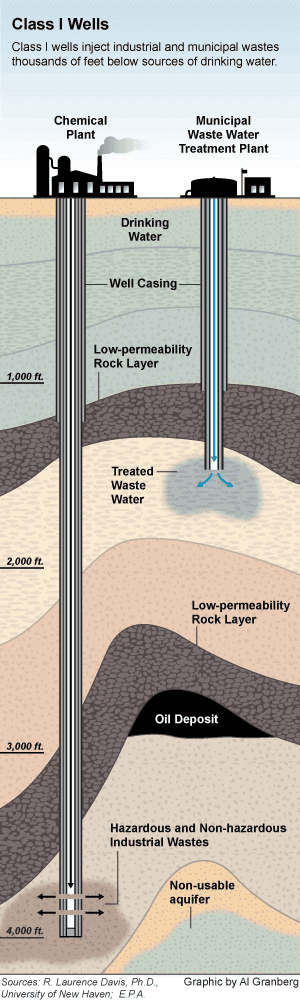
Thus begins a fascinating and exhaustive piece by Lustgarten that covers "the more than 680,000 underground waste and injection wells nationwide, more than 150,000 of which shoot industrial fluids thousands of feet below the surface. Scientists and federal regulators acknowledge they do not know how many of the sites are leaking. Federal officials and many geologists insist that the risks posed by all this dumping are minimal. Accidents are uncommon, they say, and groundwater reserves — from which most Americans get their drinking water — remain safe and far exceed any plausible threat posed by injecting toxic chemicals into the ground. But in interviews, several key experts acknowledged that the idea that injection is safe rests on science that has not kept pace with reality, and on oversight that doesn't always work."

"In 10 to 100 years we are going to find out that most of our groundwater is polluted," said Mario Salazar, an engineer who worked for 25 years as a technical expert with the Environmental Protection Agency's underground injection program. "A lot of people are going to get sick, and a lot of people may die." The boom in oil and natural gas drilling is only making matters worse, geologists say. (Read more.)

Arch Coal to lay off 650 Appalachian miners, mostly in E.Ky.; blame game begins

Blaming market conditions and regulatory obstacles, Arch Coal announced its intent to lay off about 650 miners -- 500 of those in Eastern Kentucky, 125 in West Virginia and 25 in Virgina. “You’ve got people that are going to lose their homes, lose their livelihood,” Perry County Judge-Executive Denny Ray Noble of Hazard, Ky., said of the decision, terming it "a disaster" for the region.

"Some Kentucky officials directly blamed the layoffs on recent actions by the Obama administration and the federal Environmental Protection Agency, which have taken a more aggressive stance in recent years to reduce emissions from coal-fired power plants and to crack down on water pollution from surface mining," Mike Wynn of The Courier-Journal reportsBut Matt Wasson of the environmental group Appalachian Voices challenged those assertions, saying while Kentucky mining operations have laid off more than 900 workers in recent months, coal companies have attributed nearly all of those cuts to market conditions. “It’s really unfortunate that is how some of the local officials are going to play this,” he said. “That is all about politics. . . . The reality is that four years ago coal supplied half of our electricity. Today it supplies a third. That has enormous consequences."

Friday, June 8, 2012

Coal supporters confront EPA in Central Appalachia

Industry supporters, left, confront mining
foes and state official between hearings.
(Photo by Chris Anderson)
This week marked the first time that members of the Environmental Protection Agency under the Obama administration visited Eastern Kentucky for an open, public forum, reports Chris Anderson of the Appalachian News Express in his story about two EPA hearings on surface-mining permits.

Yesterday was a chance for hundreds of people in the Central Appalachian coalfield "to be heard by a government agency that many feel is attacking their way of life," Anderson writes. EPA had announced its plan to veto 36 surface mining permits in the region, on grounds that they would cause too much water pollution. The meetings to discuss the government's controversial stance drew members of both sides of the mountaintop-removal coal mining debate, with Anderson reporting that those in support of mining far outnumbered those against it.

Miners spoke passionately about jobs and said President Obama was trying to ruin their livelihoods. Mine operators, like Don Gibson of Arch Coal, urged the meeting's participants to make their voices heard in November. Ama Bentley, an employee of Appalachian States Analytical Laboratory, argued that regional water quality is actually improved by coal mining in some places, and she and others said more harm is done by lack of proper sewerage.

Anderson notes that "a handful of environmental activists . . . spoke in favor of the EPA’s blocking of the issuance of the permits." They included Matt Wasson of the Appalachian Voices group, who countered pro-industry arguments about jobs by noting Appalachian coal jobs have actually increased since 2009. He said the coal industry's troubles are not the doing of EPA, but factors such the industry’s inability to compete with cheap natural-gas prices. "He also blasted Eastern Kentucky leaders for failing to expand the region’s economy."

The later the evening got, the less civil was the discourse. Anderson reports that "Roger Warton, who claimed to represent several pro-coal groups from West Virginia, told the EPA officials that those in attendance at the meeting were just as adamant about 'whipping somebody’s butt' as the soldiers who stormed beaches on D-Day in World War II. He also alluded to the possibility that the EPA officials would not be allowed to leave Charleston, W.Va., if they traveled there to fly out of the region." (Anderson's story is behind a paywall.)